
Douglas-fir tussock moth
Orgyia pseudotsugata
Description
How to identify
The Douglas-fir tussock moth is a member of the Erebidae family, specifically the Lymantriinae subfamily. It is a well-known defoliator native to western North America.
Sexual dimorphism is striking in this species: the males are winged, active fliers, whereas the females are flightless, possessing vestigial wings and a stout, sedentary body.
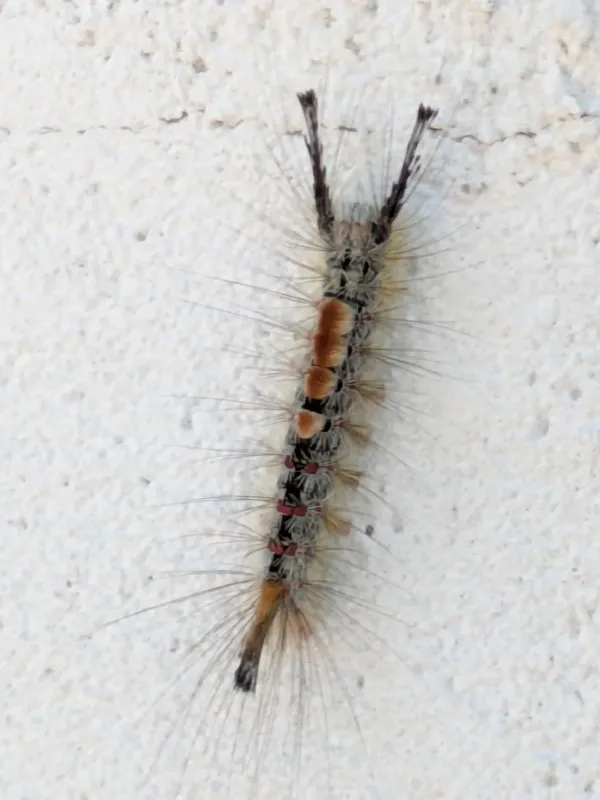
Larvae, commonly known as caterpillars, are distinctive due to their prominent tufts of hair, known as tussocks, and longer black hair pencils on the front and rear.
The body of the caterpillar is marked with bright red or yellow spots, which serve as a warning to predators about their urticating (stinging) hairs.
There is only one generation per year, and the insect survives the winter exclusively as an egg, encased in a protective mass produced by the female.
What it damages
The primary hosts of this pest are Douglas-fir and various species of true firs, which suffer significantly during population outbreaks.
If the population density becomes high enough, caterpillars will readily feed on other conifers, including spruce, if they are present in mixed stands.
Defoliation typically begins at the top of the tree, progressing downwards as the caterpillars consume the needles, eventually stripping the branches bare.
Severe infestations can kill mature, healthy trees in just one or two growing seasons, particularly if the trees are under stress from drought or other factors.
Secondary pests, such as wood-boring beetles, often colonize trees weakened by the tussock moth, accelerating the mortality of the infested timber.
When it appears
The eggs hatch in late spring, generally synchronized with the bud break of the host conifers to ensure the larvae have fresh, nutritious food available.
Larval development proceeds throughout the summer, consisting of several instars, with the caterpillars growing steadily as they feed on the foliage.
Pupation occurs in mid-to-late summer, when the larvae spin silk cocoons attached to twigs or branches, preparing for the transition to the adult stage.
Adult moths emerge in late summer and early autumn to mate; the female then deposits her eggs near the site where she emerged, ensuring survival through winter.
The insects remain in the egg stage for the majority of the year, providing a resilient strategy against freezing temperatures and seasonal environmental changes.
Signs of infestation
The first sign of infestation is often the browning of the needles at the top of the tree, caused by the early feeding stages of the larvae.
As larvae mature and consume more foliage, the trees develop a characteristic thin, ragged appearance, with visible webbing between the needles.
A mass of silk webbing and droppings (frass) under the canopy is a clear indicator of a significant population of caterpillars feeding overhead.
Clusters of empty, grayish-brown cocoons found attached to branches or tree trunks are definitive proof of the insect's presence in the stand.
Dead or dying branches in the upper crown are a classic late-stage sign, indicating that the tree has been heavily defoliated over multiple seasons.
Control measures
Biological control utilizing Bacillus thuringiensis (Bt) is a common and effective practice for managing outbreaks while minimizing impact on non-target species.
Pheromone monitoring is used extensively by forest managers to detect population increases early and determine the potential need for intervention.
Chemical insecticides are generally reserved for high-value areas, such as urban forests or seed orchards, where total loss of trees is unacceptable.
Natural predators, including various parasitoid wasps and tachinid flies, are vital for keeping the population in check during non-outbreak years.
Strategic silvicultural management, including thinning dense stands, can help reduce the susceptibility of forests to massive tussock moth outbreaks.
Taxonomy
- Latin name
- Orgyia pseudotsugata
- Order
- Lepidoptera (butterflies)
- Family
- Erebidae
- EPPO code
- ORGYPS
Discussion
No discussions yet — be the first.