
Definite Tussock Moth
Orgyia definita
Description
How to identify
The Definite Tussock Moth (Orgyia definita) belongs to the Erebidae family, subfamily Lymantriinae. Adult males have grayish-brown wings with a wingspan of about 30 mm, while females are virtually wingless and lead a sedentary lifestyle.
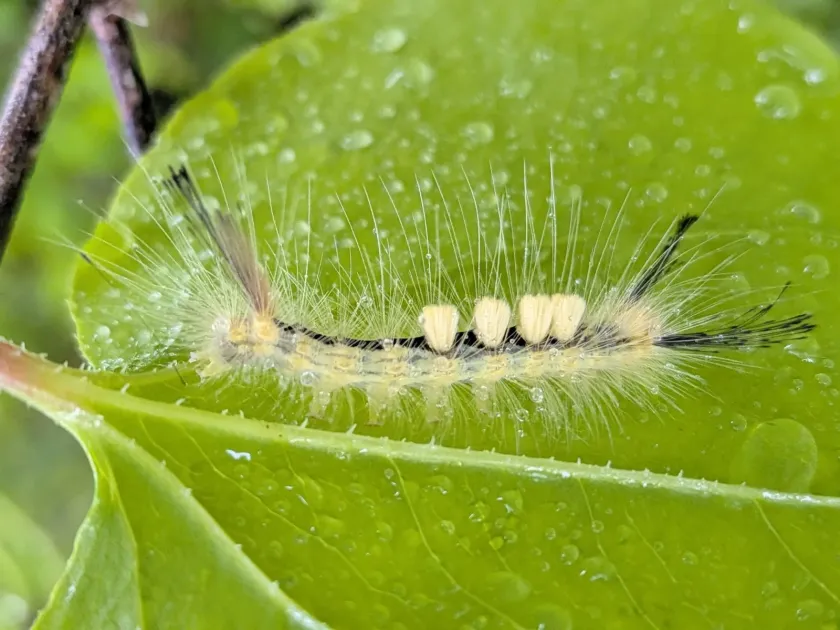
Caterpillars of this species are easily identified by their striking appearance: their bodies are covered with dense tufts of yellowish or light brown hairs. On the dorsal side, there are four prominent brushes of dense hair that serve as a defense mechanism against predators.
The heads of the caterpillars are often bright orange or yellow, making them conspicuous against the foliage. The body is also decorated with black stripes and spots, which can vary depending on the developmental stage of the individual.
Eggs are laid by females in dense cocoons covered with their own hair, which provides protection for the clutch from harsh weather conditions and parasites. These egg masses are usually located on the branches or trunks of host plants.
Pupation occurs inside a silky cocoon, which the caterpillar anchors in a secluded spot. The pupal stage is relatively short, after which adults emerge, ready for mating.
What it damages
The primary hosts for this pest are deciduous trees and shrubs. Significant damage is caused to members of the Fagaceae and Salicaceae families, as well as various fruit-bearing trees.
Common host plants include oaks, birches, lindens, willows, maples, and various fruit trees such as apple. Under high population densities, the pest may spread to other ornamental plants.
Young caterpillars begin feeding on the surface of the leaves, chewing small holes. As they mature, they are capable of completely consuming the leaf blade, leaving only large veins, which leads to a significant loss of photosynthetic surface.
Severe defoliation weakens the tree, reducing its resistance to other diseases and pests. In cases of mass outbreaks, the Definite Tussock Moth can lead to the death of young saplings or a significant reduction in yields for fruit orchards.
Prolonged exposure to this pest negatively affects wood growth and the overall physiological health of the plantations. Therefore, population control is necessary at early stages of detection.
When it appears
The life cycle of the Definite Tussock Moth in most regions includes one or two generations per year. Overwintering occurs at the egg stage, as the eggs remain viable inside dense cocoons until the arrival of spring warmth.
Larvae (caterpillars) emerge in late spring or early summer, coinciding with the active growing season of plants. This is when they are most voracious and cause maximum damage to young leaves.
The feeding period of the caterpillars usually lasts several weeks, followed by the pupation phase. In mid-to-late summer, adult moths emerge and begin laying eggs for the next cycle.
Adult activity peaks in the summer months, when wingless females attract males using pheromones. The entire life cycle is closely linked to climatic conditions and the availability of food sources during the current season.
In autumn, development slows down, and the eggs enter a state of diapause, waiting for favorable conditions in the coming year. Monitoring the population in the spring helps effectively prevent outbreaks.
Signs of infestation
The first sign of the pest's presence is the appearance of lacy damage on the edges or centers of the leaves. As the caterpillars grow, the number of holes increases, and the leaves begin to yellow and drop prematurely.
The presence of specific hairy caterpillars, often found in large groups on branches, is a direct signal to take action. Also, look for cocoons attached to the bark of trees.
- Presence of damaged leaves with chewed edges.
- Clusters of hairy caterpillars on the underside of leaves.
- Frass (excrement) remains on leaves below feeding sites.
- Discovery of fuzzy cocoons on trunks and branches.
- Gradual thinning of the tree crown by mid-summer.
Birds actively flocking to affected trees to feed on caterpillars can serve as an indirect sign. However, relying solely on natural enemies is not advisable when pest density is high.
When inspecting the garden, it is recommended to carefully check branches for egg masses covered in light or brown hairs, especially during winter and early spring.
Control measures
Mechanical control involves gathering and destroying egg masses during the tree's dormant season. This is the simplest and most environmentally friendly method, significantly reducing the next generation's population.
Biological products based on bacteria, such as Bacillus thuringiensis, are highly effective against early-instar caterpillars. These agents are safe for the environment and beneficial insects.
In case of mass infestations, systemic or contact insecticides registered for forestry or agricultural use are applied. Treatment is recommended during the period of active caterpillar feeding.
Attracting natural enemies of the pest, such as entomophagous insects, predatory bugs, and insectivorous birds, plays an important role. Creating favorable conditions for their reproduction helps keep the moth population under control.
Agrotechnical measures include maintaining high tree health, regular pruning of dry branches, and observing spatial isolation rules in nurseries to prevent the spread of the pest.
Taxonomy
- Latin name
- Orgyia definita
- Order
- Lepidoptera (butterflies)
- Family
- Erebidae
- EPPO code
- ORGYDE
Discussion
No discussions yet — be the first.