
Goatbeard fruit fly
Orellia falcata
Description
How to identify
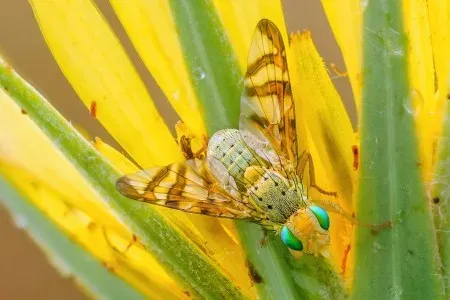
The goatbeard fruit fly (Orellia falcata) is a member of the Tephritidae family, known as fruit flies or picture-winged flies. These insects are easily recognized by the complex, dark patterns on their wings.
Adult flies have a body structure typical for the family, with coloration designed for camouflage against the background of plant leaves and stems.
The larvae are legless and whitish, specialized for consuming the internal tissues of flower heads. Their mouthparts are highly efficient at processing plant material.
The life cycle undergoes complete metamorphosis, comprising four stages: egg, larva, pupa, and adult. They are primarily active during the blooming period of their host plants.
Identification often involves examining the specific wing venation and patterns, as these serve as the primary diagnostic features for species within this genus.
What it damages
The larvae of Orellia falcata primarily infest plants belonging to the Asteraceae family, with a strong preference for the genus Tragopogon (goatbeard).
Damage occurs when larvae tunnel into flower heads, consuming developing seeds and ovaries, which leads to significant losses in seed production and agricultural yield.
In addition to destroying seeds, the feeding activity disrupts the plant's reproductive organs, often leading to total infertility of the affected flower head.
The mechanical damage caused by the larvae acts as an entry point for secondary bacterial and fungal infections, which further degrade the quality of the plant material.
Under high population density, this pest can significantly reduce the success of seed-producing crops, necessitating active management strategies.
Signs of infestation
Key signs of infestation include the presence of holes on the exterior of the flower heads, indicating larval entry or emergence.
Infested plants often display deformed or stunted flower heads that wither or rot prematurely before the seeds can fully mature.
Examination of internal tissues reveals larval frass and feeding damage, with the larvae themselves often found buried deep within the floral structures.
During the adult flight period, the presence of flies resting on buds suggests that egg-laying is occurring, which is a critical observation for monitoring.
Wilting, discoloration, and structural failure of the flower head are common visual indicators of advanced larval infestation.
Control measures
Cultural control is a primary method of management, particularly deep plowing after harvest to destroy overwintering pupae present in the soil.
Sanitation of field borders is essential, as removing weeds from the Asteraceae family prevents the pest from building up its population outside the main crop.
Chemical control should target the adult stage, applying appropriate insecticides during the pre-oviposition period to prevent larvae from entering the flower heads.
Pheromone traps are highly effective for monitoring the emergence of adults, allowing for precise timing of treatment applications.
- Crop rotation to break the life cycle.
- Prompt destruction of infested plant waste.
- Biological control using natural predators or parasites.
Taxonomy
- Latin name
- Orellia falcata
- Order
- Diptera (flies)
- Family
- Tephritidae
- EPPO code
- ORELFA
Discussion
No discussions yet — be the first.