
Fruit fly (Tephritid)
Orellia
Description
How to identify
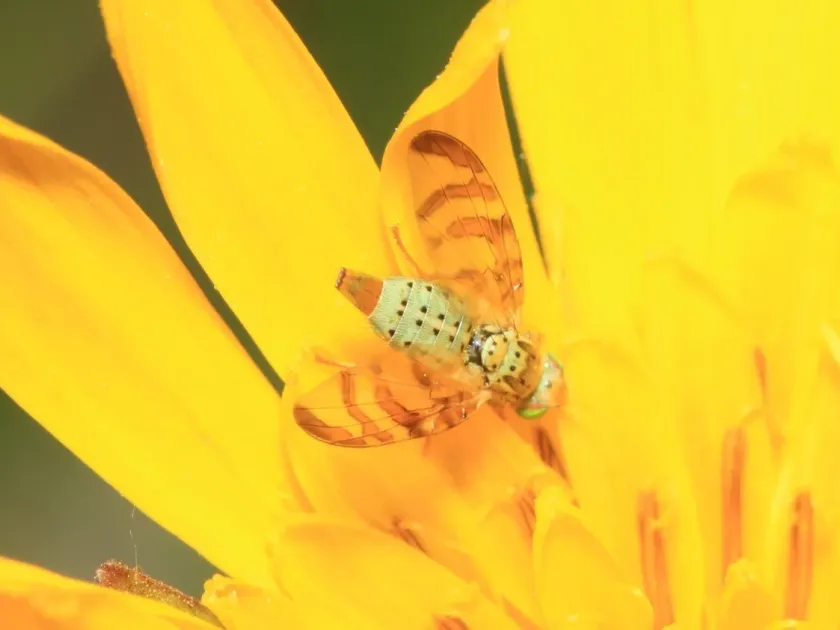
Fruit flies of the family Tephritidae, including the genus Orellia, are often referred to as peacock flies due to their intricate wing patterns. These insects are distinguished by their colorful, banded wings that are used for courtship displays.
The adults are relatively small, usually ranging from 3mm to 7mm in length. They possess well-developed compound eyes and are often found active during warm, sunny periods, which coincides with the flowering stage of their host plants.
What it damages
The larval stage is the most destructive, as they feed internally on plant parts. They target the inflorescences and developing seeds of plants within the Asteraceae family, causing significant agricultural damage.
By consuming the internal tissues of flower heads, these larvae destroy the ovules and prevent proper seed development. This leads to yield loss and compromised seed quality for commercial and home-grown crops.
When it appears
The life cycle of the fruit fly is synchronized with the blooming period of host plants. Adults emerge in late spring or summer and immediately begin seeking suitable host buds for oviposition.
Larvae feed within the plant tissues for several weeks. Depending on the species, pupation can occur inside the plant structure or the larvae may drop into the soil to overwinter as pupae until the following season.
Signs of infestation
Signs of infestation include distorted flower heads and a significant reduction in seed production. Often, the external appearance remains unchanged until the seeds are ready to harvest, at which point the damage becomes evident.
Inside the flower head, one may find larvae or their fecal matter, along with damaged tissue that may show signs of decay. In some instances, exit holes created by emerging adults are visible on the surface of the plant tissue.
Control measures
Integrated pest management (IPM) is essential for controlling this pest. Cultivation techniques, such as tilling the soil after harvest, are highly effective as they expose overwintering pupae to predators and adverse weather conditions.
Sanitation is equally important, which includes removing and destroying infested plant material immediately after detection. If necessary, selective insecticides applied during the early flowering stage can help reduce adult populations before they lay eggs.
Taxonomy
- Latin name
- Orellia
- Order
- Diptera (flies)
- Family
- Tephritidae
- EPPO code
- ORELSP
Discussion
No discussions yet — be the first.