
Banana moth
Opogona sacchari
Description
How to identify
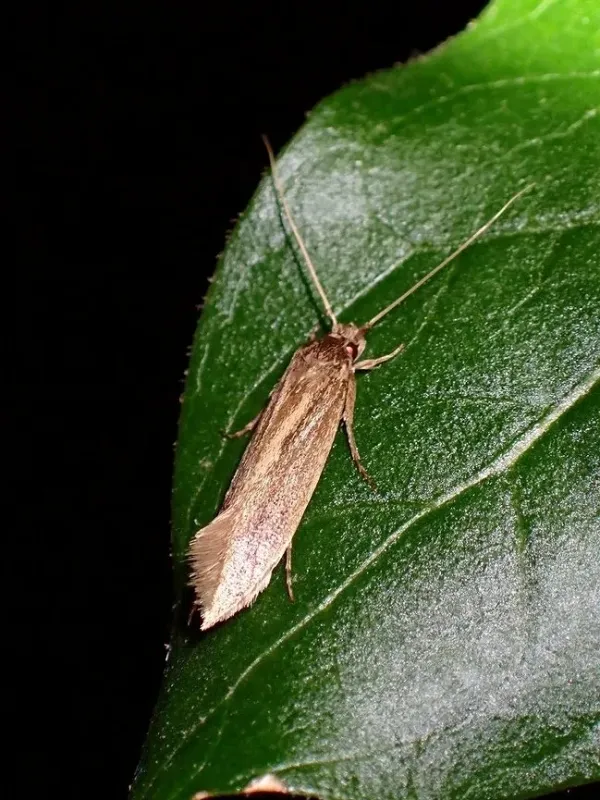
The banana moth (Opogona sacchari) belongs to the Tineidae family of moths. The adult moth is relatively small, with a wingspan of about 20–25 mm, and exhibits a yellowish-brown coloration with darker longitudinal markings on its forewings.
The larvae are cream-colored, smooth-bodied caterpillars with a distinct, darkened head capsule. They are highly mobile and spend their entire larval stage boring into the internal tissues of host plants, which makes them difficult to target.
The moth undergoes a complete metamorphosis, including egg, larval, pupal, and adult stages. Under favorable greenhouse conditions with high temperatures, the life cycle is rapid, allowing for multiple generations per year and quick population build-up.
Adult moths are nocturnal and typically remain hidden during the day. They prefer dark, secluded spaces, such as leaf axils or crevices, making them elusive for casual monitoring unless using pheromone traps.
Being a tropical species, it thrives in warm, humid environments. It is a significant quarantine pest, often transported globally through the trade of ornamental and tropical plant nursery stock.
What it damages
This species is a highly polyphagous pest capable of infesting a wide range of plants. Major hosts include banana plants, dracaenas, yuccas, palms, bromeliads, orchids, and several greenhouse vegetables like peppers and eggplants.
The caterpillars are internal feeders. They tunnel through the stems, pseudostems, roots, and sometimes the fruits of the host plant. This internal boring destroys the plant's vascular system, leading to wilting, stunted growth, and death.
Damage caused by larvae often creates entry points for secondary fungal and bacterial infections. These rot-causing pathogens accelerate the tissue decay, often leading to the collapse of the plant structure within a short period.
In ornamental horticulture, even minor infestations can render a plant unsalable due to visible damage or general decline. In commercial agriculture, the losses can be severe if control measures are not implemented promptly.
- Stem and pseudostem tunneling
- Root and tuber consumption
- Increased susceptibility to soft rot
- Loss of vigor and stunted development
Signs of infestation
The primary indicator of an infestation is the presence of frass (larval excrement), which looks like fine brown sawdust. This material is usually found at the base of the plant or around entry holes in the stem.
Plants affected by the banana moth often show signs of sudden, unexplained wilting despite having adequate water. This is a classic symptom of the larvae consuming the internal conductive tissues.
Exuviae (empty pupal casings) are a definitive sign. As the moth completes its development, it pushes the pupal casing partially out of the exit hole in the stem before emerging as an adult.
Soft or hollow spots on the stem or roots, detectable by gentle touch, indicate internal tunneling. When these areas are dissected, the larvae or their galleries are usually clearly visible.
Leaves may show yellowing (chlorosis) or necrosis as a direct result of the disrupted nutrient and water supply caused by the damage in the stem or crown of the plant.
Control measures
Strict phytosanitary control is the first line of defense. All incoming plant material should be carefully inspected for signs of tunneling or frass and kept in quarantine before being introduced to the main collection.
Cultural control involves the immediate destruction of infested plants or plant parts by burning. Sanitation is critical, as any remaining organic debris can serve as a nursery for subsequent generations of the moth.
Pheromone traps are highly effective for monitoring adult moth populations and timing control efforts. In some cases, high densities of traps can also contribute to mass trapping and population reduction.
Chemical control focuses on the use of systemic insecticides that are absorbed into the plant tissues. Because the larvae live inside the plant, treatments must be thorough and persistent to reach the pests.
Biological control using entomopathogenic nematodes, such as Steinernema feltiae, is a highly recommended strategy. These nematodes can navigate the galleries created by the larvae, effectively killing them without leaving toxic residues.
Taxonomy
- Latin name
- Opogona sacchari
- Order
- Lepidoptera (butterflies)
- Family
- Tineidae
- EPPO code
- OPOGSC
Discussion
No discussions yet — be the first.