
Opogona omoscopa
Opogona omoscopa
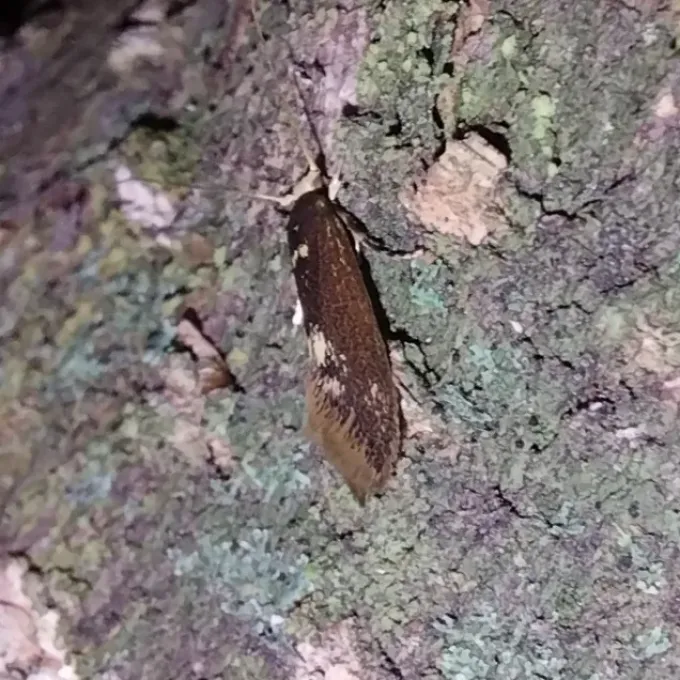
Description
How to identify
Opogona omoscopa, commonly known as the banana moth or simply as a stem-boring moth, belongs to the family Cosmopterigidae. These small moths are well-adapted to indoor environments, such as greenhouses and botanical gardens.
The larvae are cream-colored with brown heads and grow up to 20 mm in length. They are primarily borers, meaning they spend the majority of their life cycle tunneling through the stems and soft tissues of host plants.
The life cycle is largely influenced by ambient temperature. In warm indoor environments, they can complete multiple generations in a single year, making them persistent and difficult to eradicate.
Females lay eggs in crevices of the bark or near the soil line. After hatching, the larvae immediately seek entry points, often targeting weakened or wounded areas on the host plant.
Adult moths are nocturnal and are attracted to light sources. Their ability to fly and relocate within a greenhouse contributes to the rapid spread of infestations across different plant sections.
What it damages
Opogona omoscopa is a broad polyphage, meaning it feeds on a wide range of host plants. It is particularly damaging to ornamental species, including palms, dracaenas, and various succulents.
The primary damage is caused by the larvae as they tunnel into the plant's core. These tunnels disrupt the plant's vascular system, preventing the upward movement of water and nutrients from the roots to the leaves.
Affected plants often exhibit a slow decline, manifesting as yellowing, wilting, and reduced growth. Because the larvae are hidden inside the stem, the damage is often irreversible by the time it becomes visible.
In addition to physical tissue destruction, the tunnels created by the larvae provide easy access for secondary pathogens, including bacteria and fungi, which cause internal rot and stem collapse.
In commercial nurseries, an unchecked infestation of this pest can result in significant economic loss, as thousands of high-value plants can be compromised in a very short period.
Signs of infestation
The most visible sign of infestation is the appearance of small holes in the stem or at the base of the plant. Small piles of frass, or powdery excrement, often accumulate around these entry points.
Plants may suddenly lose turgor or begin to wilt despite receiving sufficient water. This symptom usually indicates that the internal vascular system has been severely compromised by larval activity.
Stems may appear deformed or feel spongy or hollow to the touch. Sometimes, sap or resinous substances leak from the holes as the plant attempts to seal its wounds, providing a diagnostic clue.
The presence of adult moths in light traps or flying around the foliage at night is a major red flag that an infestation is currently underway and needs immediate intervention.
If a stem is cut open, it will reveal a network of tunnels filled with debris and frass, confirming the presence of larvae inside the host tissue.
Control measures
Strict quarantine protocols are essential when introducing new plant material into an existing collection. Carefully inspect all stems and bark for any signs of entry holes before moving them to the main growing area.
Early intervention is key. If infestation is detected in a specific plant, it should be isolated immediately to prevent the moths from spreading to other specimens in the area.
Systemic insecticides are the most effective chemical control method because they are absorbed by the plant and target the larvae as they feed on the internal tissues.
Biological controls, such as the application of entomopathogenic nematodes, can be used to treat the soil or stem surfaces, offering an environmentally friendly alternative to harsh chemicals.
- Maintain rigorous greenhouse hygiene by removing dead plant matter.
- Use light traps to monitor for the presence of adult moths.
- Regularly check the basal areas of plants for signs of larval frass.
- Systemically treat high-value plants as a preventative measure.
- Destroy heavily infested specimens to reduce the overall population pressure.
Taxonomy
- Latin name
- Opogona omoscopa
- Order
- Lepidoptera (butterflies)
- Family
- Tineidae
- EPPO code
- OPOGOM
Discussion
No discussions yet — be the first.