
Banana moth
Opogona dimidiatella
Description
How to identify
The banana moth (Opogona dimidiatella) belongs to the family Tineidae. Adult moths have a wingspan of approximately 20–25 mm, with brownish-yellow forewings marked by distinct dark spots.
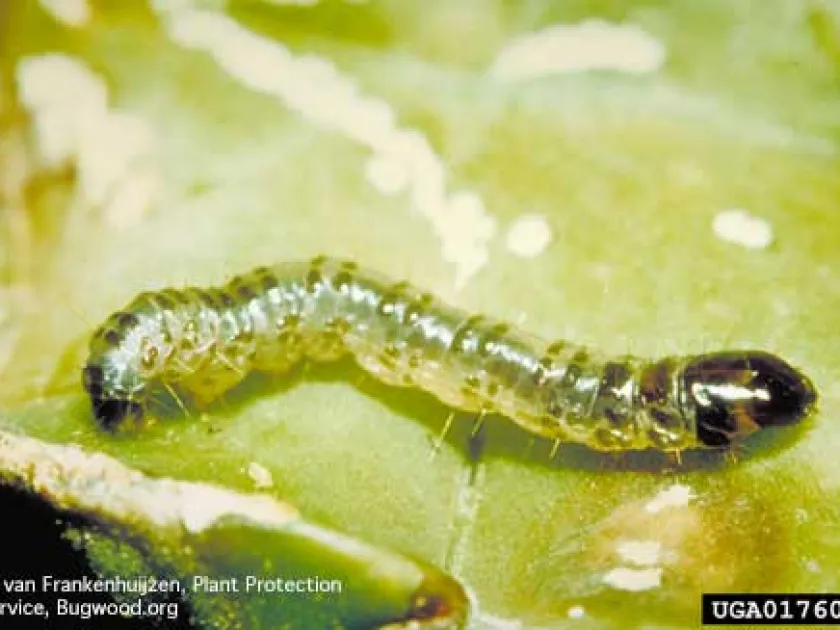
The larvae are whitish to yellowish with dark heads. These larvae are highly active and spend their entire developmental phase feeding within the protected plant tissues.
Eggs are typically laid singly or in small clusters near cracks in the bark or existing wounds on the plant stems, favoring conditions with high humidity.
The insect is a notorious polyphagous pest, capable of infesting a wide range of tropical and ornamental plant species, including various palms and dracaena.
Since adults are nocturnal, their presence is best identified using light traps or pheromone-based monitoring systems in large-scale plantations or greenhouses.
What it damages
The primary damage is caused by the larval stage, which tunnels through stems, pseudostems, and developing fruit, disrupting nutrient transport and plant vitality.
Besides bananas, the moth frequently targets ornamental nursery plants, making it a major concern for the horticultural industry globally.
Larval feeding on fruit pulp creates hollowed-out areas that invite secondary fungal pathogens, leading to rapid rot and total loss of commercial value.
Weakened stems due to internal tunneling can lead to structural failure, causing plants to lean or collapse, which significantly interferes with harvest operations.
Severe infestations can cause overall stunted growth and eventual plant mortality, especially in young nursery transplants that cannot withstand heavy larval tunneling.
Signs of infestation
Small piles of frass (larval excrement) appearing near entry holes on the stem surface are the most prominent visual sign of an active infestation.
Surface depressions or necrotic spots on fruit indicate that larvae are feeding internally just beneath the peel of the banana.
Sudden wilting of individual leaves or the entire plant suggests that larvae have damaged the vascular tissue at the base of the plant.
Inside the plant tissue, longitudinal tunnels packed with excrement confirm the presence of Opogona dimidiatella during plant dissection.
The presence of fine silken webbing near the entrance of larval tunnels is another common sign indicating that larvae are nesting or moving through the plant.
Control measures
Strict quarantine measures on imported plant stock are essential to prevent the entry of this pest into non-infested regions or greenhouses.
Cultural practices, such as the immediate removal and destruction of infested plant material, are vital for breaking the pest's reproductive cycle.
Biological control methods, including the application of Bacillus thuringiensis or entomopathogenic nematodes, provide a sustainable alternative to chemical sprays.
Systemic insecticides may be used when infestations are detected early, provided that the timing is strictly aligned with the crop safety regulations.
- Regular monitoring using light and pheromone traps.
- Sanitation by clearing all plant debris from growing areas.
- Ensuring proper plant health to improve resistance.
- Training staff to recognize early symptoms of larval tunneling.
Taxonomy
- Latin name
- Opogona dimidiatella
- Order
- Lepidoptera (butterflies)
- Family
- Tineidae
- EPPO code
- OPOGDI
Discussion
No discussions yet — be the first.