
Gold-scaled Opogona moth
Opogona aurisquamosa
Description
How to identify
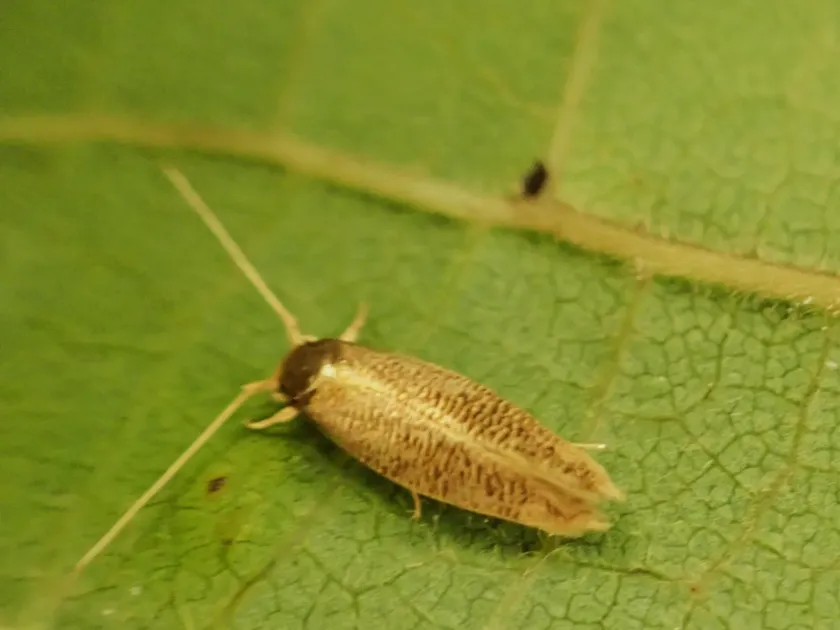
The gold-scaled Opogona moth (Opogona aurisquamosa) belongs to the Tineidae family. It is a small insect that exhibits cryptic nocturnal behavior throughout its adult stage.
Larvae of this species have specialized mouthparts, allowing them to bore galleries within plant tissues. They often appear whitish or translucent, darkening as they mature into later instars.
Adults are small moths with narrow wings covered in golden or brownish scales. Their life cycle is closely linked to humid, tropical, or greenhouse-like environments.
Systematically, this species is a close relative of the banana moth, which explains the similarities in their ecological niches and behavioral patterns in nature.
Identification is frequently challenging because larvae spend nearly their entire developmental cycle inside stems or fruits, emerging only to pupate in a dense, protective cocoon.
What it damages
The primary damage is caused by the polyphagous larvae. They attack a wide range of tropical and ornamental crops, including bananas, sugarcane, and various greenhouse plants.
Larvae create deep tunnels in stems, leaf petioles, and fruits, which disrupts nutrient flow, causes shoot deformation, and eventually leads to wilting and death of the plant.
Under heavy infestation, premature leaf drop and seedling mortality are common, as damaged tissues become entry points for secondary fungal and bacterial pathogens.
This pest weakens the host plant's immune system, leading to significant economic losses in agriculture by reducing the market value of produce and overall yields.
Damage to the growth point is particularly critical, as it prevents further plant development and makes the affected area impossible to recover.
Signs of infestation
The first sign of infestation is the appearance of small entry holes on stems or fruit surfaces, surrounded by frass (larval excrement) appearing as a powdery, brownish mass.
Wilting of specific shoots or leaves despite regular watering often indicates internal tunneling that compromises the plant's vascular system.
Upon dissecting affected areas, one can find the larvae or evidence of their activity: longitudinal or erratic winding galleries filled with brownish, sawdust-like waste.
The presence of dense white cocoons in leaf axils or under peeling bark confirms that the pest has completed its developmental cycle and is pupating.
Fruit deformation and the presence of necrotic spots at the larval entry points serve as classic visual markers for the presence of this moth species.
Control measures
The most effective strategy for managing Opogona involves an integrated approach, including strict quarantine measures for imported plants and regular crop monitoring.
The use of pheromone traps is a critical step for early detection of adult moths, helping to disrupt the breeding cycle through mass trapping programs.
Biological control methods, such as the application of entomopathogenic nematodes or bio-insecticides, have proven highly effective in greenhouse settings.
Chemical control involves applying systemic insecticides during the peak flight of adults to prevent them from laying eggs on the host plant surfaces.
- Prompt removal and destruction of infested plant debris.
- Maintaining optimal humidity levels and high sanitation standards in greenhouses.
- Strict quarantine protocols for all new nursery stock.
- Application of microbial agents like Bacillus thuringiensis.
Taxonomy
- Latin name
- Opogona aurisquamosa
- Order
- Lepidoptera (butterflies)
- Family
- Tineidae
- EPPO code
- OPOGAU
Discussion
No discussions yet — be the first.