

Tropinota hirta
Tropinota hirta
Description
How to identify
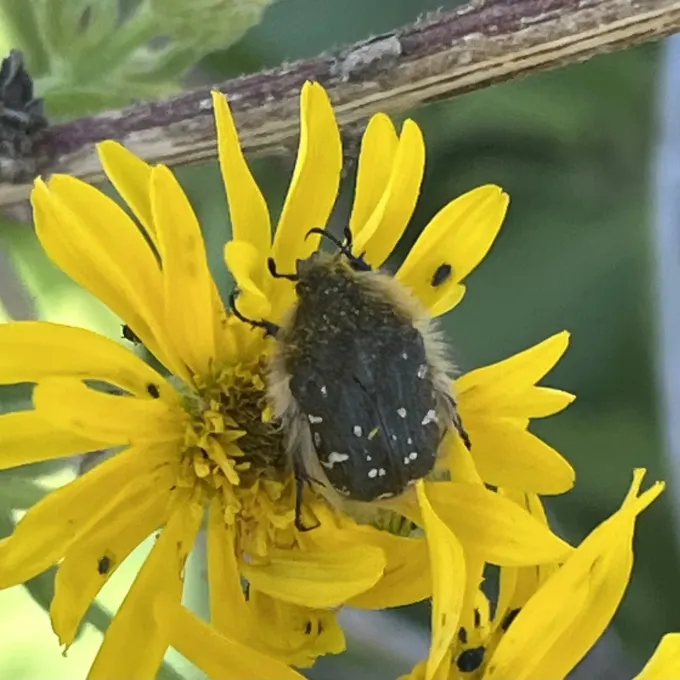
Tropinota hirta, commonly known as the hairy rose beetle or the shaggy rose beetle, belongs to the family Scarabaeidae. The adult beetle is 8–12 mm long, matte black, and covered with white spots on its elytra.
The body is densely covered with long, grey hairs, which distinguishes this species from others. They are active during daylight hours, preferring warm and sunny weather to fly and feed.
The life cycle is completed in one year. They overwinter as adults, primarily in the soil at depths of 15–20 cm, emerging as soon as the first spring warmth occurs.
The larvae live in the soil and feed on humus and decaying plant matter, posing no direct threat to cultivated plants during this stage of their development.
Pupation occurs in the summer, and the new generation of adults appears by late July or August, where they remain in the soil until the following spring.
What it damages
This beetle is a polyphagous pest, causing significant damage to various cultivated plants. Fruit trees are particularly vulnerable during their peak flowering period.
Key host plants include the domestic apple tree (Malus domestica), pears, plums, and cherries. The beetles feed on the reproductive parts of flowers: stamens, pistils, and ovaries.
Beyond orchards, the beetle frequently attacks ornamental flowers like tulips, daffodils, and roses, destroying blossoms and reducing their ornamental value.
In years of mass infestation, the beetles can destroy nearly all flowers on a tree, leading to a critical decline in yield or a complete failure of fruit production.
While the invasion often starts locally, the high mobility of adult beetles allows them to spread rapidly throughout a garden or orchard in a very short time.
When it appears
The emergence of adults typically coincides with the flowering of dandelions, usually occurring in April or May, depending on the climatic zone.
The main flight period lasts throughout the duration of the garden's bloom. During this window, the beetles are most aggressive and cause the greatest impact on potential harvests.
Activity begins to decline by the end of June as the flowering phase of most fruit trees ends, and the beetles move to the soil for egg-laying.
They are most active during sunny periods; in overcast or rainy weather, they hide in the ground or under foliage, which makes control efforts more challenging.
Monitoring should be started as soon as the first flowers open, as seasonal weather variations can shift the timing of their emergence annually.
Signs of infestation
The primary sign of infestation is the visual presence of the beetles inside the flowers. They are often found in groups, densely packed onto the blossoms.
Upon inspection, flowers will show chewed stamens and pistils. Excessive shedding of petals and the lack of developing fruitlets are clear indicators of beetle activity.
Buds may dry out before opening due to internal tissue damage caused by the feeding beetles, leading to bare branches and poor fruit set.
In cases of heavy infestation, a large number of withered, hollowed-out flowers can be observed, significantly impairing the tree's reproductive capacity.
The presence of the beetles on weeds in adjacent areas, such as dandelions or mustard, is another indicator that they are preparing to move into the orchard.
Control measures
Controlling Tropinota hirta is difficult because their activity period overlaps with peak bloom, when applying insecticides is restricted to protect honeybees.
- Using blue-colored light traps to capture large numbers of beetles.
- Manual collection of beetles in the early morning when they are sluggish.
- Application of biological products based on entomopathogenic fungi.
- Strictly scheduled evening insecticide applications using bee-safe formulations.
- Summer soil cultivation and tilling to destroy pupae residing in the ground.
An integrated approach combining mechanical traps, cultural practices, and biological agents is the most effective strategy for managing this pest in gardens.
In brief
1
Damages crops
Content graph
Damages crops · 1
Content graph
Connections · Tropinota hirta
Most often together:
Marketplace
Products · 2

Puska
Три Дельта Компані Інтернешнл, Гонконг, Китай.
Insecticides
1
0
·
1.9K
1 offer
7.76 €per 1 l
Buy
Biology
Taxonomy
- Latin name
- Tropinota hirta
- Order
- Coleoptera (beetles)
- Family
- Scarabaeidae
- EPPO code
- EPISHI
Community
Discussion
No discussions yet — be the first.