
Argentine bagworm
Oiketicus platensis
Description
How to identify
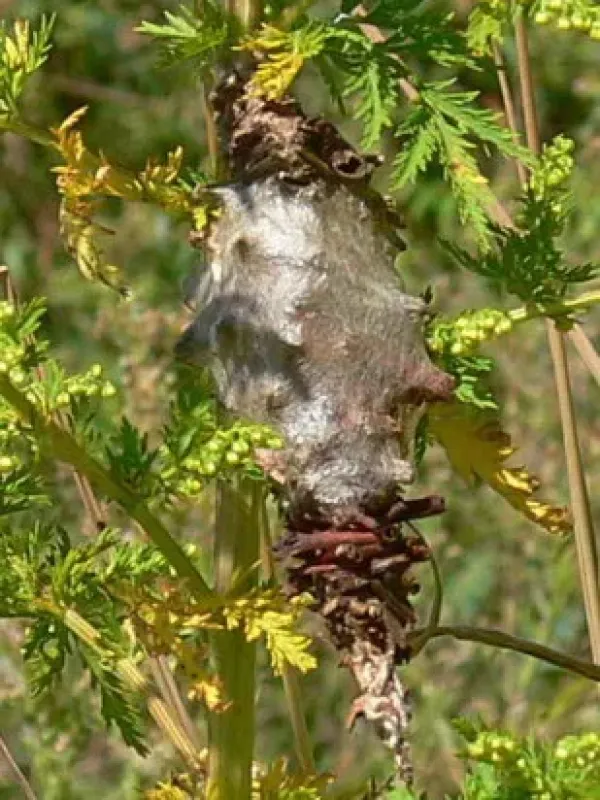
The Argentine bagworm (Oiketicus platensis) belongs to the family Psychidae, order Lepidoptera. Its most prominent feature is the construction of a protective case (bag) made of silk threads, twigs, bark, and leaf fragments.
Adult males are winged and capable of active flight to locate mates, whereas females are wingless, grub-like, and typically remain within their protective cases throughout their entire lives.
Larvae develop inside these cases, gradually expanding them as they grow. The appearance of the bag often mimics the surrounding plant material, making the pest extremely difficult to spot.
The color of the larvae ranges from greyish to dark brown, with a distinct pattern often found on the head. A mature individual inside the case can measure several centimeters in length.
Reproduction is sexual; after mating, the female lays eggs inside her case, where they remain until the following spring, protected from environmental stresses.
What it damages
This pest is a polyphage, attacking a wide range of woody and shrub species. Its hosts include both fruit trees and various ornamental conifers and broad-leaved trees.
The larvae actively feed on foliage, skeletonizing leaves or completely devouring them, which results in a critical reduction of the plant's photosynthetic capacity.
During heavy infestations, the pest can cause total defoliation of branches, significantly weakening the tree and making it susceptible to diseases and other secondary pests.
In addition to foliage, larvae may damage young shoots and bark, disrupting nutrient flow and hindering the overall development of the plant throughout the growing season.
Economic damage includes the loss of aesthetic value for ornamental plants and a significant reduction in fruit yield due to the stress inflicted upon the trees.
When it appears
The activity of the Argentine bagworm is highly dependent on temperature. Larval emergence typically coincides with the beginning of the growing season in spring, when fresh foliage appears.
The peak of damage occurs during the summer months when larvae are feeding intensely and enlarging their cases using available plant material.
Pupation takes place inside the protective case, usually towards the end of summer or early autumn, after which adult individuals prepare for mating.
Eggs overwinter inside the cases, which are securely attached to tree branches, allowing the pest to survive harsh winter conditions with high efficiency.
Monitoring for the presence of this pest should be conducted throughout the season, starting in early spring when cases are more visible on leafless branches.
Signs of infestation
The primary sign of infestation is the presence of distinctive hanging cases on branches, which can easily be mistaken for natural debris or dry plant parts.
Irregular feeding patterns are observed on the leaves, starting from the tips of branches or the edges of the canopy, where larvae move in search of food.
Damaged areas appear as skeletonized leaves with only the coarse veins remaining, which is a direct consequence of the larvae's specific feeding behavior.
The presence of strong silk threads anchoring the cases to the bark is a clear indicator that the tree is infested with bagworms.
Inspection often reveals small pellets of frass (excrement) beneath the tree or directly on the leaves, left by feeding larvae as they move along the branches.
Control measures
Mechanical removal and destruction of cases is the most effective control method for small gardens; it is best performed during the dormant winter or early spring period.
Biological control using formulations based on Bacillus thuringiensis has proven effective against larvae during their early development stages.
Chemical insecticides with stomach-action are effective during the active feeding period, but they require thorough coverage of the entire tree canopy to be successful.
It is important to encourage natural predators, such as entomophagous insects, which can help regulate bagworm populations in the garden environment.
- Pruning and destroying infested branches
- Use of pheromone traps for adult males
- Regular winter monitoring of the canopy
- Timely application of chemical treatments
Taxonomy
- Latin name
- Oiketicus platensis
- Order
- Lepidoptera (butterflies)
- Family
- Psychidae
- EPPO code
- OICEPL
Discussion
No discussions yet — be the first.