
Geyer's bagworm
Oiketicus geyeri
Description
How to identify
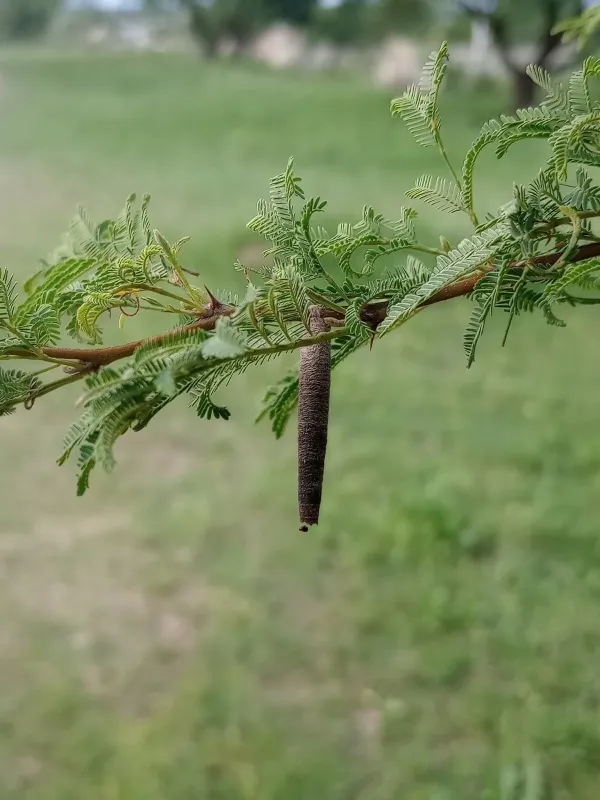
Geyer's bagworm (Oiketicus geyeri) belongs to the Psychidae family within the order Lepidoptera. This insect is best known for the characteristic protective case, or «bag», that the larva constructs around itself shortly after hatching.
The case is meticulously crafted from silk secreted by the larva, interwoven with pieces of twigs, leaves, pine needles, and bark from its host plant. This structure serves as both a home and a camouflage against predators.
The sexual dimorphism in this species is significant. While males develop wings and exhibit active flight behavior to locate mates, females remain wingless, legless, and grub-like for their entire adult life.
The entire life cycle consists of the egg, larva, pupa, and adult stages. The larval stage is the longest and the only one during which the insect feeds actively and constructs its protective shelter.
Identifying this species often relies on analyzing the unique structure of the bag. Because the larvae incorporate material from their immediate environment, the appearance of the bag can vary depending on the host plant species.
What it damages
Geyer's bagworm is a polyphagous pest, meaning it feeds on a wide range of woody plants, including various deciduous trees, shrubs, and conifers. This broad host range makes it a threat to diverse ecosystems.
The damage is caused primarily by the larvae as they graze on leaves, buds, and succulent bark. Severe infestations can result in the complete defoliation of the tree, which significantly weakens its physiological processes.
If the larvae feed on the bark of young shoots, they may cause vascular damage, leading to the dieback of branches. This is particularly dangerous for young ornamental trees and seedlings in nurseries.
Beyond direct physical damage, the presence of the insect renders ornamental plants unattractive, which is problematic for landscape management. The unsightly hanging bags ruin the aesthetic value of public parks and gardens.
Weakened trees become susceptible to secondary infections from fungi and bacteria, as well as infestations by other pests, which can accelerate the eventual death of the affected plant.
Signs of infestation
The most distinctive sign of a bagworm infestation is the presence of small, debris-like structures dangling from the branches. These bags often look like twigs or dead leaf clusters stuck in the canopy.
Close observation reveals that these structures move independently. If the tree is gently shaken or observed for a period, the larval movement can be seen as it maneuvers to reach new feeding sites.
Visible feeding damage, such as leaf skeletonization or notches on the leaf margins, is a key indicator of activity. One might also notice silken threads securing the bags to the twigs.
In winter, after deciduous trees have lost their foliage, the bags become highly conspicuous. This is the optimal window of time for orchardists and gardeners to perform inspections and manual removal.
The accumulation of larval frass (excrement) on the ground underneath the tree canopy is another clear sign that the colony is actively feeding in the upper branches, even if the bags themselves are well-hidden.
Control measures
The most effective management strategy for small-scale infestations is the manual collection and destruction of the bags. Because the larvae are slow-moving and protected by their cases, physical removal is highly efficient.
For larger infestations, biological control using Bacillus thuringiensis (Bt) is recommended. This bacterium is effective against bagworm larvae while being environmentally friendly and safe for most beneficial insects.
If chemical intervention is necessary, systemic insecticides should be applied while the larvae are young and actively feeding. Once the larvae grow and strengthen their cases, they become significantly more resistant to spray treatments.
- Regular pruning to remove infested branches.
- Encouraging natural predators like birds and parasitic wasps.
- Using pheromone traps to monitor adult male populations.
- Promoting tree vigor through proper fertilization and irrigation.
An integrated approach, combining mechanical removal during the dormant season with targeted biological sprays in the spring, is essential for keeping Geyer's bagworm populations under control in sensitive areas.
Taxonomy
- Latin name
- Oiketicus geyeri
- Order
- Lepidoptera (butterflies)
- Family
- Psychidae
- EPPO code
- OICEGE
Discussion
No discussions yet — be the first.