
Oiketicoides febretta
Oiketicoides febretta
Description
How to identify
Oiketicoides febretta belongs to the bagworm moth family (Psychidae), order Lepidoptera. There is a strong sexual dimorphism: males are winged and capable of flight, while females are wingless, legless, and antenna-less, resembling a worm-like larva throughout their adult stage.
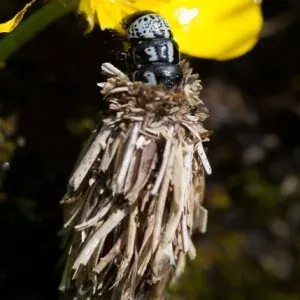
The most distinctive feature is the protective case (bag) that the larva builds from plant debris, bark, needles, and silk. The larva remains inside this case throughout its life, moving along the plant and feeding while shielded from predators and environmental factors.
The larvae are typically dark-colored with a well-developed, sclerotized head. As the caterpillar grows, the bag expands and takes on a specific cone or cylinder shape, which is a key diagnostic character for identifying this particular species among other bagworms.
Reproduction occurs inside the bag. After mating, the female lays eggs within her own cocoon, where they undergo embryonic development. This behavior makes the eggs difficult to reach with standard contact insecticides.
The biology of this species is closely linked to climatic conditions. Development is often slow, and depending on the geographical location, the species may complete its life cycle in one or two years.
What it damages
Oiketicoides febretta is a polyphagous pest capable of damaging a wide variety of deciduous trees and shrubs. It poses a significant threat to ornamental trees and can also affect certain coniferous species in nurseries and landscape gardens.
Damage is caused by the caterpillars, which feed on leaves, leaving irregular edges or creating holes in the leaf tissue. At high population densities, severe defoliation occurs, which significantly reduces the aesthetic and commercial value of the plants.
Young larvae tend to skeletonize leaves, consuming the soft tissues while leaving the veins intact. Mature larvae can consume the entire leaf, leaving only the thickest central veins.
Feeding damage weakens the plant's immune system, making it more susceptible to secondary infections, fungal diseases, and colonization by wood-boring pests that frequently target stressed trees.
In commercial plantations and public parks, mass outbreaks can lead to the death of young saplings or the loss of crop quality, requiring timely and targeted management practices.
When it appears
Larval activity begins in spring after hibernation. The larvae emerge from their wintering sites or resume feeding once the average daily temperature exceeds the activity threshold for the species.
The period of most intense feeding occurs throughout May and June. During this time, the caterpillars are highly active, gaining weight rapidly and moving through the crown in search of fresh foliage.
Pupation typically takes place in summer, followed by the emergence of males in search of mates. The mating and egg-laying process usually occurs in the second half of summer, after which the cycle repeats.
The larvae overwinter in their sturdy cocoons, which are firmly attached to branches or tree trunks with strong silk threads, providing protection against winter frosts and precipitation.
Spring awakening is synchronized with the bud-break of host plants, allowing young larvae to immediately begin feeding on fresh shoots, which is essential for their rapid development.
Signs of infestation
The first sign of infestation is the presence of objects on branches that resemble debris or bark fragments but suddenly start moving. These are the protective cases of the bagworm.
Characteristic damage on leaves includes irregular holes, chewed edges, or patches of removed epidermis. As the caterpillar grows in size, the area of damage expands noticeably.
In areas where the pest is present, one can find caterpillar frass on the underside of leaves or trapped in silk webbing, appearing as tiny dark-colored pellets.
During winter inspections of tree trunks, one can find old or active cocoons firmly attached to the bark. Their presence indicates a need for monitoring during the next vegetation season.
The drying of individual twigs or a general reduction in plant growth, accompanied by the sight of dangling "bags," is a clear signal of bagworm colonization.
Control measures
Manual removal and destruction of the cocoons is the primary and most effective method for controlling low-density populations in private gardens or small areas.
For high-density infestations, the use of systemic insecticides is recommended, as they penetrate plant tissues and affect the larvae upon ingestion of the treated foliage.
Treatment should be applied during the early stages of larval development when they are most vulnerable. Biological control using Bacillus thuringiensis based products has shown good efficacy against young larvae.
Maintaining plant health through proper irrigation and fertilization is crucial. A strong, vigorous tree is better able to withstand feeding damage and recover its foliage more rapidly.
- Maintain appropriate spacing during planting to prevent the spread of the pest between trees.
- Encourage birds in the garden, as they act as natural predators of bagworm larvae.
- Use pheromone traps to disrupt male mating behavior and monitor the population density.
Taxonomy
- Latin name
- Oiketicoides febretta
- Order
- Lepidoptera (butterflies)
- Family
- Psychidae
- EPPO code
- OIKEFE
Discussion
No discussions yet — be the first.