
Banana stem weevil
Odoiporus longicollis
Description
How to identify
The banana stem weevil (Odoiporus longicollis) is a serious pest belonging to the Curculionidae family. It is widely recognized as one of the most significant threats to banana cultivation globally.
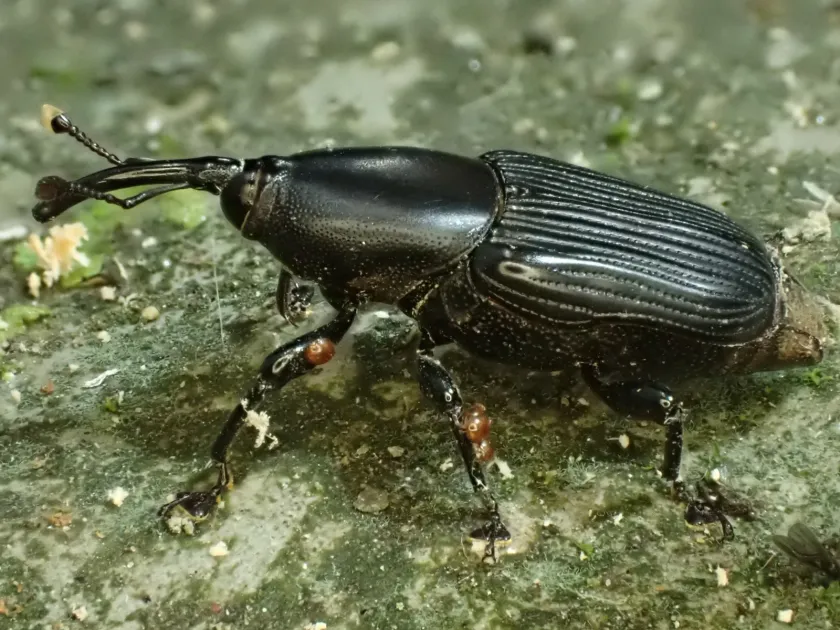
Adult weevils are large, robust beetles reaching up to 35 mm in length. Their coloration ranges from dark reddish-brown to entirely black, allowing them to blend into the shadows of the leaf sheaths.
The larvae are legless grubs with a creamy-white appearance and a hard, brown head capsule. They are exclusively internal feeders, remaining inside the banana pseudostem throughout their development.
The complete lifecycle spans from egg to adult within the plant tissue. Females use their long snouts to puncture the pseudostem epidermis and deposit eggs individually into the fibrous material.
Pupation occurs within a specialized cocoon fashioned from shredded plant fibers, protecting the transforming insect from environmental fluctuations and natural enemies.
What it damages
The weevil specifically targets members of the Musa genus. Both commercial banana varieties and plantains are susceptible to infestations across tropical and subtropical regions.
The damage is almost entirely concentrated within the pseudostem. The larvae tunnel through the tissue, creating complex networks of galleries that disrupt the plant's vascular systems.
As the larvae feed, they consume the core structural fibers of the pseudostem, significantly weakening the plant's ability to remain upright, especially during fruiting.
The internal destruction caused by feeding larvae often hinders water and nutrient transport, leading to reduced leaf growth and overall plant vigor decline.
In cases of heavy infestation, the structural integrity of the pseudostem is lost entirely, causing the plant to snap under its own weight, resulting in significant yield loss.
Signs of infestation
The most visible sign of an initial infestation is the presence of sap exudation through small, pin-prick holes made by the adult females on the outer leaf sheaths.
As the sap dries and oxidizes, it leaves dark, gummy stains on the exterior of the pseudostem, which serves as a critical indicator for early detection by farmers.
Internal symptoms include the presence of extensive tunneling and rotting of the tissue. If the pseudostem is cut, one can often find larvae, pupae, and frass (waste) inside.
Foliar symptoms appear as progressive yellowing and wilting, starting from the oldest leaves. This is due to the larval damage preventing the transport of moisture to the canopy.
In advanced stages, the plant exhibits a "toppled" appearance. The entire pseudostem may collapse, leading to the premature death of the banana plant before it completes its cycle.
Control measures
Sanitation is the cornerstone of managing Odoiporus longicollis. Removing and destroying infested stems promptly is essential to reduce the population pressure within the plantation.
Using healthy, disinfected suckers (planting material) is vital to prevent the introduction of the pest into newly established blocks or clean areas of the farm.
- Installing pheromone-baited traps to capture adult beetles.
- Using stem-section traps to monitor and reduce adult populations.
- Applying systemic insecticides around the base of the plant if necessary.
- Introducing biological control agents like Beauveria bassiana.
- Maintaining optimal soil health and proper irrigation to support plant resilience.
Regular scouting of the plantation for signs of sap leakage and early detection of damaged stems allow for targeted interventions, significantly improving the efficacy of management efforts.
Taxonomy
- Latin name
- Odoiporus longicollis
- Order
- Coleoptera (beetles)
- Family
- Dryophthoridae
- EPPO code
- ODOILO
Discussion
No discussions yet — be the first.