
Banana stem weevil
Odoiporus
Description
How to identify
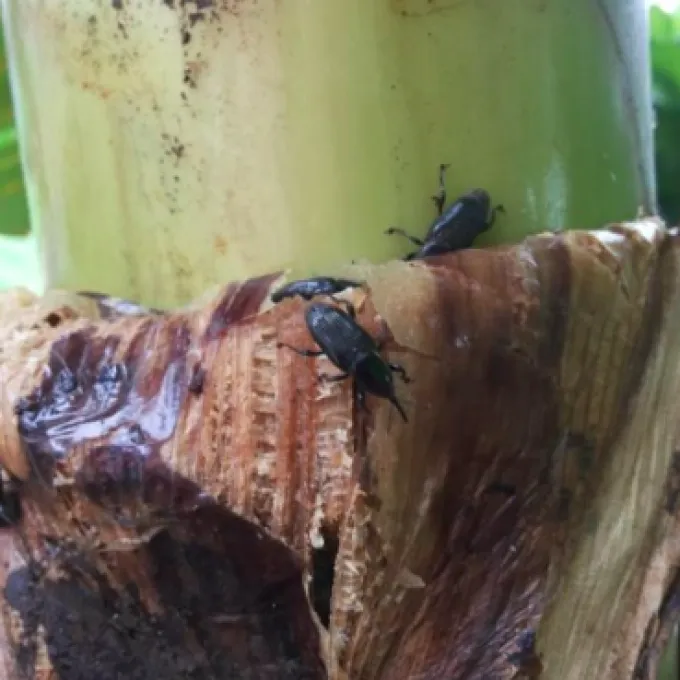
Odoiporus longicollis, commonly known as the banana stem weevil, is a significant pest belonging to the Curculionidae family. The adult beetle is typically 10–15 mm long with a body coloration ranging from reddish-brown to black.
The insect possesses a distinctive elongated rostrum, which it utilizes to penetrate the tough banana plant tissue. This adaptation allows the weevil to reach protected areas within the stem for feeding and egg-laying.
Larvae are legless, grub-like, and creamy white in color with a dark, sclerotized head capsule. They remain entirely concealed within the pseudostem during their development, which makes early detection a challenge for farmers.
The life cycle of this pest is closely tied to the host plant. In tropical environments, breeding occurs year-round, allowing the population to build up rapidly if conditions remain favorable and sanitary measures are neglected.
Adult weevils are largely nocturnal, showing activity after sunset. During the day, they prefer hiding in tight leaf sheaths or under decaying plant tissues to avoid predation and environmental stress.
What it damages
The primary host for this pest is the banana plant (genus Musa). Both young and mature plants can be attacked, although the pest tends to favor plants that have already reached a significant size.
The damage is caused primarily by larvae boring into the pseudostem. These tunnels disrupt the plant's vascular system, hindering the upward movement of water and nutrients essential for growth and fruit production.
Weakened stems lose structural integrity and are prone to snapping under the weight of the fruit bunch or during moderate wind events, leading to complete loss of the individual plant's yield.
Furthermore, the galleries created by the larvae serve as entry points for secondary infections. Pathogenic fungi and bacteria often exploit these wounds, causing internal rot and rapid plant decay.
Economic damage is substantial, as heavy infestations reduce the size and quality of fruit bunches, shorten the productive lifespan of the plantation, and necessitate premature replanting.
Signs of infestation
Early signs of an infestation include small entry holes on the exterior of the pseudostem. Often, a sticky sap exudes from these holes, which eventually oxidizes and turns dark or black.
When the pseudostem is split open, the interior reveals extensive networks of tunnels. These are often filled with larval frass and decaying fiber, indicating that the internal tissue has been severely compromised.
Visual symptoms on the exterior include premature yellowing and drooping of the leaves, starting from the lower levels. This is a direct consequence of the damaged vascular system failing to nourish the canopy.
In advanced cases, the plant may show a pronounced bend or twist in the stem. Fruit bunches may appear underdeveloped or stunted due to the severe disruption of nutrient flow to the developing fruit.
Finding adult weevils in the leaf axils or base of the plant, particularly during nighttime inspections, confirms their presence and the need for immediate intervention.
Control measures
Sanitation is the cornerstone of control. Removing and chopping infested stems into small pieces prevents the completion of the weevil's life cycle and reduces the local breeding population significantly.
The use of pseudostem traps is a practical method for monitoring and suppression. Cut pieces of banana stems placed on the ground act as decoys, attracting adults that can then be easily collected and destroyed.
Chemical control can be implemented by applying systemic insecticides directly into the larval galleries or treating the base of the stems where weevils tend to hide during the day.
Biological control agents, including entomopathogenic fungi such as Beauveria bassiana or specific parasitic nematodes, have shown potential in reducing weevil numbers in an environmentally sustainable way.
- Ensure the use of clean, pest-free planting materials for new sites.
- Maintain proper plantation spacing to ensure good air circulation.
- Regularly monitor fields using pheromone or food-based traps.
- Implement post-harvest field hygiene to eliminate potential refuges for the pest.
Taxonomy
- Latin name
- Odoiporus
- Order
- Coleoptera (beetles)
- Family
- Dryophthoridae
- EPPO code
- ODOISP
Discussion
No discussions yet — be the first.