
Leach's storm petrel
Oceanodroma leucorrhoa
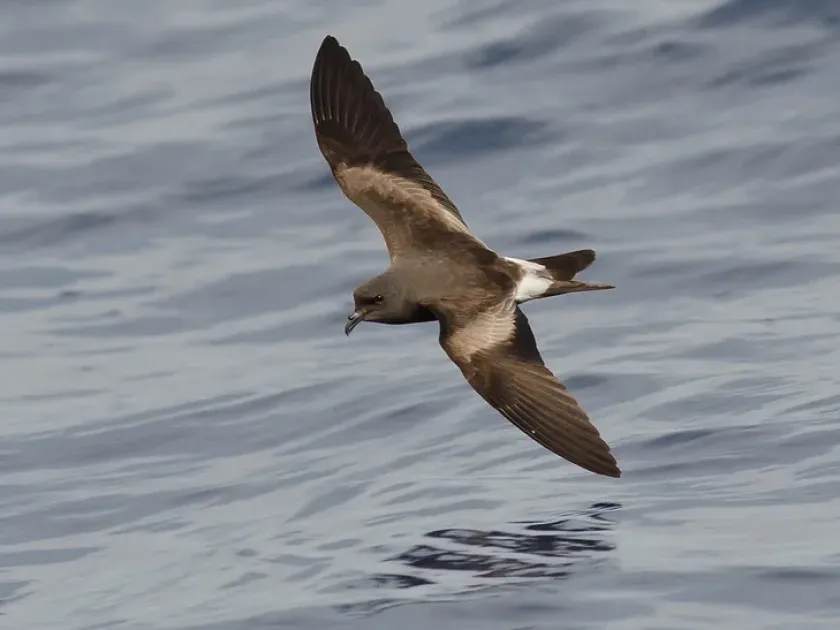
Description
How to identify
The Leach's storm petrel, scientifically known as Oceanodroma leucorrhoa, is a small seabird belonging to the order Procellariiformes and the family Hydrobatidae.
The species is characterized by its dark plumage, a distinctive white rump patch, and a deeply forked tail, which helps distinguish it from other petrels.
These birds are adapted to life over the open ocean, with specialized wings designed for efficient soaring and flight above the water surface.
They are primarily nocturnal at their nesting sites, which makes them difficult to observe in their colonies during the daylight hours.
The Leach's storm petrel is a marine-dependent species that spends most of its life cycle far from terrestrial environments.
What it damages
The Leach's storm petrel is not an agricultural pest; it has no impact on crops, orchards, or stored agricultural products.
Its diet consists strictly of marine organisms such as planktonic crustaceans, small fish, and cephalopods caught at sea.
Since the species does not interact with agricultural plants or human food supplies, it causes no damage to farming operations.
The classification of this bird as a pest is biologically inaccurate and is not supported by agricultural or ornithological studies.
There is no economic damage associated with this bird, as it never feeds on land-based crops or vegetation.
When it appears
The breeding season for the Leach's storm petrel occurs during the spring and summer months on rocky offshore islands.
Outside the breeding period, these birds are nomadic, ranging widely across the Atlantic and Pacific Oceans in search of food.
Migration routes are strictly over marine environments, ensuring there is no overlap with agricultural lands.
Their life cycle is governed by marine food availability rather than seasonal planting or harvesting activities.
As such, there is no temporal overlap between the presence of these birds and the agricultural production cycle.
Signs of infestation
There are no signs of Leach's storm petrel activity in agricultural settings, as they only burrow in coastal island soils.
Damage symptoms usually attributed to agricultural pests, such as leaf consumption or fruit loss, cannot be caused by this species.
Any observations of bird damage on farms should be attributed to local terrestrial species, not oceanic petrels.
The ecological niche of the Leach's storm petrel is confined to the marine ecosystem, far removed from agrarian activity.
Agricultural monitoring programs do not need to account for this species, as it leaves no trace in inland farming systems.
Control measures
No pest control measures are necessary for the Leach's storm petrel, as it is a protected marine species and not an agricultural pest.
Conservation efforts are often in place to protect their nesting habitats from invasive land-based predators.
Farming practices should focus on managing actual pests, as the Leach's storm petrel poses no threat to crop yield or health.
Promoting ecological balance involves recognizing that species like the Leach's storm petrel are neutral to human agriculture.
Farmers are encouraged to support biodiversity, ensuring the safety of non-harmful wildlife that does not interfere with production.
Taxonomy
- Latin name
- Oceanodroma leucorrhoa
- Family
- Hydrobatidae
- EPPO code
- OCEDLE
Discussion
No discussions yet — be the first.