
Wilson's storm petrel
Oceanites oceanicus
Description
How to identify
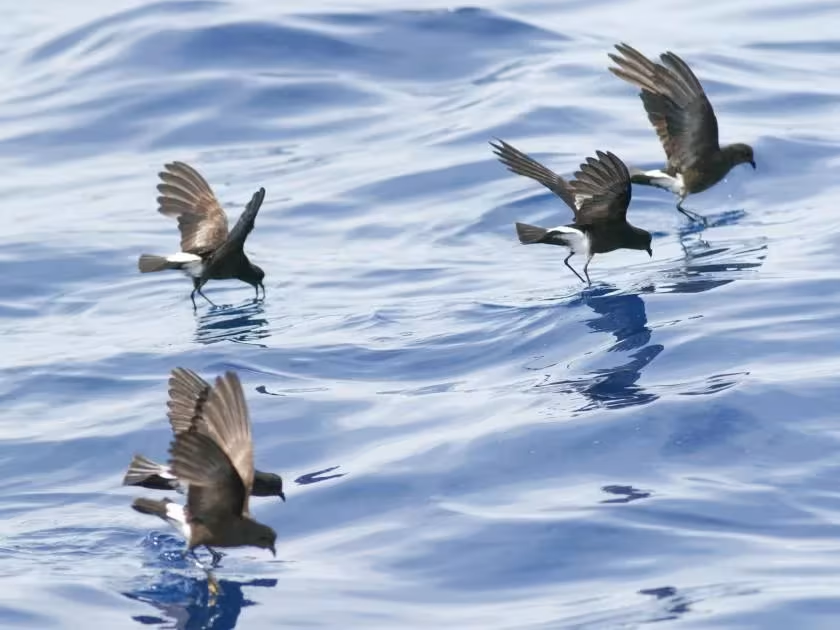
Wilson's storm petrel (Oceanites oceanicus) is a small seabird belonging to the order Procellariiformes and the family Oceanitidae. It is widely recognized as one of the most abundant bird species in the world.
The bird has a distinct dark-brown plumage and a noticeable white rump patch, which is visible during flight. Its average length is about 15–19 cm with a wingspan of approximately 40 cm.
These petrels have long legs with webbed feet, which they use to «walk» on the water surface while feeding on small prey. They are strictly maritime, rarely coming to land except to breed in burrows or rock crevices.
They are primarily found in the Southern Ocean, nesting on Antarctic and sub-Antarctic islands. Their migratory patterns take them across vast open oceans, keeping them away from mainland agricultural zones.
Their biology is perfectly adapted to the marine environment. They possess specialized glands to process salt water and feed on plankton, small crustaceans, and tiny fish.
What it damages
Wilson's storm petrel is not an agricultural pest. It has absolutely no interest in land-based crops, seeds, or vegetation, and thus cannot be classified as a threat to farming or horticulture.
The species does not consume leaves, fruits, stems, or roots. It is entirely excluded from the category of animals that negatively impact agricultural yield or plant health.
There is no mechanism through which this species could cause damage to farm infrastructure or crops. Their presence in the wild is vital for marine ecosystem health and offers no risk to farmers.
Any concerns regarding potential crop damage by this species are scientifically unfounded. Wilson's storm petrel is a marine inhabitant that poses zero risk to terrestrial food production.
Agro-ecosystem management programs should ignore this species entirely, as it occupies a completely different ecological niche than farm pests.
Control measures
Control measures are neither necessary nor appropriate for Wilson's storm petrel. Since the bird does not cause damage, no intervention or deterrence strategy is required.
The species is protected under various international environmental laws and conservation treaties. Any attempt to disturb, harm, or interfere with these birds is strictly prohibited and unnecessary.
In the unlikely event that an individual bird is found near agricultural facilities, it should be treated as a displaced wildlife individual and not as a pest to be eradicated.
Farmers are advised to prioritize the management of actual pests that directly affect production, such as invasive insects, mites, or weeds, rather than targeting neutral seabird species.
Ecological best practices encourage the preservation of natural biodiversity, which includes ensuring that harmless seabirds are left undisturbed in their natural migration paths.
Taxonomy
- Latin name
- Oceanites oceanicus
- Family
- Hydrobatidae
- EPPO code
- OCENOC
Discussion
No discussions yet — be the first.