
Canna leaf roller
Nymphula cannalis
Description
How to identify
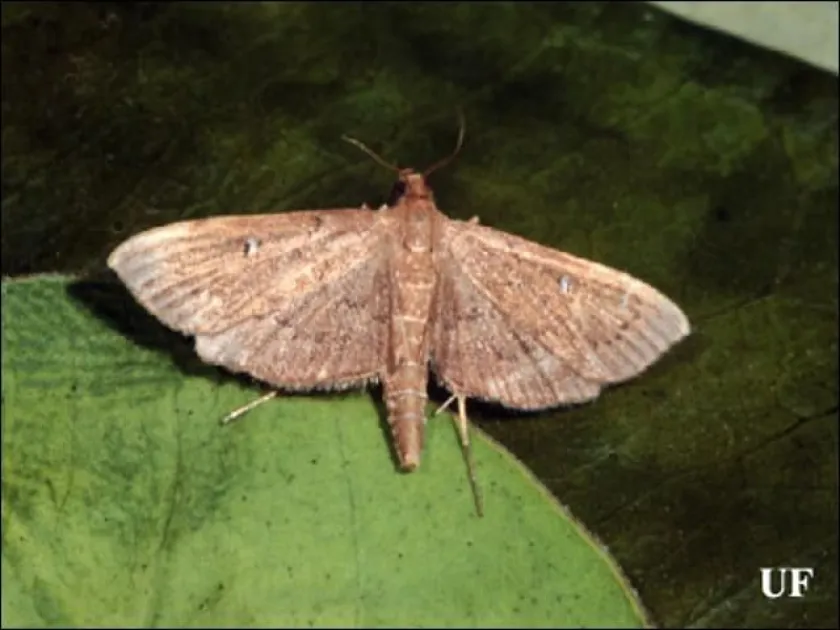
The Canna leaf roller (Nymphula cannalis) is a specialized pest that specifically targets plants of the Canna genus. The adult insect is a small moth with a wingspan of approximately 20–25 mm.
The wings of the moth typically feature a brownish-gray coloration with subtle darker cross-bands and lighter spots. Their slender bodies and well-developed antennae are characteristic of the Crambidae family.
The larvae, or caterpillars, undergo several developmental stages, transitioning from a pale green color to a yellowish-brown hue as they mature. Their dark head capsule serves as a reliable marker for identification.
The lifecycle of this moth is highly dependent on humidity levels. Peak activity and reproduction occur during warm periods with high air humidity, which provides optimal conditions for egg development.
Female moths prefer to lay their eggs on the underside of young, succulent leaves, effectively shielding the larvae from harsh direct sunlight and most airborne predators.
What it damages
The caterpillars primarily feed on the tender, expanding foliage of Canna lilies. This feeding pattern often leads to significant leaf deformation as the plant continues to grow.
Larvae graze on the leaf epidermis, creating characteristic "windows" or irregular holes. In severe cases, they may consume the entire leaf lamina, leaving only the primary veins intact.
This feeding behavior drastically reduces the photosynthetic surface of the plant, leading to stunted growth. When infestations reach high levels, the plant's aesthetic value is completely compromised.
Caterpillars often spin silk threads to roll or fold the leaf edges, creating protected enclosures where they can feed safely. These shelters also shield them from contact insecticides.
Beyond the foliage, larvae may also feed on developing flower buds, resulting in poor blooms or blossoms that fail to unfurl, thereby ruining the plant's primary ornamental purpose.
When it appears
The first generation of adults emerges in late spring or early summer, triggered by rising soil and air temperatures that allow the insects to break their pupal diapause.
Activity usually peaks mid-summer, coinciding with the rapid vegetative growth and blooming period of the Canna plants, which offers a plentiful food supply for the larvae.
Throughout the growing season, the Canna leaf roller can complete multiple generations, necessitating continuous monitoring and control measures to prevent a population explosion.
As temperatures begin to drop in the autumn, the moth population declines, and individuals seek out overwintering sites within plant debris or in the soil near the base of the host plants.
Early-season monitoring is crucial, as the most significant damage occurs when caterpillars attack young, developing leaves immediately after the plants are set out in the garden.
Signs of infestation
The primary symptom of an infestation is the presence of rolled or folded leaves, often secured with fine silken threads that indicate the caterpillar's activity inside.
Visible "window-pane" marks on the leaf surfaces, which eventually degrade into holes, serve as a clear indication that larvae are actively feeding on the plant tissue.
The presence of fine, dark granular frass (excrement) deposited on the leaves or tangled within the silk webbing is a definitive sign of an active caterpillar population.
Adult moths are nocturnal and may be seen flying around the host plants at dusk. Their attraction to artificial light sources is a common method for detection using light traps.
Withered or distorted buds that fail to open properly are often a result of larvae feeding on the developing flower parts, serving as a secondary indicator of severe infestation.
Control measures
Cultural control involves maintaining a weed-free garden surrounding the Canna beds, as secondary hosts may serve as a refuge for the pest during the off-season.
For minor infestations, manual removal of rolled leaves and caterpillars is a simple and effective way to reduce the immediate threat to your plants.
Biological control methods, such as applying Bacillus thuringiensis, are highly effective against larvae while remaining safe for beneficial insects and garden biodiversity.
Chemical control may be necessary in cases of heavy infestation, utilizing systemic or contact insecticides applied directly to the foliage, especially the undersides of the leaves.
- Always spray during cooler evening hours to avoid plant burn and evaporation.
- Rotate between different classes of insecticides to prevent the development of pest resistance.
- Ensure thorough coverage of the leaf undersides where caterpillars hide.
- Keep plants well-hydrated and fertilized to improve their natural resilience against insect feeding.
Taxonomy
- Latin name
- Nymphula cannalis
- Order
- Lepidoptera (butterflies)
- Family
- Crambidae
- EPPO code
- NYMHCA
Discussion
No discussions yet — be the first.