
Brown-tail moth
Nygmia xanthomela
Description
How to identify
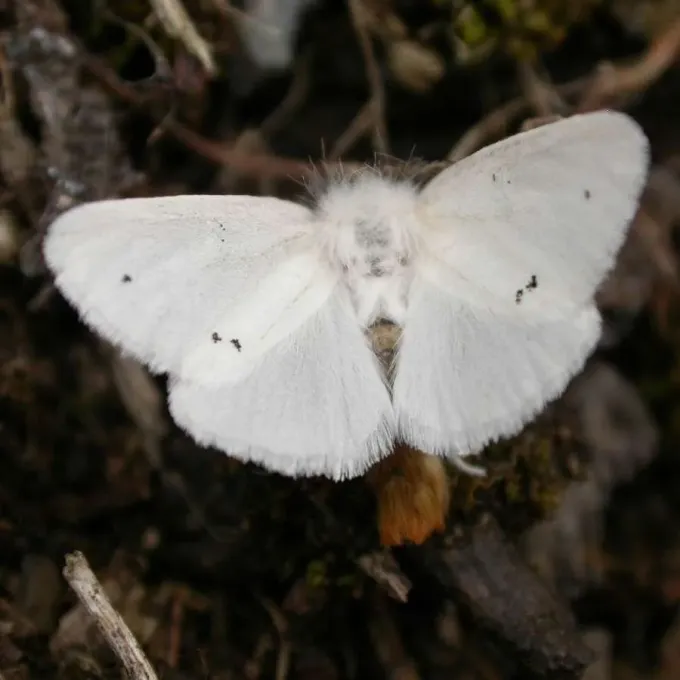
The brown-tail moth (Euproctis chrysorrhoea) is a moth of the family Erebidae. The adult moth features pure white wings with a wingspan of up to 40 mm, and the female is easily recognized by a prominent tuft of golden-brown hairs at the end of her abdomen.
The larvae, or caterpillars, are dark brown with reddish-brown broken stripes running down the sides. They are covered in dense, microscopic stinging hairs that contain toxins, which can cause severe skin irritation, rashes, and respiratory issues in humans who come into contact with them.
What it damages
This pest is highly polyphagous, meaning it feeds on a wide variety of deciduous trees and shrubs. In orchards, it causes significant damage to apple, pear, cherry, plum, and apricot trees by consuming large quantities of foliage.
Beyond fruit trees, the brown-tail moth infests forest trees like oak, hawthorn, and elm. Defoliation caused by large populations of these caterpillars can severely stress the host trees, reducing their growth rates and making them susceptible to other secondary diseases and pests.
When it appears
The brown-tail moth overwinters as larvae within communal silken webs, known as winter tents, attached to the twigs of host trees. In early spring, as temperatures rise, the caterpillars emerge from these nests to feed on emerging buds and young leaves.
Adult moths emerge and fly during the summer months, typically in June and July. After mating, females lay eggs on the undersides of leaves and cover them with protective hairs. A new generation of larvae hatches in late summer, feeds briefly on leaves, and constructs new winter nests.
Signs of infestation
The most reliable sign of a brown-tail moth infestation is the presence of silk tents on the outer branches of trees. These nests are often visible during winter and early spring when deciduous trees are bare, appearing as tough, grey-brown webs containing dried leaves.
During the growing season, visual symptoms include skeletonized leaves where the larvae have eaten the tissue between the veins. As the caterpillars mature, they consume the entire leaf blade, leaving only the main veins behind, which gives the tree a ragged, brown appearance.
Control measures
The most effective management strategy is the mechanical removal of winter nests. During the winter months, pruning off these silken webs and burning them is a highly successful way to drastically reduce the caterpillar population for the following season.
If an infestation is widespread, biological or chemical insecticides may be necessary. Treatments are most effective when applied early in the spring when the young caterpillars emerge and begin feeding, as they are then most susceptible to control measures.
Taxonomy
- Latin name
- Nygmia xanthomela
- Order
- Lepidoptera (butterflies)
- Family
- Erebidae
- EPPO code
- EUPRCA
Discussion
No discussions yet — be the first.