
Nitidinea
Nitidinea
Description
How to identify
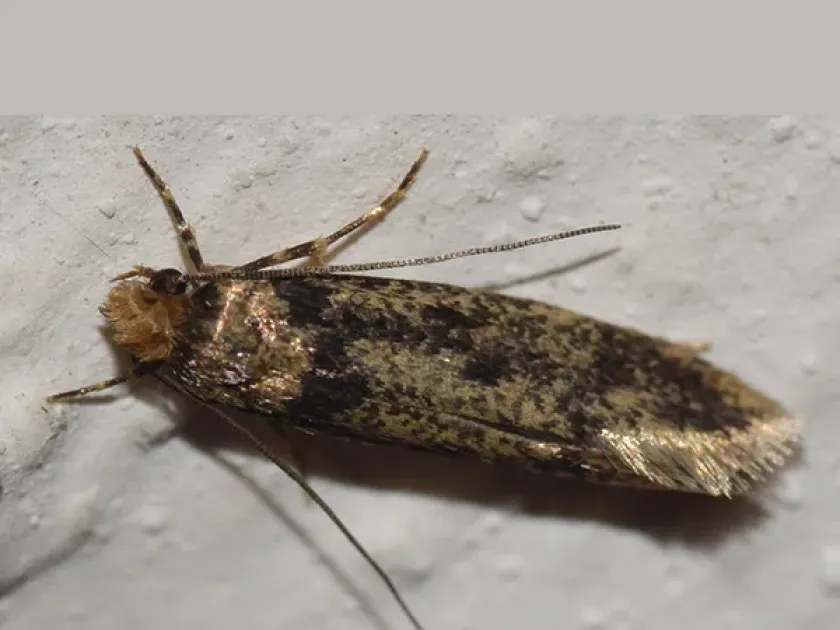
Nitidinea is a genus of small moths belonging to the Tineidae family. Adult moths possess a discreet coloration that serves as effective camouflage on tree bark or leaf surfaces.
The body of the imago is covered in dense scales, and the wings feature a characteristic pattern for the family, dominated by gray, brown, and yellowish shades. The head is equipped with well-developed maxillary palps.
Larvae (caterpillars) are the primary destructive stage of the life cycle. They feature a cylindrical body and a chitinized head capsule adapted for feeding on plant tissues or organic debris.
The insect undergoes a complete metamorphosis: egg, larva, pupa, and imago. Field identification is often challenging due to the larvae's cryptic lifestyle in the early stages of development.
For accurate species identification in laboratory settings, agronomists analyze the genitalia of adult specimens, as wing morphology can be similar to other members of the Lepidoptera order.
What it damages
The main host plants for the Nitidinea genus are forest species and agricultural crops, particularly fruit and berry orchards.
Caterpillars can damage bark, buds, and the primary tissues of young shoots, which leads to a weakening of the plant's overall immunity and a reduction in photosynthetic activity.
The damage caused by this pest opens pathways for secondary fungal and bacterial infections, significantly complicating the phytosanitary conditions in the orchard.
Significant economic losses occur during mass outbreaks when caterpillars shift to the plant's reproductive organs, destroying blossoms and fruit sets.
In nursery settings, the pest can cause irreversible damage to young seedlings, leading to deformation and potential death in the absence of timely intervention.
When it appears
The activity of the pest is directly correlated with the temperature regime of the growing season.
The first appearance of imagines is observed in late spring, when the average daily temperature consistently exceeds the 12-15 degree Celsius threshold.
Maximum egg-laying intensity coincides with the period of active sap flow and bud break in most garden crops.
During the season, Nitidinea may produce several generations if climatic conditions facilitate rapid larval development.
The pest overwinters as a pupa or early-instar larva, seeking shelter in bark crevices, plant debris, or the top layer of the soil.
Signs of infestation
The primary sign of infestation is the presence of larval frass (excrement) accumulating at damage sites on the bark or at the base of leaf petioles.
A characteristic symptom is the presence of small entry holes on the surface of young shoots, surrounded by darkened tissue areas.
- Premature yellowing and curling of leaves.
- Presence of silk webbing in areas of larval aggregation.
- Desiccation of apical buds.
- Deformation of bark in areas of larval feeding.
When inspecting plantations, attention should be paid to the condition of the trunk base and soil, where cocoons are often found during the pupation period.
Control measures
The protection system includes a complex of agrotechnical, biological, and chemical measures to keep the population at a safe level.
Agrotechnical measures consist of regular sanitary pruning, removal of damaged shoots, and destruction of plant debris where pests overwinter.
The biological method involves the use of entomophages and specialized microbiological preparations that target early-instar larvae.
Chemical control is performed during the period of mass egg hatching using systemic and contact insecticides.
A crucial element is the installation of pheromone traps to monitor population levels and make timely decisions regarding orchard spraying.
Taxonomy
- Latin name
- Nitidinea
- Order
- Lepidoptera (butterflies)
- Family
- Tineidae
- EPPO code
- NITDSP
Discussion
No discussions yet — be the first.