
Cottony maple scale
Neopulvinaria innumerabilis
Description
How to identify
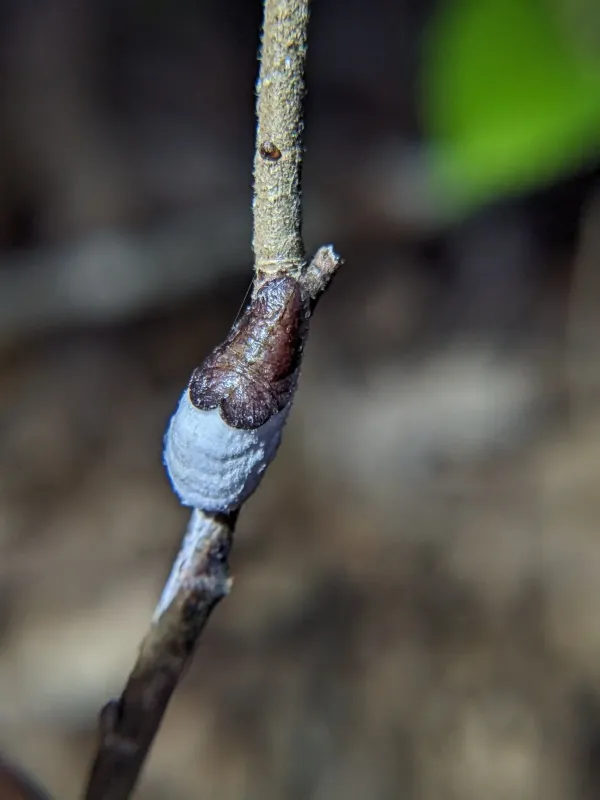
The cottony maple scale (Neopulvinaria innumerabilis) is a prominent member of the Coccidae family, commonly known as soft scales. They are well-recognized by the cottony, white egg sacs produced by females during the reproductive stage.
Adult females are brown, convex, and relatively immobile. Once they attach to a branch or leaf vein, they remain stationary, focusing their energy on producing eggs protected by the characteristic white ovisac.
The crawlers, or young nymphs, are small, yellowish-brown, and mobile. They hatch from the eggs and migrate to the underside of leaves or onto new twigs, where they settle to begin feeding on plant sap.
This species often reproduces parthenogenetically, meaning that females do not require mating to produce viable eggs, which allows colonies to expand rapidly on a single host tree.
Although males exist, they are rarely observed in the field, as the life cycle is dominated by the female's reproductive activity throughout the growing season.
What it damages
This pest affects a wide variety of deciduous trees, including maples, elms, poplars, and various fruit trees such as apple and pear. It is particularly notorious for causing distress in urban forestry.
As the insects feed on plant sap, they remove vital nutrients, leading to reduced vigor and stunted growth. Heavy infestations can cause significant branch dieback and weaken the tree's immune system.
By extracting large volumes of sap, the scale insects significantly reduce the tree's ability to cope with environmental stressors like drought, making the host more susceptible to secondary diseases.
The aesthetic damage is also considerable, as the presence of white egg sacs and honeydew leads to a decline in the tree's visual appeal, which is critical in landscaping and municipal parks.
In nurseries, infestation can result in significant economic loss, as young, weak trees may fail to reach marketable standards due to persistent scale pressure.
When it appears
The insect overwinters as second-instar nymphs in crevices of the bark. As temperatures rise in early spring, they resume feeding and migrate towards the developing branches.
The most distinctive stage occurs in late spring to early summer when the females develop the white, cotton-like egg sacs. This is when the infestation becomes most apparent to observers.
Crawlers usually emerge in early to mid-summer. This period is the most active phase of the life cycle, as young nymphs spread across the canopy to establish new feeding sites.
Throughout the remainder of the summer, the nymphs continue to feed and mature. They pass through various developmental stages while attached to the host tissue.
As autumn approaches and temperatures drop, the scales settle into their overwintering sites, preparing to survive the cold months on the host branches.
Signs of infestation
The most obvious sign of an infestation is the appearance of white, cottony masses on the undersides of branches or leaf petioles, resembling small bits of cotton wool.
The production of honeydew is a common indicator. This sticky, sugary liquid coats leaves and branches, often leading to the growth of a black, sooty mold fungus.
A heavy presence of ants and wasps on the tree trunk is a strong signal that scale insects are present, as these insects are attracted to the sugary honeydew excreted by the scales.
Leaf yellowing and premature leaf drop are common symptoms of a stressed tree. In severe cases, the entire foliage may look thin and chlorotic.
- White, cottony egg sacs on twigs.
- Sticky honeydew residue on leaves.
- Black sooty mold on the canopy.
- Increased ant activity on the bark.
- Early leaf senescence or yellowing.
Control measures
Management begins with cultural practices such as pruning and removing heavily infested branches. This physical removal can significantly reduce the overwintering population.
Systemic insecticides applied when crawlers are active provide the most effective control. Because crawlers are soft-bodied, they are highly susceptible to targeted chemical treatments.
Dormant oil applications in late winter or early spring can be highly effective by suffocating the overwintering nymphs before they become active and move to the new growth.
Encouraging biological control agents like ladybird beetles and parasitic wasps is a sustainable approach, as these predators can naturally keep scale populations in check.
Maintaining tree health through proper irrigation and mulching helps the tree withstand scale feeding and recover more quickly from the nutrient loss caused by the infestation.
Taxonomy
- Latin name
- Neopulvinaria innumerabilis
- Order
- Hemiptera (bugs, aphids, leafhoppers)
- Family
- Coccidae
- EPPO code
- PULVIN
Discussion
No discussions yet — be the first.