
Nemorilla ruficornis
Nemorilla ruficornis
Description
How to identify
Nemorilla ruficornis is a species of fly belonging to the Tachinidae family within the order Diptera. These flies are well-known parasitoids that play a crucial role in regulating insect populations in various habitats.
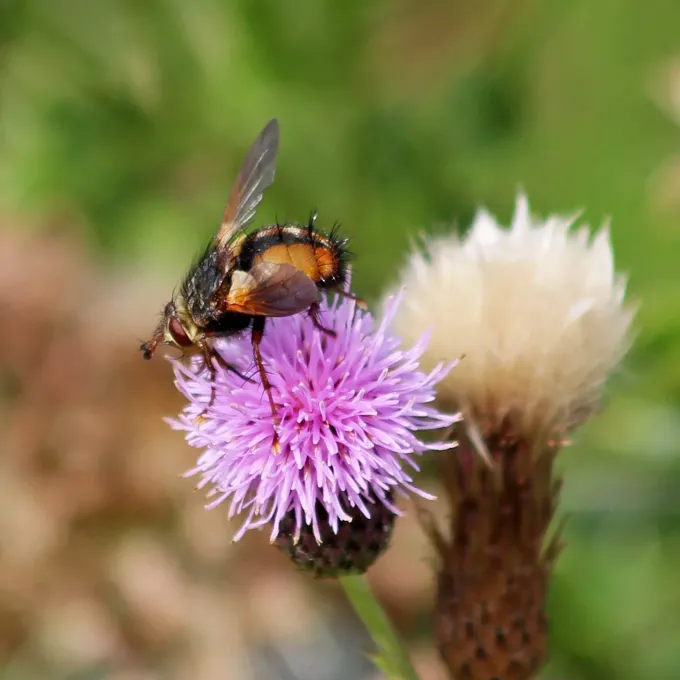
The adult fly typically measures between 6 to 10 millimeters. Its body is covered with dense, dark bristles, and it possesses a robust thorax. The antennae are often reddish or brown, which gives the species its specific epithet ruficornis.
The lifecycle begins when the female adult lays eggs on the cuticle of a host caterpillar or near its feeding site. Upon hatching, the larva bores into the host's body and feeds on internal tissues, eventually killing the caterpillar.
In the field, adults are often seen resting on vegetation or flowers. They are highly active during warm, sunny weather, which corresponds to the peak activity periods of their lepidopteran hosts.
Identification often requires expert analysis of wing venation and abdominal setation, as many tachinid species share similar morphology and can be easily confused in the field.
What it damages
Nemorilla ruficornis is not a plant pest; it is a beneficial insect. It does not feed on plant tissues, flowers, or fruits, and therefore poses no threat to crop yield or plant health.
The actual harm to crops is caused by the caterpillars that Nemorilla ruficornis parasitizes. By preying upon these destructive larvae, the fly acts as a natural biological control agent.
Farmers often misidentify tachinids as pests because they are present on damaged crops. However, their presence is a clear indicator that a natural defense mechanism is currently working against the pest infestation.
Indiscriminate use of broad-spectrum insecticides can eliminate these natural enemies, leading to secondary outbreaks of caterpillars that were previously controlled by the flies.
Integrating Nemorilla ruficornis into pest management programs helps to stabilize the agricultural ecosystem and reduces the overall need for synthetic chemicals.
Control measures
Control measures against Nemorilla ruficornis are neither necessary nor recommended. Instead, the focus should be on conservation biocontrol to enhance their survival and efficacy.
To support populations of Nemorilla ruficornis, it is beneficial to maintain field margins with diverse nectar-producing plants. Access to floral resources is essential for the longevity and fecundity of adult tachinids.
When chemical pest management is deemed necessary, growers should prioritize the use of biorational or selective pesticides that have low toxicity to natural enemies, thereby allowing the parasitoids to survive.
Implementing Integrated Pest Management (IPM) practices, such as monitoring the ratio of parasitized hosts to healthy ones, can help in making informed decisions about whether intervention is truly required.
- Avoid prophylactic spraying of crops.
- Incorporate flowering hedges into the farm landscape to support pollinators and parasitoids.
- Use thresholds based on pest counts before applying any control measures.
Taxonomy
- Latin name
- Nemorilla ruficornis
- Order
- Diptera (flies)
- Family
- Tachinidae
- EPPO code
- NEMLRU
Discussion
No discussions yet — be the first.