
Oak fungus moth
Nemapogon quercicolella
Description
How to identify
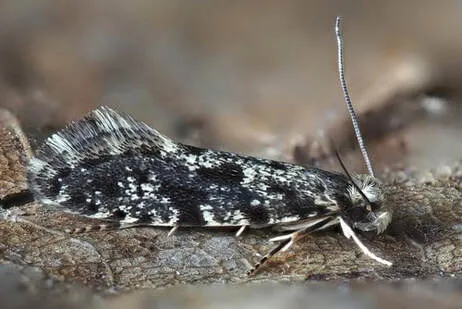
The oak fungus moth is a small member of the family Tineidae, commonly found in oak-dominated woodlands. With a wingspan of roughly 12–15 mm, it possesses a cryptic coloration that blends seamlessly with tree bark.
Adult moths feature narrow, fringed wings characterized by mottled shades of grey and ochre. Their heads are covered in dense scales, a key morphological trait used by entomologists for species identification within the Tineidae family.
Larvae are secretive and inhabit the internal structures of fungi. They are typically whitish with a dark, sclerotized head capsule and well-developed thoracic legs, which they use to navigate through fungal tissue.
This species is strictly mycophagous, meaning it feeds exclusively on fungi, particularly bracket fungi (polypores) that grow on the trunks of oak trees.
The life cycle involves complete metamorphosis, including egg, larva, pupa, and adult stages. Females carefully select oviposition sites on or near fungal growth to ensure larvae have immediate access to food.
What it damages
The larvae primarily feed on the fruiting bodies of bracket fungi found on the trunks of pedunculate oaks, causing significant internal damage to the fungal structure.
While the moth itself does not directly consume healthy wood, its presence often indicates an underlying issue with tree health, as it colonizes trees already weakened by fungal pathogens.
Damage occurs when larvae construct elaborate galleries inside the mushroom tissues, effectively destroying the fungal hymenium and preventing normal spore dispersal.
Severe infestations can accelerate the decay of the fungal fruiting body, turning it into a porous, crumbly mass of waste and silk.
In forestry settings, the presence of these moths is considered an indicator of forest decline and poor stand sanitation that requires silvicultural intervention.
When it appears
Adult moths typically emerge in late spring, usually peaking in May or June, which aligns with the initial growth phase of host fungi.
Depending on local climatic conditions and temperature, the moth may undergo two distinct generations per year, with a second flight period occurring in late summer.
Larval activity is highest during the warmer months, as humidity and temperature levels favor the development of the fungal hosts required for their survival.
The species overwinters as a larva in a silk-lined cocoon, often hidden within the cracks of tree bark or deep inside the remnants of fungal fruiting bodies.
As soon as temperatures rise in the spring, the larvae resume feeding to complete their development and prepare for pupation.
Signs of infestation
The most reliable sign of an infestation is the presence of fine, brown frass (larval excrement) scattered at the base of the tree or on the surface of the bracket fungi.
Fine silken threads or webbing on the surface of the fungi indicate the movement of larvae, which they create for protection against predators.
Internal inspection of the fungi often reveals a network of tunnels packed with organic debris, indicating long-term colonization by the larvae.
Premature drying, deformation, or crumbling of the bracket fungi are common symptoms that the fungal structure has been compromised by the moth.
Using nocturnal light traps is an effective method for detecting adults and monitoring population levels during the peak flight season in forest areas.
Control measures
Effective management focuses on improving forest hygiene, specifically through the removal of trees affected by rot and heavy fungal colonization.
The mechanical removal of bracket fungi from tree trunks can significantly reduce the available breeding grounds and suppress the moth population.
In ornamental and park settings, cleaning wounds and treating damaged bark can help improve tree health and prevent further fungal infection.
Biological control strategies, such as the application of entomopathogenic fungi or bacteria, may be utilized in nurseries to manage larval populations.
- Sanitary removal of infected trees.
- Mechanical removal of bracket fungi.
- Regular inspections of tree trunks.
Taxonomy
- Latin name
- Nemapogon quercicolella
- Order
- Lepidoptera (butterflies)
- Family
- Tineidae
- EPPO code
- TINEQU
Discussion
No discussions yet — be the first.