
Cork moth
Nemapogon cloacellus
Description
How to identify
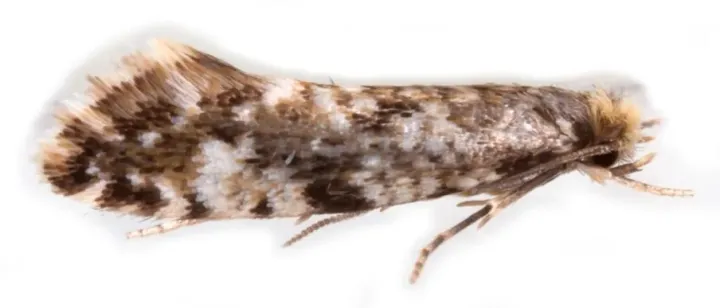
The cork moth (Nemapogon cloacellus) belongs to the Tineidae family of the order Lepidoptera. The adult is a small moth with a wingspan of 10–15 mm, characterized by mottled brown and white wing patterns.
The larvae, which are the main damaging stage, grow up to 10 mm in length. They possess a pale body and a distinct brown head capsule, making them identifiable to trained agronomists.
Pupation occurs within a silken cocoon constructed from debris and mycelial threads, often hidden within the substrate or crevices of the growing structures.
These moths are primarily nocturnal, which often masks the true scale of an infestation during daylight hours when workers are present.
The life cycle is closely linked to ambient humidity and temperature, with development times varying depending on the specific growing conditions of the crop.
What it damages
This species is a significant pest in mushroom farming, particularly affecting cultivated mushrooms such as Agaricus bisporus and various oyster mushroom species.
Larvae feed directly on the mushroom tissue, creating tunnels within the caps and stalks. This significantly degrades the market quality of the mushrooms.
By grazing on the fungal mycelium, the larvae can cause the collapse of the mycelial network, which directly leads to reduced yields across the production cycle.
Beyond direct damage, the moths act as vectors for various microorganisms, including bacteria and other fungi that can cause secondary rot infections.
In stored dried mushrooms, the larvae are considered highly destructive, as they can quickly spoil entire batches by spinning silk and leaving frass behind.
When it appears
In outdoor environments, adult moths are active from late spring through early autumn, taking advantage of favorable temperatures for reproduction.
Within indoor growing facilities, the cork moth can maintain continuous breeding cycles if the temperature remains consistently above 15 degrees Celsius.
High humidity levels, which are standard in mushroom production, create an ideal microclimate for the rapid development of larvae from eggs to pupae.
Peak emergence periods can be monitored using traps, which allows farm managers to schedule sanitation or intervention protocols effectively.
The moth is highly adaptable and can survive in various micro-environments, making it a persistent threat in facilities with poor structural hygiene.
Signs of infestation
Visible boreholes on the surface of mushroom caps are a primary indicator that larvae have infiltrated the fruiting body.
Small amounts of silk webbing found on the surface of the casing soil or growing blocks suggest that the population has established itself.
The sighting of small, mottled moths flying in the vicinity of mushroom beds during twilight or in dark areas is a clear warning sign of infestation.
The accumulation of granular frass on the substrate surface, resembling sawdust or dirt, indicates active larval feeding in the underlying layers.
Any discoloration or thinning of the white mycelium growth on the surface of the blocks often points to larval disruption of the fungal network.
Control measures
Sanitation is the cornerstone of cork moth management. After each production batch, facilities should be thoroughly cleaned to eliminate all fungal debris.
Exclusion strategies, such as installing fine-mesh screens on ventilation ducts, are highly effective at preventing adult moths from entering the facility.
- Using light-based or pheromone traps to monitor and reduce adult moth populations.
- Implementing strict crop rotation and disposal of spent substrate away from the facility.
- Regular disinfection of all surfaces including walls, floors, and equipment.
- Targeted biological control methods using specialized entomopathogens.
Maintaining optimal hygiene and preventing the buildup of organic waste are the best long-term strategies for preventing cork moth outbreaks.
Taxonomy
- Latin name
- Nemapogon cloacellus
- Order
- Lepidoptera (butterflies)
- Family
- Tineidae
- EPPO code
- TINECL
Discussion
No discussions yet — be the first.