
Picture-winged fly
Neaspilota
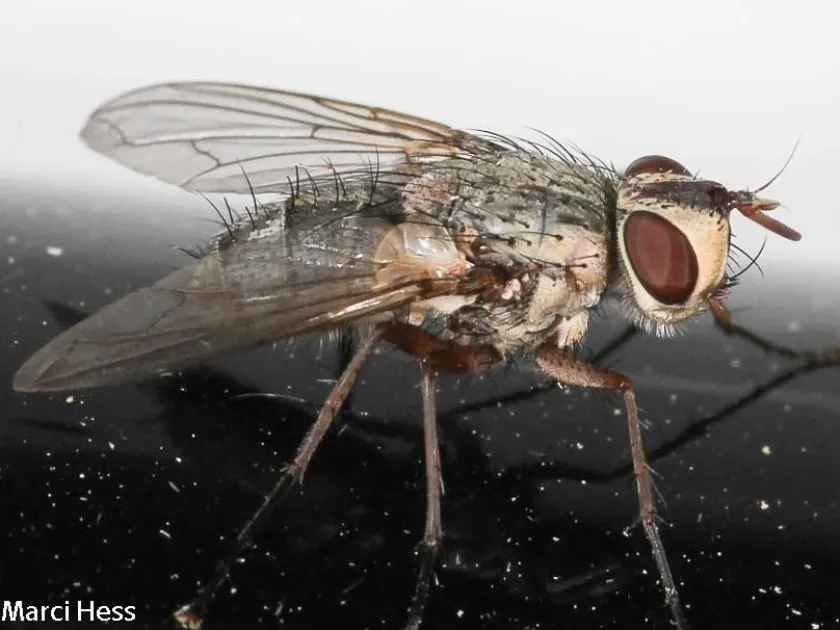
Description
How to identify
The Neaspilota genus belongs to the Tephritidae family, commonly known as picture-winged flies. These insects are distinguished by the intricate, patterned pigmentation on their wings, which serve as a unique identification marker.
Adult flies are generally small, ranging from 3 to 5 mm in length. Their bodies are often covered in fine hairs, and they exhibit colors ranging from yellowish-brown to dark brown, aiding in their concealment among vegetation.
The head features large, prominent compound eyes that are often iridescent. While adult flies feed on nectar and floral secretions, their larval stage is exclusively spent as an internal feeder within plant tissues.
Taxonomically, they are highly specialized to occupy niches within host plants of the Asteraceae family. Their wing venation patterns are key characteristics used by entomologists for precise identification.
The female's ovipositor is a specialized organ capable of piercing dense floral structures, allowing the fly to deposit eggs directly into the developing ovary or floral head of the host plant.
What it damages
The primary hosts for Neaspilota larvae are plants within the Asteraceae family. This includes a wide range of ornamental flowers, commercial crops, and various common weeds that act as reservoirs.
Larval damage occurs internally within the flower heads. The larvae feed on the developing seeds and the floral receptacle, effectively destroying the plant's reproductive potential.
In seed production fields, the economic impact can be significant, as heavy infestation can lead to total loss of seed yield or severely degraded seed quality for the next season.
Externally, damage is manifested by the stunted growth of the flower head, premature petal drop, and a general lack of aesthetic appeal, which is detrimental to ornamental nurseries.
The punctures left by the female during oviposition often serve as entry points for secondary pathogens, including bacteria and fungi, which can lead to rapid rot and decay of the entire flower head.
When it appears
The activity of adult Neaspilota flies is closely synchronized with the flowering phenology of their specific host plants, typically occurring from late spring through the summer months.
Females are active on sunny days, searching for suitable buds for egg deposition. Once the eggs hatch, the larvae bore into the flower head, where they remain protected throughout their development.
Depending on the species and environmental conditions, these flies may undergo multiple generations per year, provided there is a continuous supply of blooming host plants.
Developmental rates are temperature-dependent, with warmer climates accelerating the lifecycle and potentially increasing the total population density during a single season.
Overwintering usually takes place in the soil as a puparium or within plant debris as a dormant larva, ensuring the species survives until the following season's host emergence.
Signs of infestation
Initial signs of infestation are subtle, typically consisting of minute, circular entry punctures on the bracts of the flower buds, which are often overlooked until damage becomes severe.
As larvae develop, the flower head may appear deformed, uneven, or stunted. A common symptom is the failure of the flower to open uniformly or premature browning of the petals.
Careful dissection of the floral receptacle will reveal the presence of creamy-white or yellow apodous larvae, often accompanied by frass and signs of tissue breakdown.
Fungal growth is a frequent secondary sign, manifesting as dark, mushy patches on the exterior of the flower head, resulting from the combination of larval feeding and pathogen colonization.
- pin-sized entry holes on flower buds
- misshapen or asymmetric blooms
- premature wilting of flower heads
- presence of larvae within the seed head
Control measures
Integrated pest management starts with sanitation: removing and destroying host weeds surrounding the crop area is critical to reducing the local population of these flies.
Tillage operations, such as deep plowing in the autumn, can effectively destroy pupae overwintering in the soil, preventing the emergence of the spring generation of adults.
Chemical control should be strategically applied during the pre-blooming phase. Once the larvae are inside the floral head, they are shielded from contact insecticides, making treatment less effective.
Regular inspection and manual removal of infested flower heads in smaller plantings can help keep populations below the economic threshold without the need for intensive chemical use.
Sticky traps and pheromone-based monitoring tools are highly recommended for larger operations to accurately detect the onset of adult activity and time insecticide applications for maximum effect.
Taxonomy
- Latin name
- Neaspilota
- Order
- Diptera (flies)
- Family
- Tephritidae
- EPPO code
- NEAISP
Discussion
No discussions yet — be the first.