
Myrmus miriformis
Myrmus miriformis
Description
How to identify
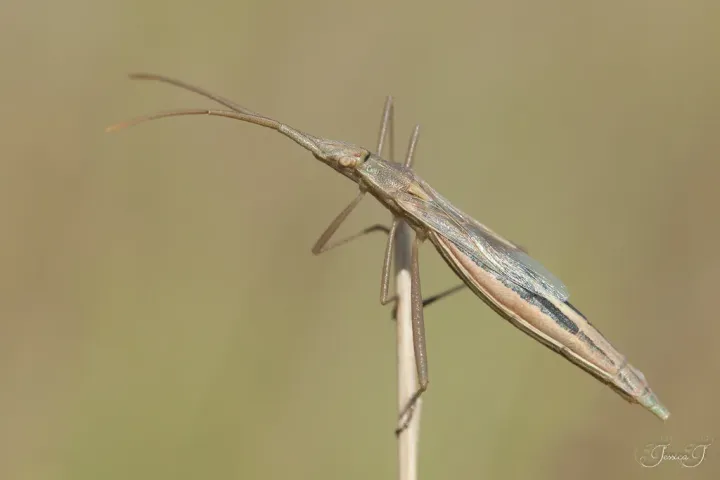
Myrmus miriformis, commonly known as a grass bug, belongs to the family Rhopalidae of the order Hemiptera. The adult insect has an elongated body, typically ranging from 7 to 10 mm in length, with a coloration that mimics the green or straw-colored stems of grasses.
The species exhibits clear sexual dimorphism. Females are generally larger and often possess shortened wings (brachypterous), whereas males are more slender and have fully developed wings, making them more mobile during the breeding season. The head and pronotum are covered in fine, dense hairs.
The insect undergoes incomplete metamorphosis. Nymphs resemble miniature versions of adults but lack wings and reproductive organs. They pass through five instar stages, gradually increasing in size and developing the characteristic coloration of the mature bug.
These insects prefer open habitats with dense vegetation, such as meadows, forest edges, and field margins. Their excellent camouflage allows them to remain hidden among grass stalks, making them difficult to detect without careful observation or the use of sweep nets.
The population density is highly dependent on environmental conditions. Hot and dry summers significantly favor their development, as high temperatures accelerate the nymphal stages, resulting in higher survival rates and larger populations the following year.
What it damages
Myrmus miriformis is a specialized pest that feeds on the sap of various plant species. It primarily targets members of the Poaceae family, including both wild grasses and economically important cereal crops like wheat, barley, and oats.
In agricultural settings, these bugs pose a threat to both winter and spring grain crops. While massive outbreaks are less frequent compared to other grain bugs, their consistent feeding can weaken young plants and reduce the overall vitality of the crop during critical growth phases.
Aside from cultivated grains, the pest utilizes wild grasses as a primary reservoir throughout the season. When grain crops begin to mature and fill their seeds, the bugs move into the fields, attracted by the high nutrient content of the grain heads.
The most significant damage occurs during the seed-filling period. By piercing the plant tissues and extracting sap, the bugs disrupt the flow of nutrients to the head, leading to shriveled grains and reduced yields. This mechanical damage also stresses the plant, making it less resilient.
Affected stems and leaves often lose turgor pressure, turn yellow, and eventually die. In severe infestations, the cumulative damage can lead to a noticeable decrease in the plant's biomass, directly impacting both the quality and quantity of the harvest per unit area.
When it appears
The species overwinters primarily in the egg stage. Eggs are laid on dry stems and leaves of grasses, which provides protection against winter temperatures and ensures that the emerging nymphs have immediate access to a food source when spring temperatures rise.
Nymph hatching typically coincides with the beginning of the active growing season for cereals. This is a critical window for crop management, as the young plants are particularly susceptible to damage during their early stages of growth and establishment.
There is usually one generation per year. Adults emerge in mid-summer and remain active until autumn cooling occurs. During this period, they feed extensively, gather energy, and prepare for the next generation by laying eggs on suitable overwintering sites.
The peak activity of adults usually falls in July and August. They are highly mobile during this time and can migrate between fields in search of the most suitable food sources, which allows the pest to spread rapidly across large agricultural areas.
As autumn progresses, the metabolic activity of the bugs declines. Once the first significant frosts arrive, the adult population dies off, leaving behind the egg-laden crop residues that will survive the winter and restart the lifecycle in the following spring.
Signs of infestation
The primary visual sign of infestation is the appearance of discolored spots on leaves and stems, which later transition into yellow or brown patches. These are the locations where the bug has pierced the plant and extracted cellular fluid, damaging the vascular system.
Early-stage damage can manifest as twisting or curling of the upper leaves. Infested plants may appear stunted or lack the vigor of healthy plants. These differences are often most visible at the edges of fields where the pest first enters the crop.
Direct observation is possible during morning or evening hours when the bugs are most active. Because of their protective coloring, it is often necessary to use a sweep net to confirm their presence and estimate the population density for management decisions.
Secondary signs include the development of opportunistic fungal or bacterial infections. The wounds created by the bug act as entry points for pathogens, further degrading the health of the plant and exacerbating the damage caused by the initial feeding.
A high number of empty or underdeveloped grain heads, particularly if coupled with a visible population of bugs on the stems, is a clear indicator of the pest's negative impact on the reproductive development of the grain crop.
Control measures
The primary method of control is agrotechnical. Deep autumn plowing is highly effective as it buries the plant residues that contain overwintering eggs, ensuring they are destroyed and cannot hatch in the following season, thus preventing the initial infestation.
Crop rotation and weed management are essential components of integrated pest management. Eliminating wild grass species in and around fields removes the bug's primary food source and breeding grounds, significantly reducing their population pressure on crops.
Chemical control should only be implemented when the economic threshold of damage is exceeded. If treatment is necessary, systemic insecticides applied during the peak hatching period can provide effective protection for the young crop against sap-sucking activity.
Regular field scouting is critical for early detection. By monitoring field margins for signs of the pest, growers can identify hotspots and apply localized insecticide treatments, which minimizes the need for whole-field spraying and reduces the impact on beneficial insects.
Biological control involves maintaining a habitat for natural predators such as spiders, ground beetles, and parasitic wasps. By minimizing the use of non-selective broad-spectrum insecticides, farmers can encourage these natural enemies to keep bug populations in check.
Taxonomy
- Latin name
- Myrmus miriformis
- Order
- Hemiptera (bugs, aphids, leafhoppers)
- Family
- Coreidae
- EPPO code
- MRMSMI
Discussion
No discussions yet — be the first.