
Fruit fly (Myopites stylatus)
Myopites stylatus
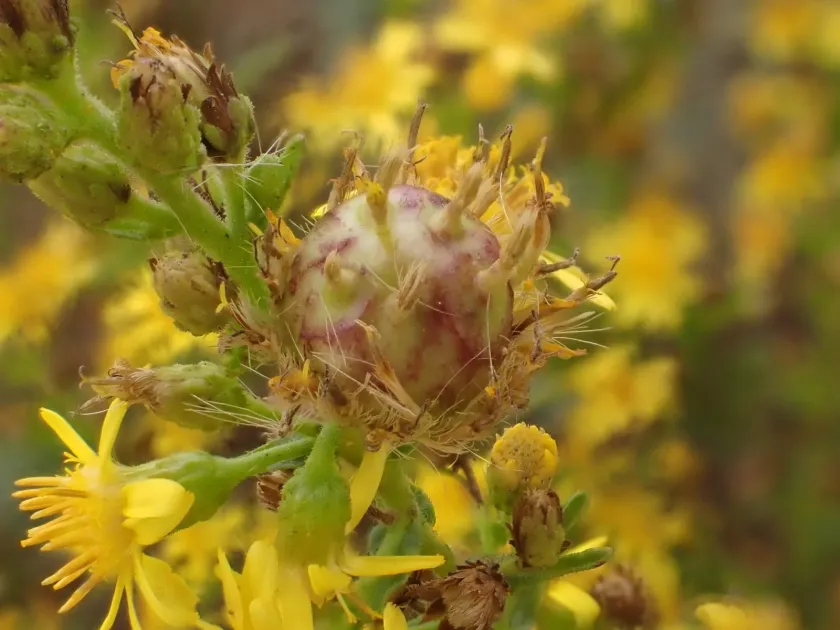
Description
How to identify
Myopites stylatus is a species of fruit fly belonging to the Tephritidae family, recognizable by its wing patterns and distinct body shape.
Adult flies possess a specialized ovipositor designed to penetrate plant tissues, specifically the dense structures of host flowers.
The lifecycle includes distinct stages: egg, larva, pupa, and adult, with the larval stage causing the most visible impact on the host plant.
Identification is primarily based on the morphology of the larvae and the specific type of galls they induce on the host plant.
These insects are highly adapted to their niche, utilizing specific host plants to ensure the survival and development of their offspring.
What it damages
The primary hosts for Myopites stylatus are various species within the Asteraceae family, particularly those in the Inula genus.
Larvae feed internally on the tissues of flower heads, leading to the formation of pathological growths known as galls.
This feeding activity disrupts the plant's nutrient transport and reproductive development, causing stunted growth and deformity.
Severe infestations lead to the failure of seed production, which significantly reduces the yield and quality of the crop.
The internal tissue destruction weakens the plant, making it more susceptible to secondary pathogens and environmental stress.
When it appears
The activity cycle of this pest is strictly synchronized with the phenological stages of its host plants, starting in early summer.
Adult flies emerge during the budding phase, looking for suitable flower heads to deposit their eggs into the developing tissues.
The larval development period lasts throughout the summer months, during which the gall structure provides protection and food.
Overwintering typically occurs in the pupal stage, hidden within the dry remnants of the previously infested plant parts.
The cycle repeats annually, with the emergence of a new generation coordinated with the next season's flowering event.
Signs of infestation
The hallmark sign of an infestation is the presence of swellings or galls on the flower heads or stems of the host plant.
These galls are easily identified by their abnormal, thickened tissue texture that contrasts sharply with healthy plant parts.
Openings in the flower heads or malformed petals are early indicators of internal pest presence and ongoing tissue damage.
Observing the plant's reproductive output, one may notice missing or poorly developed seeds, which is a sign of larval feeding.
Wilted flower heads or premature browning of the buds are strong indicators that larvae are actively consuming the plant's interior.
Control measures
Cultural practices, specifically the removal and destruction of post-harvest crop residues, are essential to break the lifecycle.
Monitoring fields during the early flowering stage helps in identifying and culling infested plants before larvae mature.
Biological control, including the encouragement of natural predators that parasitize larvae, can provide sustainable population suppression.
Chemical intervention should be considered as a last resort, targeted at the adult fly stage to prevent egg-laying in the buds.
- Maintaining clean borders around fields to reduce reservoirs of host plants.
- Using crop rotation to avoid planting susceptible species in the same area consecutively.
- Prompt mechanical disposal of all galled plant parts during the growing season.
Taxonomy
- Latin name
- Myopites stylatus
- Order
- Diptera (flies)
- Family
- Tephritidae
- EPPO code
- MYPIST
Discussion
No discussions yet — be the first.