
Limbarda fruit fly
Myopites limbardae
Description
How to identify
The Limbarda fruit fly (Myopites limbardae) is a species within the Tephritidae family, also known as fruit flies, order Diptera. It is a highly specialized species that interacts closely with specific host plants.
Adult flies are small, usually measuring between 3 to 5 millimeters in length. Their wings feature a distinct, mottled pattern, which is characteristic of the Tephritidae family.
The coloration of the body typically ranges from yellow to brown, providing effective camouflage while they are perched on the flowers of their host plants.
The larvae are cylindrical and creamy-white in color. They are rarely seen on the surface of the plant because they spend their entire development cycle inside the plant tissue.
Pupation occurs within the galls formed by the larvae, providing a stable and protected environment that shields the developing insect from predators and environmental stress.
What it damages
The primary host plant for Myopites limbardae is Dittrichia viscosa (also known as Inula viscosa). This species is predominantly found in the Mediterranean region.
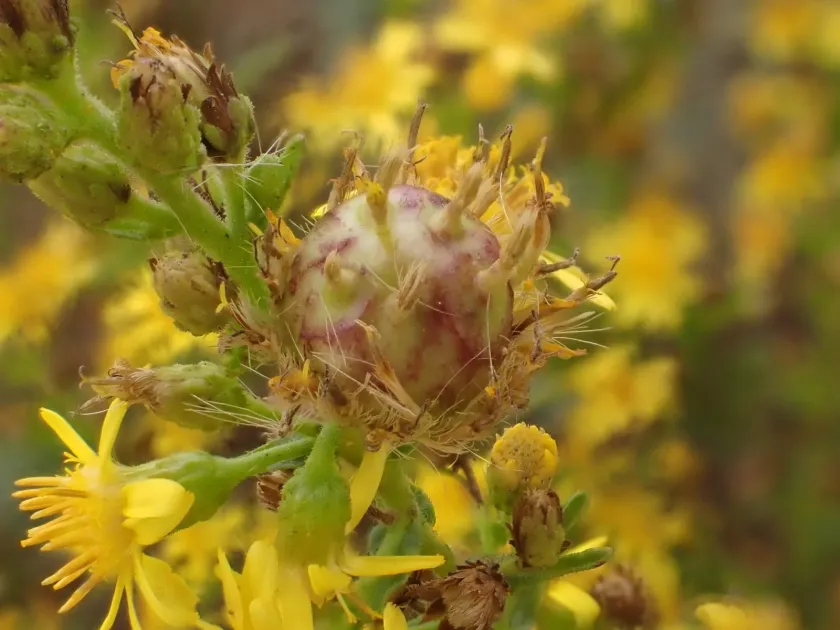
Larval feeding stimulates the plant to form pathological growths known as galls, usually located on the flower heads. These galls interfere with the normal development of the plant's reproductive organs.
The most significant impact of this pest is the reduction of seed production. Infested flower heads often fail to develop viable seeds, hindering the natural regeneration of the host plant.
In cases of high infestation, the architecture of the plant can be severely compromised, leading to stunted growth and reduced vigor in the affected area of the plant.
While often acting as a natural regulator of specific weeds, in a cultivation context, these flies can cause economic losses if the host plant is being managed for harvest or biodiversity purposes.
When it appears
The life cycle of the Limbarda fruit fly is strictly synchronized with the flowering phenology of its host plant, ensuring that larvae have immediate access to food upon hatching.
Adults emerge in late spring or early summer. Following mating, females deposit their eggs directly into the developing flower buds, initiating the gall formation process.
Depending on local environmental conditions and temperature, the species can complete multiple generations within a single growing season.
The fly typically overwinters in the larval or pupal stage inside the dried galls on the stems of the previous season’s host plants.
Emergence in the following season is carefully timed to coincide with the budding phase, allowing the cycle of infestation to restart efficiently.
Signs of infestation
The most reliable sign of an infestation is the presence of abnormal swellings or galls on the flower heads or stems of the host plant.
Infested buds often become discolored, pale, or brownish and fail to bloom. Upon dissection of the gall, one may find the larvae or pupae of the fruit fly.
- Presence of hard, irregular galls on flower buds.
- Failure of seeds to develop in infested flower heads.
- Premature wilting and drying of individual flower stalks.
- Observation of small, mottled-winged flies on plant foliage.
Any asymmetrical development of the buds should be treated as a potential indicator of infestation and warrants closer inspection for the presence of the pest.
Control measures
The most effective management strategy involves the removal and destruction of host plant debris, where the overwintering larvae and pupae reside.
Strategic mowing or pruning of infested Dittrichia viscosa populations before the new generation of adults emerges can significantly reduce the local population density.
Chemical control is rarely effective because the larvae are sequestered within the woody or thickened tissue of the galls, limiting the exposure to insecticides.
Biological control, focusing on native parasitoid wasps that target these larvae, is often the most sustainable and successful approach in natural settings.
Monitoring using yellow sticky traps is recommended to track adult activity and ensure that management actions, such as debris removal, are timed correctly.
Taxonomy
- Latin name
- Myopites limbardae
- Order
- Diptera (flies)
- Family
- Tephritidae
- EPPO code
- MYPILI
Discussion
No discussions yet — be the first.