
Bean bug
Mirperus jaculus
Description
How to identify
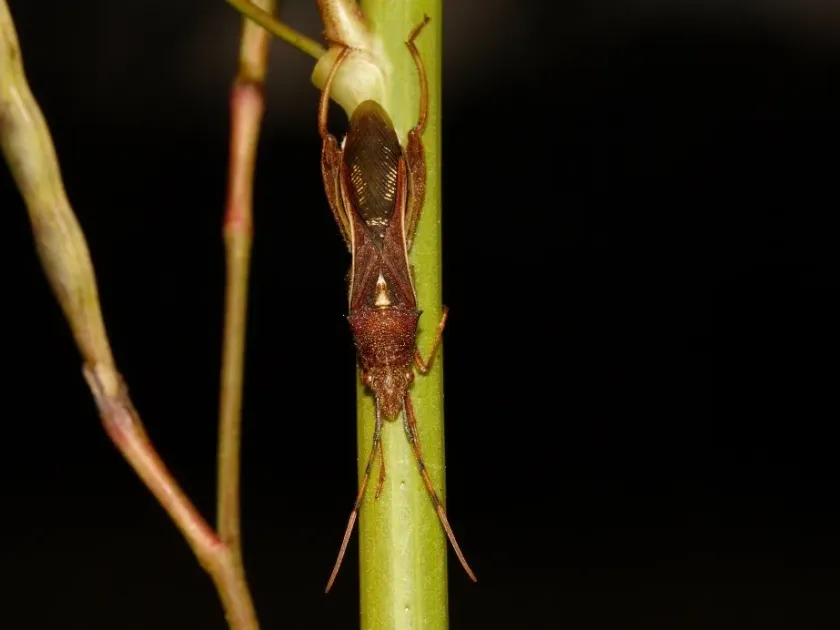
The bean bug (Mirperus jaculus) belongs to the Alydidae family of the order Hemiptera. Adult specimens typically have an elongated body, measuring between 10 and 15 mm, with coloration ranging from grayish-brown to dark brown.
A distinguishing feature of this insect is its narrow head and the specific structure of the hind legs, which is characteristic of most members of the Alydidae family. These bugs possess well-developed wings, enabling them to travel significant distances in search of host plants.
Nymphs of this pest resemble ants, especially in their early developmental stages, which is a classic example of mimicry. As they mature, they acquire features characteristic of the adult form while retaining a more rounded body shape.
The eggs of the bean bug are most commonly laid individually or in small clusters on the surfaces of leaves or stems of host crops. The egg surface is smooth, and the color varies from light cream to brownish.
This species is a typical representative of the entomofauna that prefers warm regions, where high solar activity is observed during the vegetative period of agricultural plants.
What it damages
The primary damage is inflicted on leguminous crops, including beans, soybeans, peas, and various vetch species. Adults and nymphs feed on plant sap by piercing the delicate tissues of young shoots and reproductive organs with their piercing-sucking mouthparts.
The most sensitive stages to infestation are budding and pod formation. Damage to generative organs leads to flower/pod drop, seed deformation, and reduced germination potential in the future.
Mass reproduction of the pest results in stunted plant growth, which significantly reduces the marketable yield of leguminous crops. Often, damaged areas become entry points for secondary infections, including fungal and bacterial pathogens.
Damage is also manifested in premature yellowing and wilting of the foliage located directly adjacent to the puncture sites. The plant loses a significant amount of nutrients, which directly impacts the thousand-kernel weight.
The economic impact of Mirperus jaculus increases in drought years, as weakened plants become more attractive for bug feeding due to higher concentrations of sugars and amino acids in the sap.
When it appears
Adults (imagines) overwinter in leaf litter, under plant debris, or in soil crevices near fields. With the onset of stable spring warmth, the bugs emerge from their overwintering sites and begin an active search for available host plants.
Mass emergence of the pest in fields coincides with the beginning of active vegetation of leguminous crops. The life cycle includes passing through several nymphal stages, the total duration of which depends on the ambient temperature regime.
The peak of activity and the highest population density occur in the second half of summer, when fruit formation is taking place in most legumes. This is the period when the risk of mass crop damage is at its highest.
Depending on the climatic conditions of the region, one to several generations may develop per season. Autumn migration to overwintering sites begins with a decrease in temperature and a reduction in day length.
The biology of Mirperus jaculus is closely tied to the developmental stages of crop plants; therefore, monitoring the population of the bugs must be carried out throughout the entire growing season, especially during the flowering phase.
Signs of infestation
The first visual sign of the pest's presence is the appearance of small, dark dots on the surface of stems and pods at the puncture sites. Zones of chlorosis or tissue necrosis often form around these dots.
When inspecting crops during the day, adults can be detected; when approached or disturbed, they fly away quickly or hide on the undersides of leaves. The use of an entomological net allows for rapid assessment of population density.
The presence of ant-like nymphs on young pods is a critical signal requiring immediate intervention. They usually congregate in leaf axils and at the base of the pods.
If seeds inside the pods are damaged, the pods may lag in growth and become deformed. When pods are opened, characteristic punctures are visible on the grains, which lose their natural luster and may appear spotted.
The general appearance of infested plantings is characterized by a "stunted" look: plants appear weakened, leaf tips may curl, and flowers may drop in mass without forming pods.
Control measures
Agrotechnical measures include deep fall plowing, which destroys the bugs' overwintering sites and reduces the number of adults in the spring. Controlling weeds, especially wild legumes, deprives the pest of food sources before the main crop emerges.
Adherence to crop rotation is an important preventive step, as continuous planting of legumes facilitates the buildup of the pest population in a specific area. Optimal planting dates allow plants to build resistance to pest attacks.
Chemical control is applied when the economic threshold of damage is exceeded. Spraying with systemic insecticides is effective during the formation of generative organs, when the pest is most vulnerable and causes maximum damage.
Biological methods include the use of natural natural enemies, such as egg parasitoid wasps (Telenomus spp.), which can significantly suppress the growth of bug populations. Preserving biodiversity in fields promotes the development of beneficial insect populations.
- Monitoring density using yellow sticky traps.
- Applying pyrethroid-based insecticides during evening hours.
- Regular clearing of field edges from weeds.
Taxonomy
- Latin name
- Mirperus jaculus
- Order
- Hemiptera (bugs, aphids, leafhoppers)
- Family
- Coreidae
- EPPO code
- MIRPJA
Discussion
No discussions yet — be the first.