
Milichiella lacteipennis
Milichiella lacteipennis
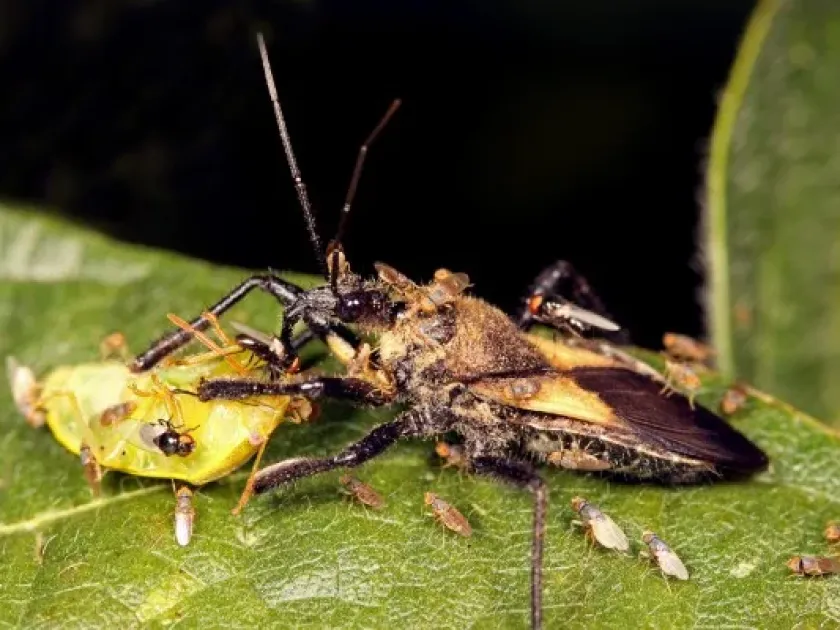
Description
How to identify
Milichiella lacteipennis belongs to the order Diptera and the family Milichiidae. The adult is a small fly characterized by distinctive whitish wing tips, which is a key feature for field identification.
The adult body is typically black with a metallic sheen common to many species in this family. The length of the adult flies rarely exceeds 2 to 3 millimeters.
Larvae of this species are cryptic, typically developing in decaying organic matter or insect excrement, making them difficult to detect during standard plant inspections.
A distinguishing feature of this family is their saprophagous nature; however, under specific conditions, they are associated with damaged or decaying plant tissues.
Identifying this species in field conditions requires sticky traps or suction devices, as the flies are highly mobile and prefer areas with high humidity and decaying organic substrates.
What it damages
This species is not typically a primary aggressive pest that attacks healthy plant tissues, but its role in agroecosystems is linked to secondary damage.
Milichiid flies are attracted to sites already damaged by other pests, such as leaf miners or sap-sucking insects that produce honeydew excretions.
The damage stems from the fly acting as a vector, carrying bacteria and fungal spores on its body and legs, which promotes secondary infections in plant tissues.
The pest poses a significant risk to greenhouse crops and ornamental plants, where high humidity levels facilitate tissue rot, which attracts the adult flies.
Under heavy infestations, flies can contaminate the leaf surface with their excrement, which reduces photosynthetic efficiency and significantly decreases the market value of the produce.
When it appears
Adult activity peaks during the warm season, typically from late spring through mid-autumn in open field conditions.
In greenhouses and indoor cultivation systems, reproduction can occur year-round provided that stable temperatures and a consistent food source are present.
The insect's life cycle is closely linked to temperature: during hot periods, larval development is accelerated, leading to rapid increases in population density.
Population peaks usually coincide with flowering or fruiting stages of crops, when organic secretions and plant exudates are most abundant.
The flies are most active during early morning and evening hours, favoring moderately humid areas with poor airflow and ventilation.
Signs of infestation
The first sign of infestation is the presence of small black flies hovering near damaged stems, fruits, or necrotic areas where decay has begun.
Small black specks, which are the insect's excrement, can be observed on leaves; these are difficult to wash off and negatively affect the aesthetics of ornamental plants.
The presence of these flies is often correlated with primary infection centers; if a plant starts to wilt suddenly, it should be checked for underlying rot.
An indirect sign of their presence is the accumulation of honeydew left by aphids or whiteflies, as milichiids actively feed on these sugary substances.
- Presence of small black flies on fruit surfaces.
- Bacterial spots or necrosis at puncture sites.
- Excrement spots visible on leaf blades.
Control measures
The primary control method is strict sanitation, which involves the removal of all plant debris, damaged tissues, or decaying organic material from the crop area.
Regulating humidity in greenhouses and organizing effective ventilation significantly reduces the attractiveness of the site for this pest.
The use of yellow sticky traps allows for the monitoring of adult populations and provides an early warning system for sudden increases in activity.
Biological control agents based on entomopathogenic fungi can be used to help suppress larval populations within the soil or growing substrate.
Chemical control with insecticides is recommended only during severe outbreaks, as the primary protection strategy should focus on eliminating favorable conditions for their reproduction.
Taxonomy
- Latin name
- Milichiella lacteipennis
- Order
- Diptera (flies)
- Family
- Milichiidae
- EPPO code
- MLCHLA
Discussion
No discussions yet — be the first.