
Milichiella
Milichiella
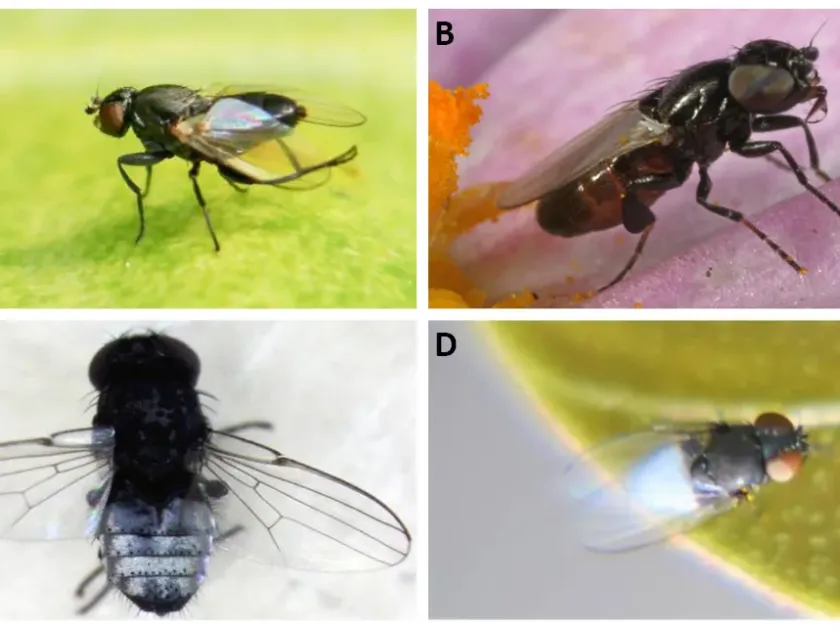
Description
How to identify
Milichiella is a genus of flies belonging to the family Milichiidae within the order Diptera. These are small flies that often go unnoticed due to their tiny size and specific habits.
Adults typically have a dark body coloration, sometimes with a metallic sheen. They possess well-developed wings, allowing them to move actively in search of food sources and oviposition sites.
The larvae possess features characteristic of the family Milichiidae: they live a cryptic lifestyle, developing within decaying organic matter or near damaged plant tissues.
Accurate identification requires the use of specialized entomological keys and microscopic examination of wing venation and body setae.
These insects are often commensals, frequently visiting sites where other insects aggregate or where plant tissues have sustained mechanical damage.
What it damages
Milichiella typically acts as a secondary pest, visiting plant tissues that are already damaged. It is particularly attracted to areas leaking plant sap.
The pest can cause damage by being drawn to honeydew secreted by aphids or scale insects, which indirectly promotes the growth of sooty mold and fungal infections.
It is most frequently encountered in greenhouse vegetable production and on ornamental crops, where the environment favors the decay of organic residues in the substrate.
Damage may affect both vegetative parts and fruits if they have cracks or wounds that exude nutrient-rich fluids.
Economic impact is primarily due to the potential of these flies to act as vectors, spreading spores of pathogenic fungi and bacteria between plants during feeding.
When it appears
The activity of Milichiella is directly dependent on temperature conditions and moisture availability. In open fields, peak activity occurs during the warmer months.
In greenhouses and nurseries, reproduction can occur year-round provided that the microclimate remains favorable and a food source is available.
Mass emergence is observed during periods of high humidity, when organic debris begins to decompose rapidly, creating an ideal environment for larval development.
The fly life cycle accelerates at temperatures between 25-28 degrees Celsius, significantly shortening the generation time of new individuals.
Monitoring population numbers is most effective during morning or evening hours, when the flies exhibit maximum activity on leaf surfaces.
Signs of infestation
The primary sign of presence is the appearance of adult flies swarming around damaged stems, fruits, or areas infested with sap-sucking insects.
The presence of these flies is often accompanied by the development of black sooty mold, which thrives on their secretions and insect excreta.
Infested plants may show symptoms of stunted growth, reduced vigor, and premature wilting, especially if secondary infections penetrate deep into the plant tissue.
In areas where larvae congregate, one can observe the softening of plant tissues, often accompanied by an unpleasant odor due to microbial decomposition.
Adhesive traps placed within a greenhouse can capture adult Milichiella, serving as an early warning for implementing control measures.
Control measures
The most important control measure is maintaining sanitation in greenhouses and fields by promptly removing decaying plant residues.
It is essential to manage populations of primary pests such as aphids and scale insects, which produce the honeydew that attracts Milichiella flies.
Application of systemic insecticides is justified only when pest populations are high and there is a verified threat to the commercial yield.
Biological control methods include the use of entomophagous insects, which can regulate dipteran populations in protected environments.
Regular ventilation of greenhouses and strict control over substrate moisture levels significantly reduce the chances of mass outbreaks of this pest.
Taxonomy
- Latin name
- Milichiella
- Order
- Diptera (flies)
- Family
- Milichiidae
- EPPO code
- MLCHSP
Discussion
No discussions yet — be the first.