
Burdock moth
Metzneria lappella
Description
How to identify
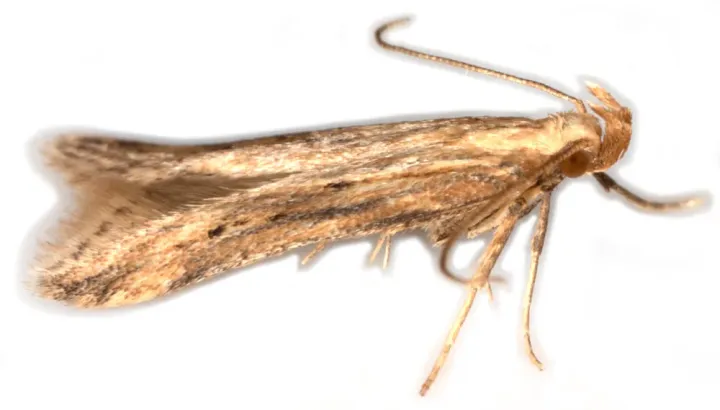
The burdock moth (Metzneria lappella) is a small moth belonging to the family Gelechiidae. Adult insects typically have a wingspan of 13–18 mm and are characterized by their grayish-brown, mottled forewings that provide excellent camouflage on the seed heads of their host plants.
The larval stage is the most damaging phase of this species. The larvae are creamy-white with a distinct dark brown head capsule. They spend their entire development period hidden safely within the flower heads of the burdock plant, feeding on the developing seeds.
What it damages
This moth primarily targets plants of the genus Arctium, commonly known as burdock. The larvae feed exclusively on the internal tissues of the seed heads, systematically destroying the florets and the forming seeds inside.
In medicinal plant cultivation, the burdock moth can cause significant economic losses. Since the seeds are often the targeted harvest, the larvae's consumption of the core reproductive parts renders the plant's production ineffective and of poor quality.
When it appears
The burdock moth typically undergoes a univoltine lifecycle, meaning it produces one generation per year. Adult moths are most active during the peak summer months, primarily in June and July, coinciding with the host plant's flowering period.
Females lay eggs on the newly formed flower heads. Upon hatching, the young larvae tunnel into the center of the burdock head. They remain there throughout their growth, feeding on the seeds until they are ready to pupate later in the season.
Signs of infestation
The most visible sign of infestation is the presence of fine, granular frass (larval excrement) inside the seed head. When splitting a suspected infested head, one will find the internal structures hollowed out or consumed by the larvae.
External signs include premature browning or deformation of the seed heads. Small entry or exit holes on the involucral bracts of the burdock flower head are also clear indicators of the moth's presence during different stages of the insect's development.
Control measures
Management of the burdock moth is primarily achieved through cultural practices. Harvesting the seed heads before the larvae reach maturity and vacate the heads is the most effective method to stop the infestation cycle and reduce the local population.
Sanitation of the growing area is crucial for long-term control. Collecting and destroying all infested plant material, along with deep autumn tillage to bury overwintering pupae, helps to significantly reduce the risk of infestation in the following growing season.
Taxonomy
- Latin name
- Metzneria lappella
- Order
- Lepidoptera (butterflies)
- Family
- Gelechiidae
- EPPO code
- METZLA
Discussion
No discussions yet — be the first.