
Treehopper Metcalfiella pertusa
Metcalfiella pertusa
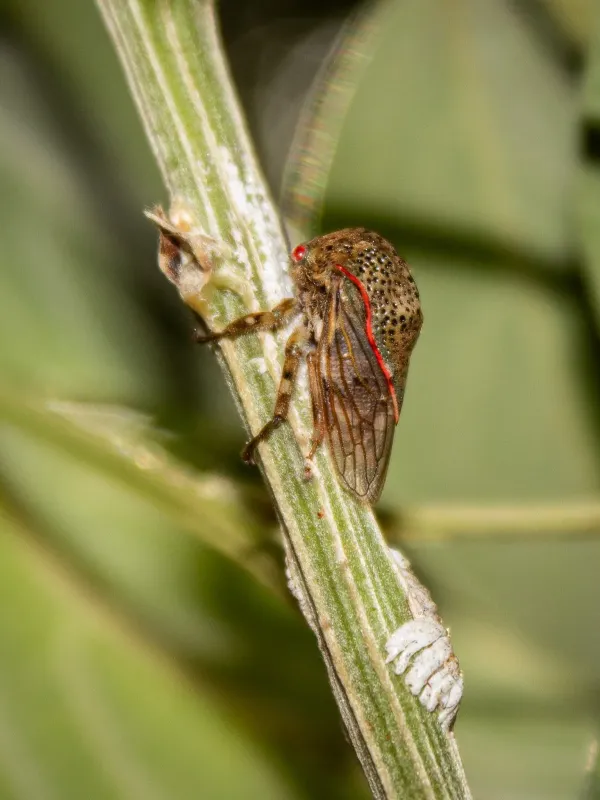
Description
How to identify
Metcalfiella pertusa belongs to the family Membracidae, order Hemiptera. These insects are known for their distinctively enlarged pronotum, which often mimics a thorn or a bark outgrowth, providing excellent camouflage.
Adult treehoppers are robust insects with well-developed wings, allowing them to move actively through the tree canopy. Their coloration typically blends with the brown and gray tones of bark, making them difficult to spot.
Nymphs, while wingless, share similar protective structures and often exhibit spiky projections on their bodies. They are generally less mobile than adults and tend to stay in concentrated areas on young shoots.
Due to their cryptic behavior, detecting these insects during routine orchard inspections can be quite challenging, even when a population is well-established.
Agronomists often use the branch-tapping method onto a light-colored surface to identify the presence of these insects during their peak activity hours in the orchard.
What it damages
The primary hosts of Metcalfiella pertusa include various deciduous trees and woody shrubs. Both saplings and established fruit trees can be affected by their feeding activities.
The insect feeds by piercing the soft tissues of young shoots with its sucking mouthparts. This constant sap extraction leads to nutrient depletion and weakened tree vigor.
Significant mechanical damage occurs when females slit the bark to deposit eggs. These incisions disrupt the vascular system of the twig, hindering the flow of water and nutrients.
Such injuries create entry points for secondary pathogens, including fungi and bacteria, which may lead to limb dieback or localized bark necrosis.
In cases of heavy infestation, symptoms include stunted shoot growth, leaf yellowing, and premature senescence, which can negatively impact overall fruit production.
When it appears
The life cycle of the treehopper is closely synchronized with the phenology of its host plants, with most activity occurring during the warmer months of the year.
The species typically overwinters in the egg stage, which are laid securely within the bark of host plants. Hatching occurs in early spring as temperatures rise.
Nymphs undergo several developmental stages, feeding continuously on the succulent tissues of new growth throughout the late spring and early summer.
Adult emergence and mating cycles peak in mid-summer, which is the period of maximum dispersal and colonization of new host trees within the garden or orchard.
As autumn approaches, mated females deposit their eggs into the bark of annual or biennial twigs, ensuring the survival of the next generation through the winter dormancy.
Signs of infestation
The most reliable indicator of an infestation is the presence of scarring on young bark, appearing as longitudinal or curved incisions left by egg-laying females.
Nymphal feeding often results in the excretion of honeydew, a sticky substance that promotes the growth of sooty mold and attracts foraging ant species.
Infested branches often show signs of physical distortion, such as bending or twisting, which contrasts noticeably with the straight growth of healthy branches.
Leaves on affected twigs may appear chlorotic, wilted, or prone to premature drop due to the disrupted supply of water caused by bark lesions.
Observing aggregations of nymphs or their concentrated waste on leaves directly beneath the feeding site is a definitive sign of an active infestation.
Control measures
Sanitation is the first line of defense; pruning and destroying heavily infested twigs during the dormant season significantly reduces the overwintering egg population.
During the growing season, systemic insecticides are effective against nymphs, as they travel through the plant's sap and reach the insects within the tissues.
Maintaining optimal tree health through balanced fertilization and irrigation helps trees recover faster from bark injuries and tolerate the pressure of feeding.
Installing sticky bands on tree trunks can limit the movement of ants, which frequently protect treehopper nymphs from natural predators and parasites.
Biological control efforts should focus on preserving natural enemies, such as parasitic wasps and predatory insects, which serve to keep populations below the economic injury threshold.
Taxonomy
- Latin name
- Metcalfiella pertusa
- Order
- Hemiptera (bugs, aphids, leafhoppers)
- Family
- Membracidae
- EPPO code
- HOPPPE
Discussion
No discussions yet — be the first.