
Metamasius spinolae
Metamasius spinolae
Description
How to identify
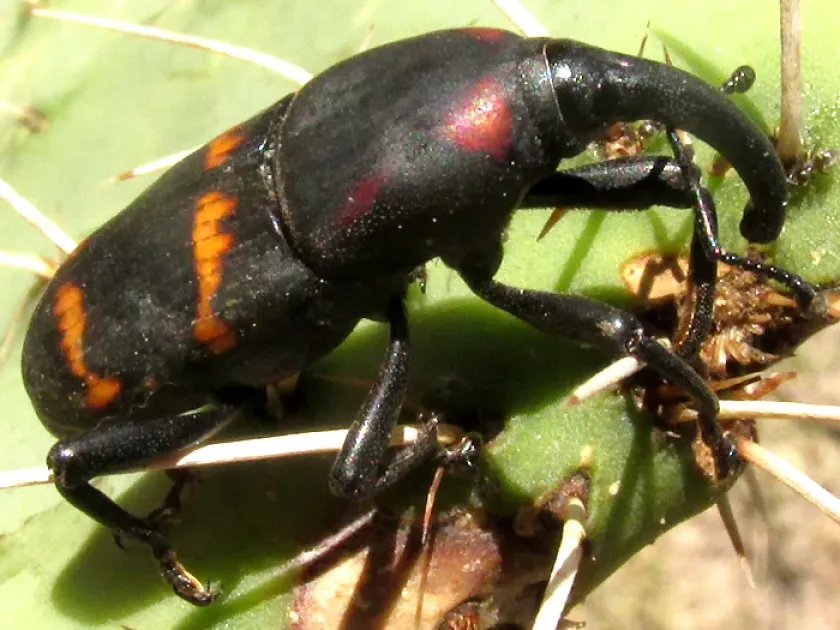
Metamasius spinolae is a member of the Curculionidae family, commonly known as weevils. These insects are characterized by a pronounced rostrum (snout) which females utilize to bore into plant tissue for oviposition.
The adult beetle typically exhibits a dark brown or black coloration, often marked with vibrant red or orange patterns on the elytra. They are generally cryptic, spending most of their time hidden within leaf axils or deep inside plant stems.
The larvae are legless, creamy-white in color, and possess a distinctively hardened brown head capsule. This stage is responsible for the majority of the structural damage to the host plant as they feed on internal tissues.
The life cycle follows complete metamorphosis, including egg, larval stages, pupa, and adult. Because their development occurs primarily inside the stem, the pest is difficult to detect until significant damage has already occurred.
This species is well-adapted to tropical and subtropical climates, where it has evolved to exploit maize and related grass species as primary food sources.
What it damages
Maize is the primary host for Metamasius spinolae, though it can also infest various other graminaceous crops. The pest is a significant concern for farmers in regions where its lifecycle synchronizes with the crop growth cycle.
Damage is caused primarily by larvae boring into the stalks and ears, creating complex tunnel systems. This feeding interrupts the vascular system, preventing the transport of water and nutrients throughout the plant.
Stalk infestation leads to severe weakening of the plant structure. As a result, infested maize plants are highly susceptible to lodging, which can cause total loss of the crop before harvest.
The tunnels created by larvae serve as entry points for secondary fungal and bacterial pathogens, leading to stalk rot and ear decay, which drastically reduce grain quality.
A high infestation level can lead to plant death during the early growth stages or result in barren, stunted plants that fail to produce marketable ears.
Signs of infestation
The presence of boreholes at the base of the stalk or in the cob is the most reliable indicator of an active Metamasius spinolae infestation.
Plants often exhibit signs of physiological stress, including premature yellowing of leaves and wilting, despite adequate soil moisture levels.
Inspecting the inside of the stem reveals tunnels filled with frass and decaying plant matter, alongside the presence of larvae or pupal chambers.
Adult beetles may be observed in the leaf axils during the early morning or evening hours as they emerge to mate and move across the field.
Unusual stalk deformity or snapping under light wind conditions often points to extensive internal feeding by larvae, indicating a compromised plant structure.
Control measures
Crop rotation is the most effective cultural practice to disrupt the insect's life cycle and reduce the local population density over successive seasons.
Effective management of crop residues after harvest is crucial; tilling or burning stalks helps destroy overwintering larvae and pupae residing inside.
Systemic insecticides may be applied during peak adult emergence periods. Timing is essential to ensure maximum efficacy while minimizing harm to beneficial insects in the ecosystem.
Breeding for stalk-resistant maize varieties is a recommended long-term strategy for farmers to minimize reliance on intensive chemical applications.
- Monitor fields using pheromone-based traps.
- Maintain spatial isolation between new maize plantings and previous infestation zones.
- Support biological control agents and natural predators.
Taxonomy
- Latin name
- Metamasius spinolae
- Order
- Coleoptera (beetles)
- Family
- Dryophthoridae
- EPPO code
- SPPHSI
Discussion
No discussions yet — be the first.