
Banana weevil
Metamasius sericeus
Description
How to identify
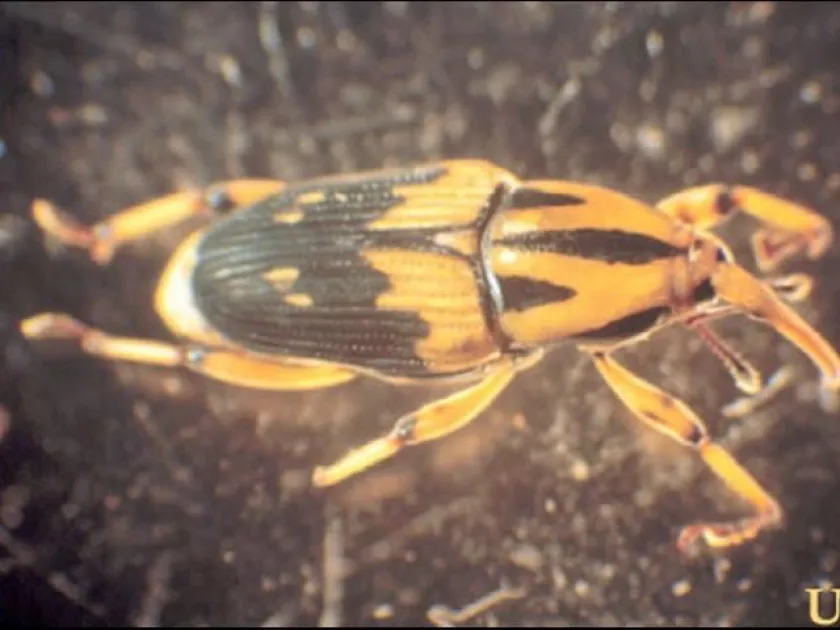
The banana weevil, scientifically known as Metamasius sericeus, belongs to the Curculionidae family. Adult beetles are typically 10–14 mm long, displaying a reddish-brown to black coloration, often featuring distinctive black markings on the elytra.
Larvae are legless, cream-white grubs with a well-developed brownish head capsule. Because they spend their entire development cycle boring inside plant tissues, they are rarely seen by field workers until the damage becomes severe and structural.
Adults are primarily nocturnal and possess flight capabilities, allowing them to migrate between fields and infest new plants. Their ability to hide in leaf sheaths or debris during the day makes them difficult to detect during routine scouting.
Their biological development is favored by warm, humid tropical conditions, where reproduction occurs year-round. This continuous lifecycle makes managing the pest population a permanent task for plantation managers.
Females create small oviposition sites in the plant's succulent tissues using their rostrum. Each female can lay numerous eggs over its lifespan, ensuring a steady colonization of vulnerable banana stands if left unchecked.
What it damages
The banana weevil is a significant pest primarily targeting the Musaceae family. Commercial banana cultivars are highly susceptible to infestation, leading to severe economic losses if the population remains unmanaged.
Beyond banana plants, the pest exhibits polyphagous behavior, occasionally attacking sugarcane, pineapple, and various palm species. This ability to survive on secondary hosts complicates eradication efforts on diversified farms.
Larval feeding is the primary cause of damage. As the larvae tunnel through the pseudostem and rhizome, they sever vital vascular tissues, effectively starving the plant of nutrients and water and causing premature yellowing of the foliage.
Structural damage is a major concern as the internal tunneling weakens the base of the plant. This loss of physical integrity leads to lodging or snapping of the pseudostem, especially under windy conditions, resulting in the total loss of the fruit bunch.
Secondary infections occur when the larval tunnels become pathways for pathogens. Bacteria and fungi enter the plant through these wounds, triggering internal rot that accelerates the death of the plant and reduces the overall crop quality.
Signs of infestation
The most immediate signs of infestation include small, circular holes on the surface of the pseudostem or the fruit stalk. These are often accompanied by sap bleeding, which is a defensive response of the plant to the beetle's entry.
As the infestation progresses, yellowing and wilting of the central leaves are observed. The plant exhibits stunted growth, and the fruit bunches may appear undersized or deformed, which is a major indicator of reduced vascular flow.
Internal symptoms are revealed when cutting into the pseudostem, showing irregular tunnels packed with fibrous debris and larval excrement. These tunnels often show dark discoloration due to the onset of necrotic decay.
Patches of fallen or tilted plants across a plantation are a classic sign of severe weevil damage. This group lodging occurs when the root system or the base of the plant has been extensively excavated by multiple generations of larvae.
During twilight hours, adults can be found congregating in the leaf axils or near the base of the plant. A high count of adult beetles on the surface of the plants is a strong predictor of significant larval activity hidden inside.
Control measures
Phytosanitary measures are the first line of defense. Ensuring that only clean, certified suckers or tissue-culture planting material are used is essential to prevent the introduction of the pest into new plantation areas.
Good agricultural practices, such as the removal and destruction of crop residues after harvesting, are crucial. Piles of old pseudostems provide a perfect breeding ground for the weevils; therefore, chopped residues should be managed properly.
Trapping techniques using pheromones or food baits (freshly cut pieces of banana stem) are highly effective. Regular maintenance of these traps helps monitor population trends and reduces the number of adults before they lay eggs.
Chemical control involving systemic insecticides may be applied in cases of high infestation. These treatments are aimed at targeting the adults and early larval stages by infiltrating the outer layers of the plant tissue.
Biological control agents, such as entomopathogenic nematodes or fungi like Beauveria bassiana, offer an eco-friendly alternative. These agents can penetrate the plant's internal tunnels to infect and kill larvae, providing sustainable long-term suppression.
Taxonomy
- Latin name
- Metamasius sericeus
- Order
- Coleoptera (beetles)
- Family
- Dryophthoridae
- EPPO code
- METASE
Discussion
No discussions yet — be the first.