
Chicken louse
Menopon pallidum
Description
How to identify
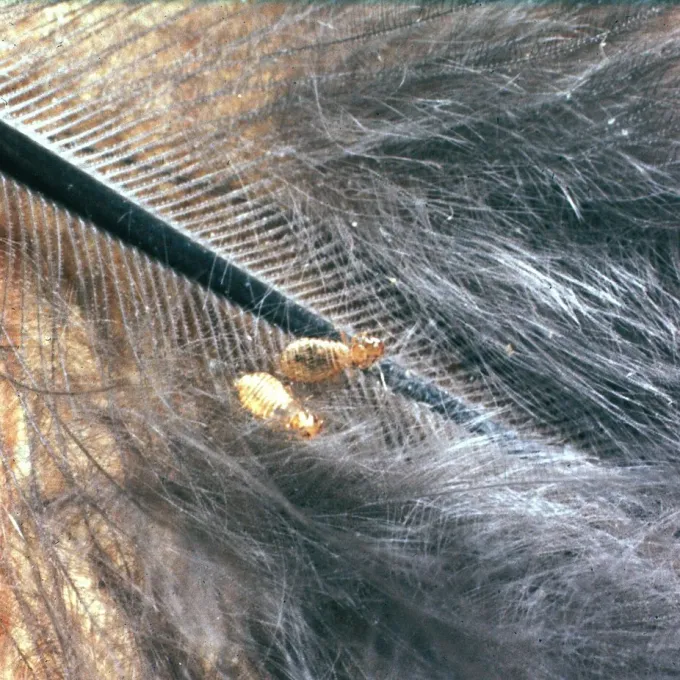
The chicken louse (Menopon pallidum), often called the shaft louse, belongs to the order Mallophaga and the family Menoponidae. It is a small, flattened insect, typically 1.5–2 mm long, with a pale yellow color.
Unlike blood-sucking lice, this species has chewing mouthparts. It feeds primarily on feathers, dead skin cells, and debris found on the host's body. They have a distinctively broad head, which helps in identifying them from other common poultry pests.
These insects are permanent ectoparasites, meaning they spend their entire life cycle on the bird. They are fragile and cannot survive away from the host for more than a few days, spreading mainly through close physical contact.
The life cycle includes the egg stage (nits), several nymphal instars, and the adult stage. Eggs are laid in clusters, usually cemented to the base of the feathers near the skin.
Under favorable conditions in a poultry house, the development from egg to adult is rapid, usually taking between two to three weeks, which allows populations to explode quickly.
What it damages
This parasite primarily targets domestic chickens, although it can occasionally affect other avian species. They prefer areas with thinner skin or higher humidity, such as the vent area and under the wings.
The harm caused by Menopon pallidum is largely due to intense irritation. The chewing activity causes significant discomfort, leading the bird to become restless, irritable, and constantly preening.
Infested birds often experience a significant drop in egg production and weight gain. Because the birds spend so much energy on irritation relief and damaged feather repair, their overall metabolism is negatively impacted.
In young birds, severe infestations can stunt growth and weaken the immune system, making them more susceptible to secondary infections or diseases.
Feather quality decreases as the insects damage the barbs, leading to broken feathers and a poor overall appearance. This loss of plumage can also disrupt the bird's thermoregulation.
Signs of infestation
The most noticeable sign is excessive preening and restlessness. A chicken infested with lice will often look ruffled, dirty, or dishevelled as it tries to soothe the itching.
Upon physical inspection, one can find the lice by parting the feathers, especially around the vent, breast, and under the wings. The insects are quick to move and usually scurry away from light.
Nits (eggs) appear as tiny, white, pearly clusters attached to the base of the feather shafts. Their presence is a definitive confirmation of an active infestation.
Patches of skin irritation, redness, or even scabs from the bird's own scratching or pecking are common. In severe cases, large areas of the body may become featherless.
A decline in the general vitality of the flock, including lethargy and a drop in productivity, despite adequate feed intake, is a major indicator of an underlying parasite issue.
Control measures
Management involves the use of approved veterinary insecticides, such as dusts, sprays, or systemic spot-on treatments. Application must be thorough and usually needs to be repeated to kill newly hatched nymphs.
Environmental control is essential. The poultry house must be cleaned and disinfected, with particular attention paid to roosting areas, nests, and cracks where lice may hide during the day.
Providing access to dust baths containing wood ash or fine sand is a natural and effective preventative measure, as it helps birds remove parasites mechanically from their feathers.
Strict biosecurity, including quarantining new birds before introducing them to the main flock, is vital to prevent the introduction of lice into a clean house.
- Regular inspection of the flock for early detection.
- Thorough cleaning and litter removal in the poultry house.
- Using insecticide products strictly according to label directions.
- Maintaining high nutritional standards to support bird health.
Taxonomy
- Latin name
- Menopon pallidum
- Family
- Menoponidae
- EPPO code
- MENNPA
Discussion
No discussions yet — be the first.