
Root-knot nematode
Meloidogyne paranaensis
Description
How to identify
Meloidogyne paranaensis is a species of plant-parasitic nematode belonging to the family Meloidogynidae and the order Tylenchida.
Adult females are sedentary endoparasites, typically pear-shaped, residing within the roots of host plants where they produce egg masses.
The second-stage juveniles (J2) are the infective stage, moving through the soil film to locate and penetrate new host roots.
Because they are microscopic, identification in the field is impossible without diagnostic expertise and laboratory examination of roots.
Species-level identification usually requires molecular techniques like PCR or detailed morphological analysis of the female perineal pattern.
What it damages
While primary hosts include coffee plants, Meloidogyne paranaensis also attacks various agricultural crops such as tomatoes, potatoes, and dry beans.
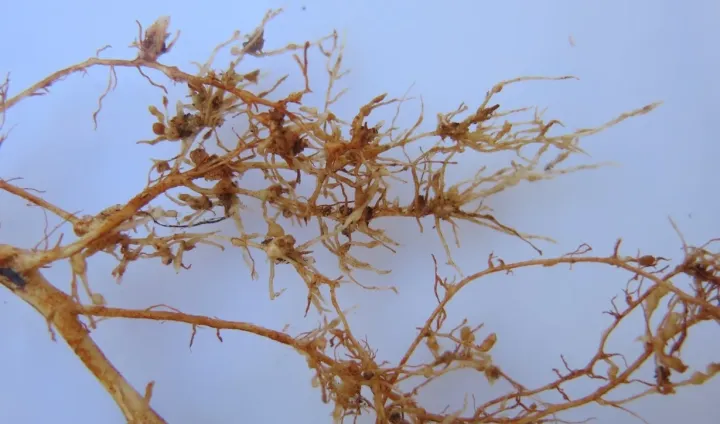
The nematode feeds within the roots, inducing the formation of characteristic galls or knots that disrupt the plant's vascular system.
By preventing the efficient uptake of water and nutrients, these galls lead to stunted growth, yellowing foliage, and significant yield loss.
Severely damaged root systems become susceptible to secondary infections by soil-borne pathogens like bacteria and fungi, exacerbating plant decline.
In high-density infestations, the parasite can cause widespread crop failure, making it a critical threat to commercial agriculture in affected regions.
When it appears
The biological cycle of Meloidogyne paranaensis is heavily influenced by soil temperature and moisture levels, which regulate metabolic rates.
Optimal soil temperatures between 20°C and 28°C significantly accelerate the development of generations and the frequency of new invasions.
The nematode survives adverse environmental conditions within root tissues or as dormant eggs/cysts buried in the soil profile.
Depending on environmental favorability, a complete life cycle can be finished in roughly four to six weeks, allowing for multiple generations annually.
Activity peaks during phases of active root growth, when the plant releases exudates that signal the juveniles to congregate and invade.
Signs of infestation
Symptoms above ground include general chlorosis, extreme stuntedness, and premature wilting, especially during peak temperature periods.
Below-ground examination of the roots reveals small, knot-like galls, which are the hallmark sign of a Meloidogyne infestation.
These galls can develop into massive clusters of deformed roots, significantly reducing the surface area available for water absorption.
In mature plants, the root structure may appear decayed or necrotic, further impairing the plant's structural integrity and stability.
Fields with severe infestations often exhibit patchy growth, with isolated areas of suffering plants scattered among seemingly healthier zones.
Control measures
Integrated Pest Management (IPM) is essential, starting with the use of nematode-free, certified planting material to prevent field introduction.
Crop rotation with non-host plants is an effective strategy to naturally reduce nematode population densities over a period of several seasons.
Biological control options, including the application of nematophagous fungi like Pochonia chlamydosporia, show promise in reducing parasite numbers.
Sanitation practices such as cleaning farming equipment and limiting the movement of soil between fields help curb the spread of the pathogen.
- Breeding and utilizing resistant plant varieties or rootstocks.
- Applying organic matter to improve soil suppressiveness.
- Steam sterilization of substrate for nursery environments.
- Using chemical soil fumigants only as a last resort in high-value production.
Taxonomy
- Latin name
- Meloidogyne paranaensis
- Order
- Nematodes
- Family
- Meloidogynidae
- EPPO code
- MELGPA
Discussion
No discussions yet — be the first.