
Cereal root-knot nematode
Meloidogyne naasi
Description
How to identify
The cereal root-knot nematode (Meloidogyne naasi) is an obligate endoparasitic nematode within the order Tylenchida. It is a microscopic organism specialized in attacking the root systems of various monocotyledonous crops.
The life cycle involves eggs, four larval stages, and adults. Females are sedentary and pear-shaped, residing within the plant tissues, while the second-stage larvae (J2) are mobile and responsible for finding new host roots in the soil.
Reproduction is primarily parthenogenetic, allowing populations to multiply rapidly when conditions are favorable and host crops are present. This high reproductive rate often leads to significant infestations.
The species has a distinct environmental preference, thriving in temperate climates with moderate soil moisture. It can survive in the soil for several years in the form of eggs encased in gelatinous matrices.
Precise identification of Meloidogyne naasi typically requires expert morphological examination of the perineal patterns of the female or molecular diagnostic tools to distinguish it from other root-knot species.
What it damages
This nematode primary affects cereal crops such as barley, wheat, oats, and rye. It can also infest certain grasses and, occasionally, sugar beet, making it a threat in diverse cropping systems.
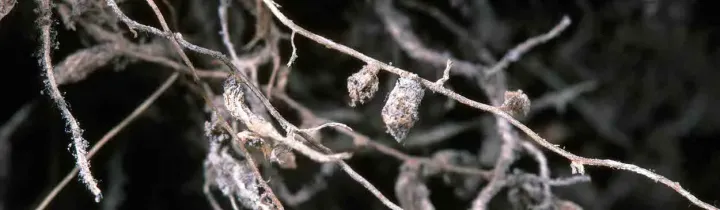
Damage is characterized by the formation of root galls, which are localized swellings. These galls disrupt the vascular tissues, impairing the plant's ability to uptake water and nutrients effectively.
Infested plants exhibit stunted growth, chlorosis, and wilting, especially during periods of water stress. The root system often appears deformed, shortened, and lacks normal secondary root development.
The overall impact is a significant reduction in grain yield and biomass. In severe cases, the weakened root system becomes highly susceptible to secondary fungal or bacterial pathogens, causing root rot.
Economic losses are often underestimated because the symptoms, such as general lack of vigor, are frequently attributed to soil infertility or other abiotic stressors rather than nematode infestation.
When it appears
The nematode's activity is closely synchronized with the growth cycle of host plants. Infestation usually begins in early spring when the soil warms up, facilitating the movement of J2 larvae.
During the vegetative growth phase, the nematodes penetrate the roots, establish feeding sites, and develop into mature females, causing galls to enlarge significantly.
As the host plant matures and begins to senesce in late summer, the nematodes complete their generation and produce eggs. These eggs serve as the resting stage to survive through the autumn and winter months.
The survival of the nematode during the winter period is primarily in the egg stage in the soil. Population density fluctuates based on the previous year's cropping history and soil environmental conditions.
Optimal environmental conditions for the nematode include cool, moist soil during the spring, which maximizes the infectivity rate of the larvae toward the developing crop roots.
Signs of infestation
Field symptoms often appear as patches of stunted, yellowing plants that contrast with the rest of the healthy field. These patches tend to persist and expand in subsequent seasons if not managed.
The most reliable sign of infection is the presence of small, characteristic knots or galls on the lateral roots of the plant, which are visible when the plant is carefully unearthed with a soil core.
Affected plants often show premature wilting during warm days because the compromised root system cannot keep up with the plant's transpiration requirements.
A reduction in the number of tillers and a delayed heading phase are common observations in heavily infested fields, leading to uneven crop maturity at harvest time.
If suspicious patches are observed, laboratory confirmation is essential. This involves washing the soil from the roots and examining the root tissue for the presence of embedded female nematodes.
Control measures
The cornerstone of management is a well-planned crop rotation. Including non-host crops, such as certain legumes or broad-leaved species, for two or more years can effectively reduce nematode levels.
Strict sanitation protocols for farm machinery are necessary to prevent the mechanical transport of infested soil from affected fields to clean, non-infested land.
Enhancing soil health through the incorporation of organic matter can promote beneficial microbial activity, which may help in suppressing nematode populations through natural predation or parasitism.
While resistant varieties are the ideal goal for integrated pest management, limited breeding success for resistance to Meloidogyne naasi makes cultural control the primary defense mechanism.
Chemical control is rarely practiced in cereal production due to high costs and environmental regulations regarding soil fumigation; therefore, preventative measures remain the most sustainable solution.
Taxonomy
- Latin name
- Meloidogyne naasi
- Order
- Nematodes
- Family
- Meloidogynidae
- EPPO code
- MELGNA
Discussion
No discussions yet — be the first.