
Lusitanian root-knot nematode
Meloidogyne lusitanica
Description
How to identify
The Lusitanian root-knot nematode (Meloidogyne lusitanica) is a microscopic worm belonging to the order Tylenchida and the family Meloidogynidae. This obligate endoparasite spends most of its life cycle inside the roots of its host plants, causing distinct physiological and morphological changes.
Adult females are sedentary and pear-shaped, residing within the root tissue, while second-stage juveniles (J2) are the mobile phase responsible for infecting healthy root tips. Due to their minute size and morphological similarity to other Meloidogyne species, accurate identification requires specialized techniques.
Molecular diagnostics, such as PCR-based analysis of ribosomal DNA, are the most reliable methods to distinguish M. lusitanica from other common root-knot nematode species. Traditional identification involves examining the perineal patterns of adult females under a microscope.
The nematode's life cycle is highly influenced by soil temperature and moisture levels. Warm conditions accelerate the development of generations, leading to a rapid buildup of the nematode population in the soil, which increases the risk of severe plant infestation.
As an obligate parasite, M. lusitanica relies entirely on host plants for survival. This biological characteristic provides a strategy for management: by implementing fallow periods or planting non-host crops, farmers can significantly reduce the soil population density over time.
What it damages
The Lusitanian root-knot nematode has a broad host range, primarily affecting woody perennial crops like grapevines, as well as various vegetables grown in both field and greenhouse conditions. It infests the roots, leading to the development of characteristic galls or knots.
These root galls disrupt the normal vascular function of the plant, preventing the efficient uptake and translocation of water and essential nutrients. As a result, the plant suffers from constant physiological stress, particularly during periods of high transpiration.
Infected vines and plants often display reduced vigor, stunting, and premature wilting. Over time, the root system loses its ability to sustain the plant, leading to significant yield losses, poor fruit quality, and, in severe cases, the decline of entire plantations.
The damage is compounded by the fact that nematode-damaged roots become highly susceptible to secondary infections by soil-borne fungi and bacteria. This complex infection pattern makes it difficult to diagnose the primary cause of plant decline without careful inspection.
Furthermore, the persistent nature of the nematode means that once a field is infested, the pathogen remains in the soil, posing a continuous threat to subsequent crops that are susceptible to the same species of Meloidogyne.
Signs of infestation
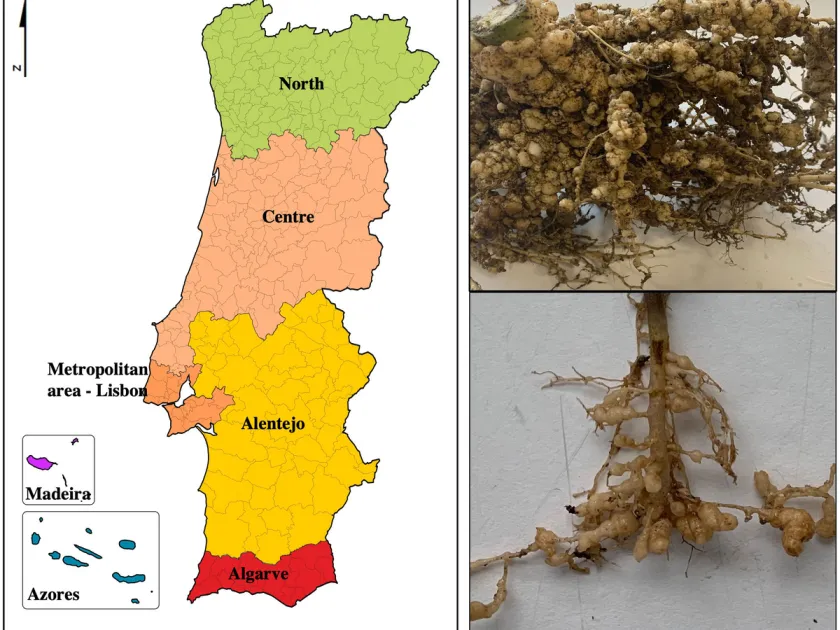
The primary symptom of infestation is the appearance of galls (knots) on the root system, which can range from small swellings to large, distorted clusters. These galls are the result of the plant's abnormal cell growth in response to the nematode's feeding activity.
Above-ground symptoms are typically non-specific and resemble general nutrient deficiencies. Common indicators include yellowing leaves (chlorosis), stunting, and leaf curling. Affected plants often fail to respond to fertilizer applications, indicating a damaged root system.
During the peak growing season, infected plants exhibit severe wilting during the hottest hours of the day, even when soil moisture appears adequate. This is a direct consequence of the roots' inability to transport water to the canopy due to gall formation.
To confirm the diagnosis, root samples must be washed and inspected for the presence of galls. Additionally, soil samples should be processed using extraction methods to identify the mobile J2 juveniles, which confirms the presence of an active nematode population.
Early detection is challenging because symptoms are often unnoticed until the damage is already severe. Routine monitoring of root development and soil sampling programs are essential for effective management in high-value production systems.
Control measures
Managing the Lusitanian root-knot nematode requires an integrated pest management (IPM) approach. The most effective measure is the prevention of nematode introduction by using certified, nematode-free planting stock and ensuring clean equipment.
Cultural control strategies include long-term crop rotation with non-host plants to starve the nematode population. Soil solarization or steaming in greenhouses can effectively reduce the number of juveniles and eggs present in the top layers of the soil.
Biological control agents, such as nematode-parasitic fungi (e.g., Pochonia chlamydosporia), can be introduced to suppress populations. These beneficial microorganisms infect nematode eggs, preventing the next generation from infecting new roots.
Chemical control involving the application of nematicides is generally reserved for high-value greenhouse crops where infestation levels are critical. Due to environmental regulations and the toxicity of many nematicides, chemical use is increasingly restricted and must be carefully managed.
- Always use certified, pest-free planting material.
- Implement strict sanitation protocols for tools and footwear.
- Use cover crops with nematicidal properties as green manure.
- Perform periodic soil testing to monitor nematode population levels.
Taxonomy
- Latin name
- Meloidogyne lusitanica
- Order
- Nematodes
- Family
- Meloidogynidae
- EPPO code
- MELGLU
Discussion
No discussions yet — be the first.