
Root-knot nematode
Meloidogyne luci
Description
How to identify
The root-knot nematode (Meloidogyne luci) is a microscopic obligate parasite belonging to the Meloidogynidae family and the Tylenchida order. It is a highly specialized pathogen that spends most of its life cycle within the root tissues of host plants.
Identification of Meloidogyne luci is notoriously difficult based on morphology alone. Adults exhibit sexual dimorphism: females are pear-shaped and sessile, while males are vermiform and motile. Precise identification often requires molecular markers like PCR analysis.
The life cycle begins with eggs laid in a gelatinous matrix. Second-stage juveniles (J2) are the primary infective stage; they move through the soil, attracted by chemical signals from roots, which they penetrate behind the root cap.
Once inside the root, the nematode establishes a feeding site, inducing the formation of giant cells. This physiological process provides the parasite with continuous nutrition, enabling it to develop into a mature, egg-laying female.
Environmental factors significantly influence the nematode's population density. Dispersal occurs primarily via contaminated soil on farming equipment, irrigation water, and infected transplant seedlings moved between fields.
What it damages
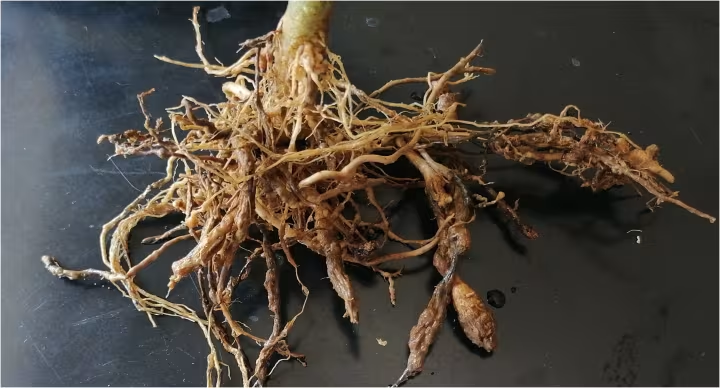
The primary damage caused by Meloidogyne luci is the formation of characteristic root galls (knots). These malformations disrupt the xylem and phloem, preventing the plant from effectively absorbing water and essential nutrients.
This nematode has an exceptionally wide host range, attacking various vegetable crops such as tomatoes, peppers, potatoes, and cucumbers. It also impacts several industrial and ornamental plants, causing significant economic losses globally.
Plants infested with root-knot nematodes show systemic weakness. They become highly susceptible to secondary infections by soil-borne fungi and bacteria, which often cause severe root rot, leading to premature plant death.
Agricultural productivity drops sharply due to the stunt in growth and poor root health. Fruits are often smaller, of lower quality, and lack the nutritional value required for market sale, causing major financial impact on farmers.
Persistent infestations in greenhouses can lead to complete failure of crop cycles. The accumulation of nematode populations in the soil makes it increasingly difficult to cultivate susceptible crops without intensive intervention.
When it appears
Meloidogyne luci is most active in warm soil conditions. Optimum development occurs at temperatures ranging between 20°C and 30°C, making spring and summer the peak periods for infestation and spread in open fields.
In greenhouses, where temperatures are often consistently high, the nematode can complete multiple generations throughout the year. This continuous breeding cycle makes it a perennial threat to greenhouse-grown crops.
During unfavorable seasons, the nematode survives in the form of eggs protected by a hardy gelatinous matrix or as juveniles within root debris. They exhibit remarkable tolerance to temperature fluctuations, ensuring their survival until favorable conditions return.
Once soil temperatures rise, dormant stages become active. The speed at which new generations emerge depends on the accumulation of heat units, which in tropical or subtropical climates allows the population to reach damaging levels very rapidly.
Seasonal management is crucial. Growers must monitor soil moisture and temperature, as these factors directly correlate with the motility of J2 juveniles and their ability to successfully infect new root systems.
Signs of infestation
The most visible above-ground signs are stunting and chlorosis. Infested plants often exhibit wilting during the hottest parts of the day, as the compromised root system fails to meet the plant's transpirational demands.
Leaves may show signs of nutrient deficiency, such as yellowing (chlorosis) or necrosis, which persist despite proper fertilization. This happens because the plant cannot transport the necessary minerals through its damaged vascular system.
The most definitive sign is the presence of galls or swellings on the roots. These can range from tiny beads to large, distorted clusters that completely overhaul the root architecture and prevent the development of fine root hairs.
Infestation usually appears in patches across a field. Nematodes move slowly through the soil, so the center of an infestation typically shows the most severe symptoms, with a gradual decline in health moving toward the periphery.
Confirming an infection requires a careful inspection of the root zone. In cases of suspected Meloidogyne luci, professionals should collect soil and root samples for laboratory analysis to distinguish it from other nematode species.
Control measures
Exclusion is the most effective management strategy. Implementing strict quarantine measures and ensuring the use of nematode-free certified planting stock is essential to prevent the introduction of this pest into clean areas.
Crop rotation remains a cornerstone of integrated pest management. Using non-host crops, such as specific grasses, can starve the nematode population and significantly reduce the number of infective juveniles in the soil over time.
Soil disinfestation is common in controlled environments. Steam treatment of the soil is highly effective at killing eggs and juveniles, and it is a preferred, environmentally friendly alternative to chemical fumigation in many greenhouse operations.
Biological control agents, including certain nematophagous fungi and bacteria, can suppress nematode populations. These biological tools are becoming increasingly popular in sustainable agriculture to maintain soil health.
Chemical control with nematicides is a last-resort option due to potential environmental impacts. Whenever possible, farmers should prioritize planting resistant or tolerant cultivars, which can maintain yields even in the presence of the nematode.
Taxonomy
- Latin name
- Meloidogyne luci
- Order
- Nematodes
- Family
- Meloidogynidae
- EPPO code
- MELGLC
Discussion
No discussions yet — be the first.