
Javanese root-knot nematode
Meloidogyne javanica
Description
How to identify
The Javanese root-knot nematode (Meloidogyne javanica) is a plant-parasitic nematode that belongs to the Heteroderidae family and Tylenchida order.
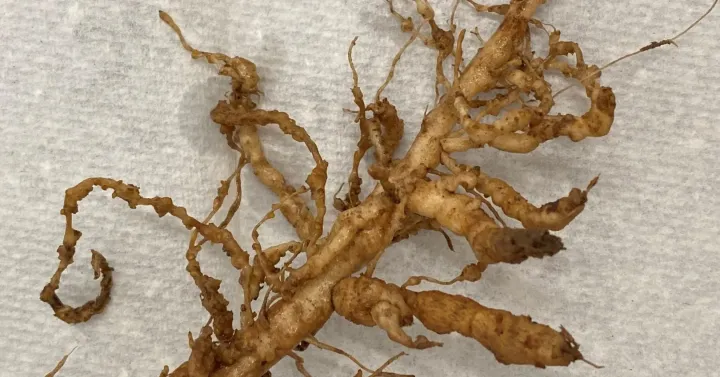
Adult females are sedentary, pear-shaped endoparasites that reside within the root tissues, where they induce the formation of characteristic root galls.
The second-stage juveniles (J2) are the infectious stage, which moves through the soil film to locate and penetrate the roots of host plants.
Because the species can reproduce via parthenogenesis, even a small number of introduced nematodes can quickly lead to a severe infestation.
Precise identification of M. javanica typically requires observation of the perineal pattern of the adult female under a high-power microscope.
What it damages
This species is a highly polyphagous pest capable of attacking over 700 species of plants, causing significant losses in global agriculture.
It severely affects major vegetable crops such as tomatoes, cucumbers, peppers, and melons, particularly in greenhouse conditions.
The nematodes disrupt the root vascular system, which hinders the uptake of water and nutrients, leading to reduced plant vigor and crop yields.
Heavy infestations frequently lead to root decay and secondary infections, often causing total plant failure in susceptible cultivars.
In addition to vegetable crops, it can also infect various ornamental plants, fruit trees, and legumes, making it a difficult pest to isolate.
When it appears
The nematode thrives in warm climates and performs optimally at soil temperatures between 25°C and 30°C, typical of summer and protected cropping.
In greenhouses, where temperatures are controlled, M. javanica can complete its life cycle in as little as 25 days, leading to multiple generations per year.
While activity slows down in cooler soil, the eggs are highly resilient and can survive in the soil for long periods until conditions become favorable.
Peak damage usually appears during the peak growing season, as the plant increases its metabolic demand and the nematode population multiplies.
Continuous cultivation of the same host plant in the same area often leads to a rapid build-up of nematode populations in the soil.
Signs of infestation
The most distinctive diagnostic sign is the presence of knots or galls on the root system, which can range from small swellings to large, misshapen growths.
Above-ground symptoms include wilting during hot periods, even when moisture levels in the soil are otherwise adequate for the plant.
Plants often exhibit stunted growth, chlorotic (yellowish) foliage, and an overall lack of productivity compared to healthy neighboring plants.
Because the root system is damaged, affected plants often show signs of nutrient deficiency, regardless of the availability of fertilizers.
- Stunted growth and poor yield
- Wilting during peak sunshine hours
- Yellowing of leaves and premature leaf drop
- Presence of visible knots (galls) on roots
- Reduced overall vigor of the plant
Control measures
Crop rotation using non-host plants or resistant cover crops is an essential management practice to reduce soil populations.
Biological control agents, such as nematode-trapping fungi or antagonistic bacteria like Pasteuria penetrans, are gaining popularity for sustainable management.
Soil solarization involves covering moist soil with plastic film during hot weather to elevate soil temperatures and kill nematodes in the upper layer.
Planting resistant varieties is the most effective way to prevent yield loss, as it prevents the nematode from successfully establishing within the roots.
Chemical control with nematicides is possible but often restricted due to environmental regulations and the need for specialized application techniques.
Taxonomy
- Latin name
- Meloidogyne javanica
- Order
- Nematodes
- Family
- Meloidogynidae
- EPPO code
- MELGJA
Discussion
No discussions yet — be the first.