
Spanish root-knot nematode
Meloidogyne hispanica
Description
How to identify
The Spanish root-knot nematode (Meloidogyne hispanica) is a microscopic worm within the order Tylenchida and the family Meloidogynidae. It functions as an endoparasite, invading the root tissues of various horticultural crops.
The biological cycle begins when second-stage infective juveniles penetrate the plant root. Once inside, they induce the formation of giant cells, which serve as their exclusive food source throughout their development.
Adult females adopt a pyriform shape and become sedentary within the root galls. They produce gelatinous matrices containing eggs, which are often deposited on the root surface to facilitate dissemination.
As a thermophilic species, it thrives in warm soil temperatures, making it particularly dangerous in tropical, subtropical climates, or within heated greenhouses globally.
Identification at the species level is notoriously difficult through morphology alone, requiring molecular diagnostic techniques like PCR-RFLP to distinguish it from other Meloidogyne species.
What it damages
This nematode possesses a wide host range, severely affecting solanaceous crops like tomatoes, peppers, and eggplants, as well as several leguminous and ornamental plant varieties.
The feeding activity disrupts the plant's vascular system, severely restricting the uptake and transport of water and nutrients from the roots to the foliage and fruits.
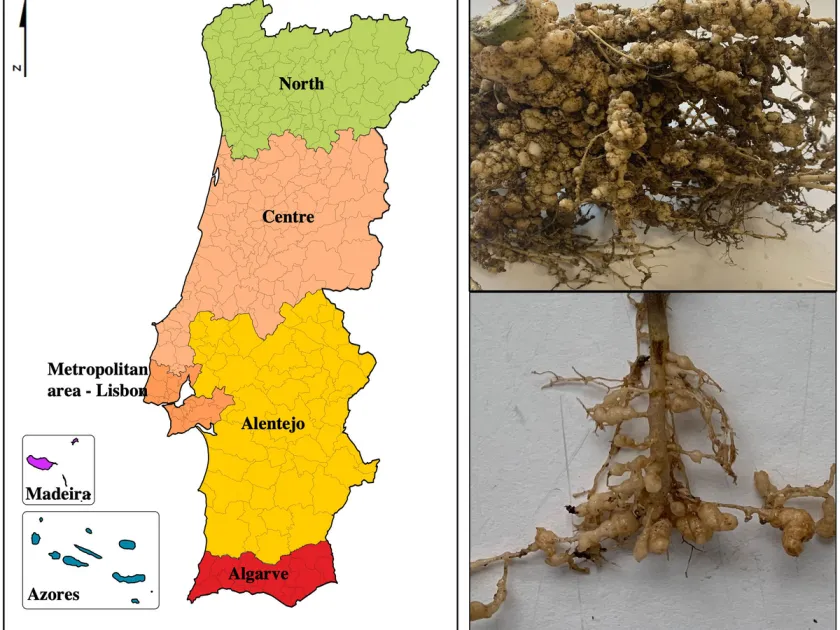
Root galls are the primary diagnostic sign of damage. These swellings disrupt the structural integrity of the root, often inviting secondary colonization by soil-borne fungi and bacteria.
Severe infestations lead to stunting and yield reduction. In heavy cases, the root system is entirely consumed by the nematode colonies, rendering the plant unable to survive environmental stress.
- General reduction in plant vigor and biomass.
- Foliar chlorosis and unexpected wilting under heat.
- Significant decrease in fruit quantity and quality.
- Increased susceptibility to abiotic stressors like drought.
When it appears
The activity of Meloidogyne hispanica is strictly regulated by soil temperature. Development accelerates significantly when temperatures reach the 20-25°C (68-77°F) range.
In controlled greenhouse environments, the life cycle can be completed in as little as 3-5 weeks, allowing for rapid population explosions if management is ignored.
Survival occurs through hardy eggs or juvenile stages present in the soil or decaying root residues, which remain viable until the next planting season.
In outdoor production, symptoms become apparent mid-summer as the nematode population builds up over several cycles alongside active plant root growth.
Greenhouse operations require constant vigilance throughout the entire year, as the pest can maintain continuous cycles if environmental conditions remain favorable.
Signs of infestation
The most reliable sign of infection is the presence of characteristic root galls (swellings) visible to the naked eye when a plant is carefully uprooted from the soil.
Above-ground symptoms include progressive stunting, yellowing of the leaves, and characteristic wilting during the hottest parts of the day, even when soil moisture appears adequate.
Wilting occurs because the compromised vascular tissues cannot keep pace with the plant's transpiration requirements, leading to physiological drought.
Field patches often show uneven growth, where infected clusters of plants stand out against the backdrop of healthier, vigorous specimens in the same bed.
Without intervention, the damage threshold is quickly surpassed, leading to total crop failure and the buildup of high nematode densities in the soil profile.
Control measures
Crop rotation using non-host species, such as cereals or specific resistant cover crops, is the cornerstone of sustainable management for this nematode species.
Soil solarization involves covering moist, tilled soil with clear plastic mulch to trap solar heat, which can effectively kill nematodes and other soil-borne pathogens in the upper layers.
Biological control agents, particularly nematophagous fungi like Pochonia chlamydosporia, have shown promise in reducing nematode populations when integrated into an overall IPM program.
Chemical nematicides are sometimes employed in professional agriculture, but their use is strictly regulated due to significant environmental and human health risks.
Sanitation is paramount: always use certified nematode-free transplants and thoroughly clean all machinery, tools, and footwear to prevent the introduction of the pest to new land.
Taxonomy
- Latin name
- Meloidogyne hispanica
- Order
- Nematodes
- Family
- Meloidogynidae
- EPPO code
- MELGHI
Discussion
No discussions yet — be the first.