
Northern root-knot nematode
Meloidogyne hapla
Description
How to identify
The Northern root-knot nematode, scientifically known as Meloidogyne hapla, belongs to the Meloidogynidae family and is a major soil-borne plant parasite.
The adult females are sedentary and pear-shaped, residing within the roots, while the juvenile stages are mobile and move through the soil to find new host roots.
This particular species is uniquely adapted to colder climates compared to other root-knot nematodes, allowing it to survive and thrive in temperate regions.
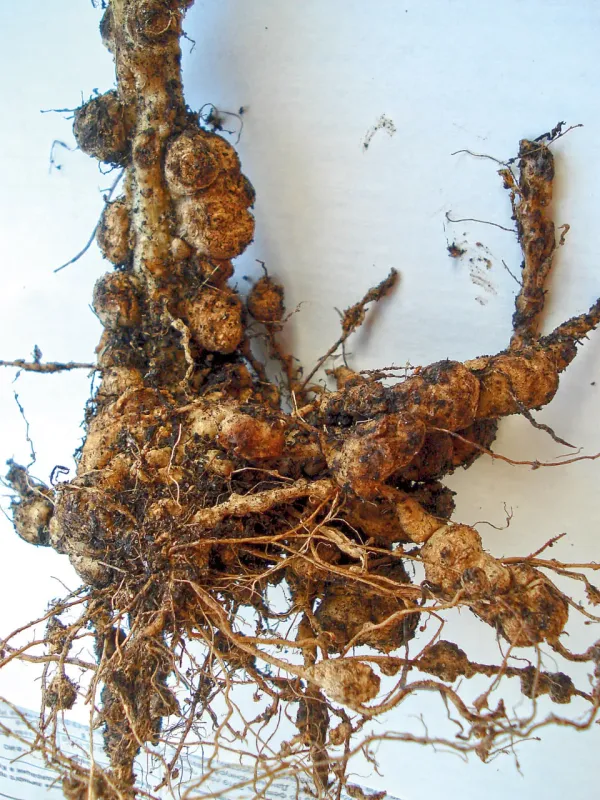
It is characterized by the formation of small, distinct galls on the roots of host plants, often accompanied by excessive root branching.
Microscopic analysis of the perineal pattern of the adult female is the standard method used by professionals to confirm the identification of this species.
What it damages
Meloidogyne hapla has an extremely broad host range, damaging a wide variety of vegetable crops, ornamental plants, and even some legumes.
In infested soils, the nematodes penetrate the roots, leading to the formation of galls that disrupt the plant's vascular system, preventing water and nutrient uptake.
For root crops like carrots and potatoes, the infestation leads to severe cosmetic damage, making the produce unmarketable due to deformities.
The weakening of the root system makes the plants much more vulnerable to secondary infections from soil fungi and bacteria, leading to rot.
Severe infestations result in stunted plant growth, significant yield losses, and the overall decline of crop quality in both open and greenhouse fields.
When it appears
The lifecycle begins when second-stage juveniles emerge from eggs in the soil and migrate toward the root tips of suitable host plants.
Developmental rates are temperature-dependent, with activity increasing during the warmer months of the growing season.
As the soil warms up in the spring, the nematodes become active and begin the process of root invasion, marking the start of the primary infection window.
The nematodes can survive the winter as eggs inside roots or within the soil, acting as a dormant reservoir for the following year's infection.
Multiple generations can occur within a single growing season, especially in greenhouses, which can lead to a rapid population buildup if left unmanaged.
Signs of infestation
Early symptoms are often non-specific, including wilting during the hottest parts of the day and a general yellowing or chlorosis of the foliage.
Plants may exhibit symptoms that mimic nutrient deficiencies, such as phosphorus deficiency, because the compromised root system cannot absorb essential minerals.
The most reliable sign of infection is the presence of small, knot-like galls on the roots, which can be easily seen upon pulling a suspect plant from the soil.
Root branching and a bushy appearance are typical of the response of the host plant to the nematode's presence in the root tissue.
- Stunted or retarded plant growth.
- Yellowing of leaves.
- Wilting during periods of stress.
- Small galls on roots.
- Reduced yield and quality.
Control measures
Integrated Pest Management (IPM) is essential, starting with the use of nematode-free planting stock and clean greenhouse substrates.
Crop rotation using non-host crops, such as certain grasses or grains, can help break the nematode's lifecycle and reduce population levels in the field.
Soil solarization or steam sterilization is highly recommended for greenhouse soil preparation to eliminate dormant stages of the pest.
Organic amendments and the use of beneficial microorganisms like Trichoderma species have shown success in suppressing nematode populations.
When chemical control is necessary, fumigants or systemic nematicides should be applied strictly according to local regulations to ensure environmental safety.
Taxonomy
- Latin name
- Meloidogyne hapla
- Order
- Nematodes
- Family
- Meloidogynidae
- EPPO code
- MELGHA
Discussion
No discussions yet — be the first.