
Grass root-knot nematode
Meloidogyne graminis
Description
How to identify
The grass root-knot nematode (Meloidogyne graminis) is a microscopic worm belonging to the order Tylenchida and the family Heteroderidae.
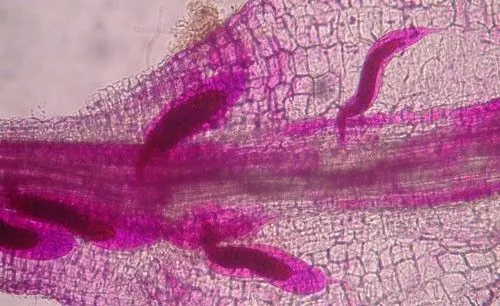
The adult females are sedentary and pear-shaped, residing within the roots, while the second-stage juveniles are the mobile form that invades the root tips.
Identification is primarily based on microscopic examination of root tissue where the characteristic swellings, or "galls," are observed.
The life cycle involves the transformation of root cells into giant cells, providing a continuous food source for the developing nematode.
Detection in the field requires specialized laboratory assays, such as root staining or soil extraction, due to the small size of the organism.
What it damages
This nematode primarily infests various grass species, including popular turfgrasses like bluegrass, fescue, and bentgrass.
By interfering with the plant's vascular system, the parasite restricts the uptake of water and essential nutrients, causing significant stress.
Infested plants exhibit reduced vigor, stunted growth, and a diminished root system that cannot support proper plant development.
Damage caused by the nematode serves as an entry point for secondary infections, including various fungi and bacteria that lead to root rot.
Economic damage is most pronounced in sandy soils, which facilitate the rapid movement and dispersal of nematode juveniles.
When it appears
Meloidogyne graminis activity is strongly temperature-dependent, with optimal reproduction occurring in warm soils (20°C to 30°C).
The nematode overwinters as eggs protected within the gelatinous matrix of the galls, effectively surviving harsh winter conditions.
In the spring, rising temperatures trigger the hatching of juveniles, which immediately seek new root tissue to begin the infection cycle.
Multiple generations can occur throughout the growing season, leading to a exponential increase in population levels in heavily infested areas.
Late summer often sees the highest incidence of symptoms, as the accumulative damage to the roots limits the plant's ability to cope with heat stress.
Signs of infestation
Symptoms often appear as patches of yellowing or wilting turf that do not respond to supplemental irrigation or fertilization.
Visible inspection of the roots reveals small, knot-like galls, which are the hallmark sign of a Meloidogyne graminis infestation.
The overall turf density decreases over time, leading to bare spots that are prone to invasion by weed species.
Root systems are typically shallow and lack the fine hair roots necessary for efficient absorption of soil resources.
In advanced cases, the grass may die back completely in specific areas, creating a patchy appearance across the lawn or field.
Control measures
Integrated pest management (IPM) is essential, starting with the use of nematode-free planting material to prevent initial infestations.
Cultural practices, such as optimizing fertilization and irrigation, help strengthen the plant's tolerance against nematode feeding.
Rotation with non-host crops is a highly effective strategy to break the life cycle of the nematode in agricultural settings.
- Implementation of quarantine measures for infected areas.
- Application of biological control agents like Pasteuria penetrans.
- Sanitation of equipment to prevent the spread of infested soil.
- Monitoring soil health to encourage beneficial soil microbes.
In extreme cases, chemical nematicides may be utilized, though their use must strictly comply with local safety and environmental regulations.
Taxonomy
- Latin name
- Meloidogyne graminis
- Order
- Nematodes
- Family
- Meloidogynidae
- EPPO code
- HYPPGR
Discussion
No discussions yet — be the first.