
Rice root-knot nematode
Meloidogyne graminicola
Description
How to identify
The rice root-knot nematode, Meloidogyne graminicola, is a highly specialized endoparasite from the family Meloidogynidae. It is considered one of the most destructive pests of rice worldwide, particularly in tropical and subtropical regions.
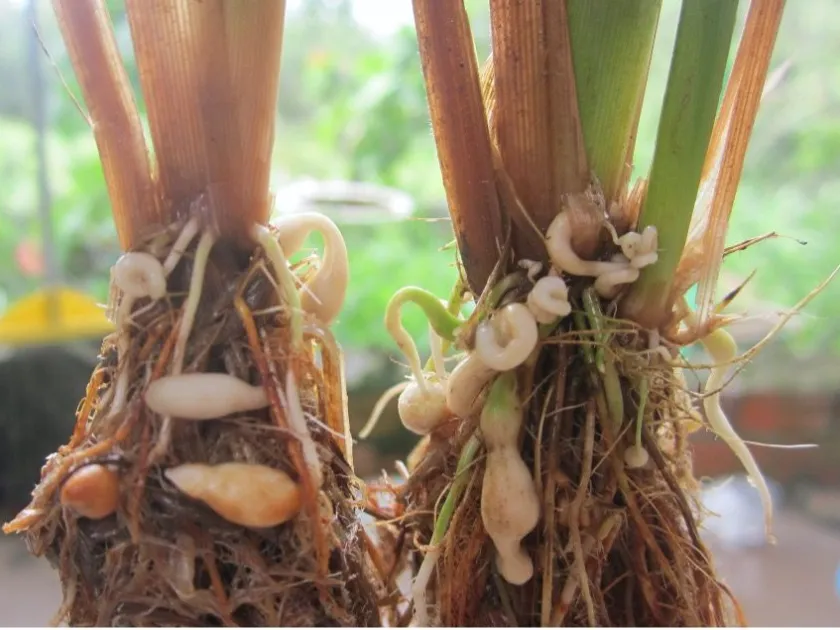
The female nematode is sedentary and becomes embedded within the root tissue, where it swells into a pear shape. It feeds on the host plant, inducing the formation of characteristic root galls that serve as a nutrient sink.
Males are slender, worm-like, and motile. They do not feed and are responsible for fertilizing the females. Their lifecycle is relatively short, allowing for rapid population explosions under favorable conditions.
Eggs are deposited in a gelatinous matrix, which protects them from environmental stress and predation. Second-stage juveniles (J2) are the infectious stage, actively seeking out healthy root tips in the soil.
Identification often requires molecular diagnostic techniques or detailed microscopic examination of perineal patterns in females to distinguish this species from other root-knot nematodes.
What it damages
While rice is the primary host, Meloidogyne graminicola has a broad host range, including various grasses, wheat, and maize. This makes rotation planning complex for farmers in affected areas.
The nematode damages the root system, causing severe stunting and preventing the plant from taking up sufficient nutrients and water. This leads to reduced biomass and impaired physiological development.
Root damage creates entry points for secondary pathogens, such as fungi and bacteria. This interaction often leads to root rot, which exacerbates the damage caused by the nematodes alone.
Crop losses can be devastating, especially in direct-seeded rice systems where young seedlings are exposed to heavy nematode pressure from the very beginning of the season.
Economic consequences include not only yield reduction but also increased costs due to intensive land preparation, pesticide usage, and the need for resistant variety development.
When it appears
The nematode is highly active in warm, moist soils. Temperatures between 25°C and 30°C are ideal for rapid multiplication and infection cycles, which can be completed in as little as two weeks.
In seasonal climates, the nematode persists in the soil or in weed hosts throughout the winter. As soon as temperatures rise and irrigation begins, juveniles emerge to infect the new crop.
The flooding of rice fields does not eradicate the pest; rather, it facilitates the dissemination of infectious juveniles through the water flow between hills, allowing them to spread across an entire field.
The most critical period for infestation is the vegetative growth stage of rice. Heavy infestations at this time significantly reduce the ability of the plant to tiller effectively.
Population density typically peaks toward the middle of the growing season as multiple generations overlap, creating a massive burden on the root system of the crop.
Signs of infestation
The most diagnostic sign of an infestation is the presence of small, hooked, or twisted galls on the root tips. These swellings are the plant's physiological reaction to the nematode's feeding.
Above-ground symptoms include yellowing (chlorosis) of the leaves and stunted, unthrifty growth. In severe cases, the entire plant may appear wilted even when there is sufficient moisture in the soil.
Fields often show patches of stunted, off-color plants. These patches signify the foci of the infestation where nematode populations have reached high levels in the soil.
Affected plants are often poorly anchored in the soil and can be easily pulled up. Their root systems are often reduced, discolored, and exhibit a lack of lateral root branching.
- Characteristic hooked galls on roots
- Stunted growth and poor tillering
- Yellowing of lower leaves
- Patchy distribution in the field
- Increased wilting during sunny periods
Control measures
Crop rotation with non-host species is a cornerstone of integrated nematode management. Alternating rice with crops like certain legumes can significantly reduce soil populations.
Breeding and deploying nematode-resistant rice varieties is the most sustainable and efficient strategy. Research continues to identify genes that confer natural immunity to M. graminicola.
Effective weed control is essential, as grasses in and around the rice fields serve as reservoir hosts, maintaining the nematode population during the fallow period.
Maintaining proper water levels and improving soil drainage where possible can create unfavorable conditions for nematode migration and infection, although this is difficult in flooded rice systems.
Biological control agents, including fungi such as Paecilomyces lilacinus, show promise in reducing nematode egg hatch and larval infection rates under greenhouse and controlled field conditions.
Taxonomy
- Latin name
- Meloidogyne graminicola
- Order
- Nematodes
- Family
- Meloidogynidae
- EPPO code
- MELGGC
Discussion
No discussions yet — be the first.