
False Columbia root-knot nematode
Meloidogyne fallax
Description
How to identify
The false Columbia root-knot nematode, Meloidogyne fallax, is a highly destructive plant-parasitic nematode belonging to the order Tylenchida and the family Meloidogynidae. It is a microscopic endoparasite that spends most of its life cycle within the roots of host plants.
Females are sedentary and pear-shaped, creating large galls on the roots of plants. These galls contain the nematode and its egg masses, which are protected by a gelatinous matrix secreted by the female during her development.
Because its morphology is nearly identical to other related species such as Meloidogyne chitwoodi, positive identification typically requires molecular biology techniques, such as PCR analysis, or expert observation of the perineal pattern.
This nematode is considered a significant quarantine pest in many jurisdictions because it can be easily transported across borders through infested soil attached to farm machinery or infected tubers.
The life cycle begins with the second-stage juvenile, which is the motile, infective stage that moves through the soil film to find and penetrate the roots of suitable hosts, eventually causing the characteristic symptoms.
What it damages
Meloidogyne fallax has a broad host range, posing a serious threat to potatoes, tomatoes, sugar beets, and various ornamental plants. By feeding on the root system, it significantly compromises the plant's ability to absorb water and essential nutrients.
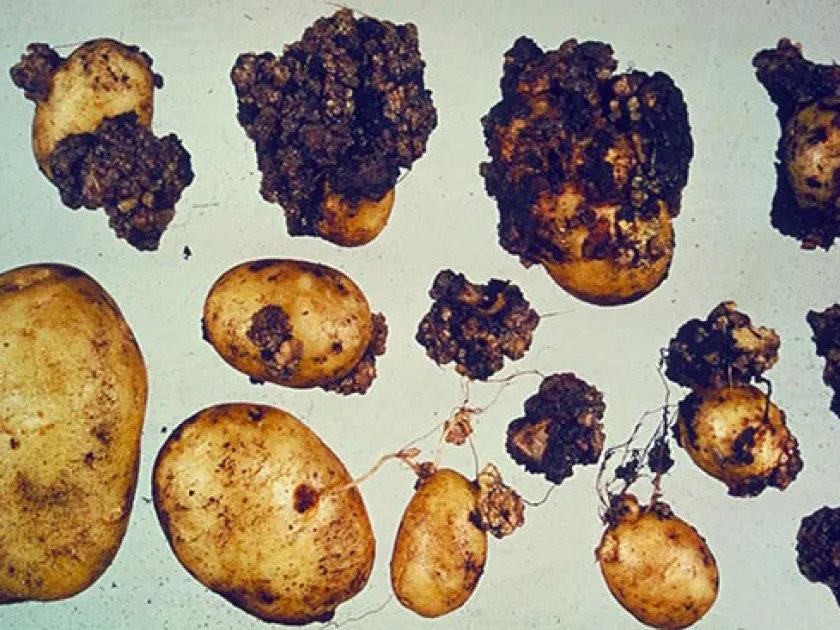
Potato crops are particularly vulnerable; the nematode induces internal and external galls on the tubers, leading to significant cosmetic damage and quality loss, making the harvest unsuitable for market sale.
Heavy infestations lead to stunted plant growth, chlorosis, and wilting, which are especially evident during periods of moisture stress, leading to substantial yield reductions.
The nematode creates persistent population hotspots in the soil, which can remain active for years, even in the absence of highly susceptible host crops, by surviving on alternative weeds or crop debris.
Economic losses arise not only from reduced crop quality and quantity but also from costly quarantine measures and regulatory restrictions placed on agricultural trade from infested regions.
Signs of infestation
The most distinctive symptom of infection is the development of root galls, which are swollen areas of root tissue caused by the nematode's influence on plant cell development.
Affected plants often show poor vigor, uneven distribution in the field, and a general lack of health. In sunny conditions, infected plants tend to wilt more rapidly than healthy neighbors due to root dysfunction.
Below ground, the root systems may appear highly branched, matted, or distorted. The presence of galls is the primary indicator, although secondary bacterial or fungal rots may also be present due to tissue damage.
On potato tubers, external symptoms include small bumps or pimples on the skin, often surrounded by a light brown discoloration or cracking that indicates deep-seated nematode activity.
Field-level diagnosis usually begins by observing patches of unthrifty, stunted, or chlorotic plants. These patches often expand annually, marking the gradual movement of the nematode through the soil.
Control measures
Strict phytosanitary measures are the first line of defense. This includes ensuring all seed potatoes and transplanting materials are certified free from Meloidogyne fallax and properly cleaning equipment between fields.
Crop rotation remains a fundamental strategy; using non-host or resistant crops disrupts the life cycle of the nematode and prevents the population density from reaching harmful thresholds.
Integrated Pest Management (IPM) incorporates the use of green manures and cover crops that possess nematostatic properties, which can actively suppress nematode numbers in the soil over time.
While chemical nematicides are available, their use is heavily regulated due to environmental impacts. Application is usually reserved for high-value crops where other control measures fail.
Biological control agents, particularly beneficial fungi and soil microbes, are increasingly used to protect roots and manage nematode populations in an environmentally friendly and sustainable manner.
Taxonomy
- Latin name
- Meloidogyne fallax
- Order
- Nematodes
- Family
- Meloidogynidae
- EPPO code
- MELGFA
Discussion
No discussions yet — be the first.