
Guava root-knot nematode
Meloidogyne enterolobii
Description
How to identify
The guava root-knot nematode, Meloidogyne enterolobii, belongs to the phylum Nematoda, class Chromadorea, order Rhabditida, and the family Meloidogynidae. It is a microscopic roundworm recognized as one of the most aggressive and destructive plant-parasitic nematodes worldwide.
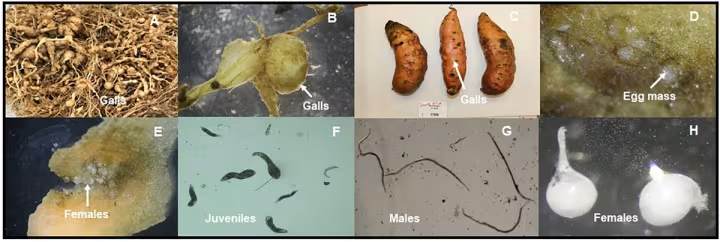
The adult females are pear-shaped and reside inside plant root tissues. The second-stage juveniles (J2) are the infective stage; they are motile and actively penetrate the host root system from the soil.
Visual identification is extremely difficult because the symptoms on roots often resemble those caused by other common root-knot nematode species. Accurate diagnosis requires molecular genetic analysis or specialized morphometric examination.
The biology of this species is characterized by a rapid reproductive cycle, allowing the population to increase exponentially even from a very low initial soil or seedling infestation level.
A significant concern is the nematode's high adaptability to varying temperature conditions, which enables it to thrive in both greenhouse environments and regions with temperate climates.
What it damages
Meloidogyne enterolobii has an exceptionally wide host range, affecting hundreds of agricultural, horticultural, and wild plant species. It causes the most severe economic losses to vegetable crops such as tomatoes, cucumbers, peppers, and eggplants.
The pest causes significant damage to root vegetables, including carrots and sweet potatoes, leading to severe galling and deformation of the marketable product. In fruit production, it has been reported to affect peach trees, apple trees, and grapevines.
The nematode also infests numerous ornamental plants and various weed species, which can serve as reservoirs for the pest in the absence of primary commercial crops.
In greenhouse settings, the nematode can completely devastate yields by spreading through contaminated substrates, irrigation water, or farming equipment.
Notably, many tomato varieties that carry the Mi-1 resistance gene, effective against other common root-knot nematodes, are susceptible to M. enterolobii, which significantly complicates management.
Signs of infestation
The most visible symptom is the formation of characteristic knots or galls on the roots. Unlike other species, M. enterolobii often produces large, severe galling that causes significant distortion of the root architecture.
Above-ground symptoms manifest as stunted plant growth, chlorosis (yellowing) of leaves, and premature wilting during hot periods, even with adequate soil moisture.
Severe infestations lead to necrosis of the root tissues. Secondary infections by soil-borne bacteria and fungi are common, ultimately leading to the total destruction of the root system and plant death.
Yield loss is typically catastrophic, as fruits become small, disfigured, and unmarketable, while root crops become unusable for both local sale and long-term storage.
- Yellowing and wilting of foliage during daytime.
- Significant reduction in plant vigor and growth rates.
- Large, irregular knot-like swellings on roots.
- Root decay and darkening.
- Poor stand establishment due to seedling mortality.
Control measures
Strict phytosanitary control of propagation material is the primary method of management to prevent the introduction of the nematode into non-infested areas.
Crop rotation with non-host plants can help suppress population numbers, although the wide host range of M. enterolobii makes finding suitable alternatives challenging.
Soil steaming or heat treatment in greenhouses is one of the most effective methods to eliminate the nematode at various depths within the soil profile.
Due to strict environmental regulations regarding chemical nematicides, emphasis is increasingly placed on biological control methods, including the use of antagonistic fungi and beneficial bacteria.
Practicing good farm hygiene, including the thorough cleaning of tools, machinery, and footwear of adhering soil, is essential to limit the spread of the nematode between different fields.
Taxonomy
- Latin name
- Meloidogyne enterolobii
- Order
- Nematodes
- Family
- Meloidogynidae
- EPPO code
- MELGMY
Discussion
No discussions yet — be the first.