
Kudzu bug
Megacopta cribraria
Description
How to identify
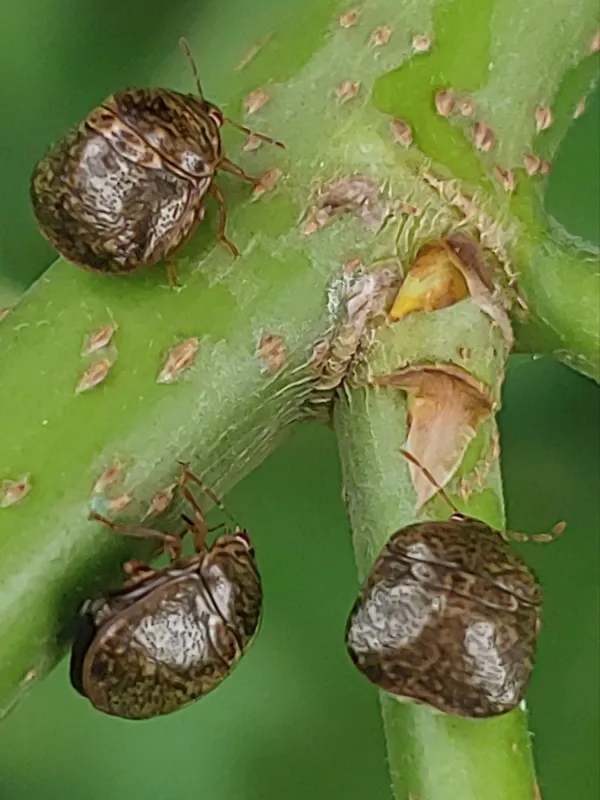
The kudzu bug (Megacopta cribraria) belongs to the order Hemiptera and the family Plataspidae. These insects have a distinctively broad, boxy shape, typically measuring between 3.5 and 6 mm in length.
The adult insect displays a coloration ranging from olive-brown to yellowish-brown, covered in tiny dark speckles. The nymphs are smaller, usually have a pinkish-orange hue, and are covered in fine, hair-like setae.
Adults possess fully developed wings, which enable them to travel long distances in search of suitable host plants. They are frequently found in large, dense clusters on plant stems and foliage.
A notable characteristic of the species is the pungent, unpleasant odor they emit when disturbed or crushed. This chemical defense is typical of many shield bug species.
In regions where they have become invasive, kudzu bugs rapidly adapt to local climates and exhibit exponential population growth throughout the warmer months of the year.
What it damages
The kudzu bug primarily feeds on members of the legume family (Fabaceae). Their most significant economic impact is observed in soybean crops, affecting both wild and commercial varieties.
Beyond soybeans, the pest is commonly found on kudzu (Pueraria montana), which is the source of its common name, as well as on dry beans, peas, and other leguminous plants.
In cases of extremely high population density, kudzu bugs may move to other agricultural crops, although they maintain a strong preference for leguminous hosts throughout their development.
Both adults and nymphs cause damage by using their piercing-sucking mouthparts to feed on plant sap during all stages of their life cycle.
Severe infestations can lead to total crop failure, as the insects drain essential nutrients from the plants, affecting growth, pod development, and final seed yield.
When it appears
The life cycle of the kudzu bug involves adult overwintering in protected sites, such as tree bark, leaf litter, or crevices in structures located near agricultural fields.
As temperatures rise in the spring, the bugs emerge from diapause and begin migrating to their primary host plants to feed and commence their mating cycle.
Females lay eggs in small, characteristic clusters, typically on the undersides of leaves, which provides the offspring with protection from direct sunlight and environmental hazards.
Depending on the climatic zone, the kudzu bug can produce two to three generations per season, leading to rapid population spikes by mid-to-late summer.
Peak insect activity generally aligns with the hottest summer months, which coincide with high sap flow and critical reproductive growth stages in soybean plants.
Signs of infestation
The most immediate sign of infestation is the presence of large clusters of adult bugs clinging to the stems, branches, and leaf nodes of the host plants.
Infested plants often show signs of stunted growth, leaf yellowing, and premature abscission due to the significant loss of nutrients and water caused by the bug's feeding.
Scouting the undersides of leaves will reveal the characteristic egg masses, which are deposited in two neat, parallel rows, making them relatively easy to spot upon inspection.
Feeding sites on the plant tissue may show dark, necrotic spots resulting from the injection of digestive saliva, which disrupts the normal physiology of the plant.
At harvest time, fields heavily affected by kudzu bugs typically display reduced pod fill and smaller seed sizes, resulting in measurable and significant yield losses.
Control measures
Integrated Pest Management (IPM) for the kudzu bug relies on consistent field monitoring, utilizing sweep nets to estimate population density and timing intervention effectively.
When populations exceed economic thresholds, the application of broad-spectrum insecticides approved for Hemipteran pests is the primary method for controlling infestations.
Cultural control is essential, focusing on the removal of wild kudzu patches surrounding cultivated fields, as these areas often serve as primary reservoirs for the pest.
Biological control efforts, including the introduction and monitoring of natural parasitoids like egg-parasitizing wasps, show long-term promise for suppressing bug populations.
Crop rotation and timely treatment of field borders are strongly recommended to intercept the insects during their initial migration from wintering sites into the production fields.
Taxonomy
- Latin name
- Megacopta cribraria
- Order
- Hemiptera (bugs, aphids, leafhoppers)
- Family
- Plataspidae
- EPPO code
- COPSCR
Discussion
No discussions yet — be the first.