
Megacopta
Megacopta
Description
How to identify
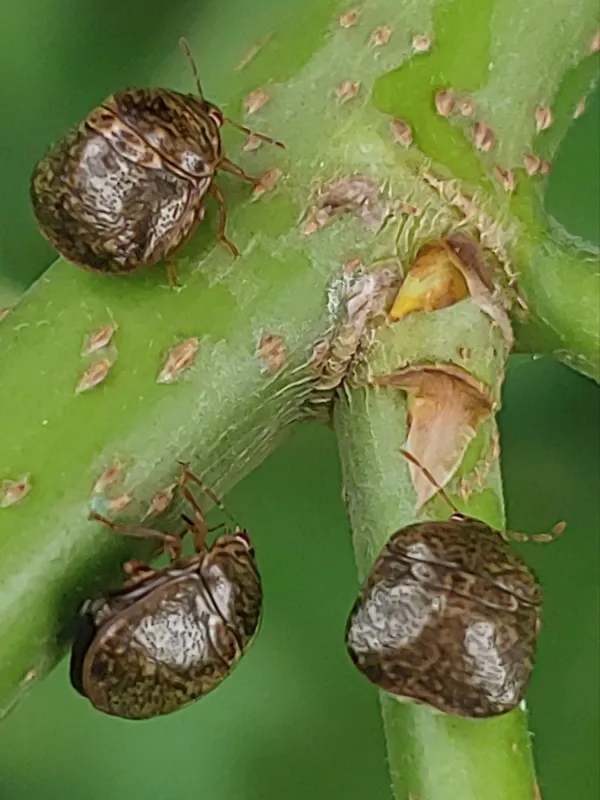
Megacopta (Megacopta cribraria), commonly referred to as the kudzu bug or globular stink bug, is a member of the Plataspidae family within the order Hemiptera. These insects are easily identified by their distinctively broad, rounded body shape, measuring approximately 4 to 6 mm in length.
Adults exhibit an olive-brown to mottled brownish-green coloration, often covered with small, dark punctures across their chitinous shell. A defining feature is their oversized scutellum, which covers almost the entire abdomen and folded wings.
When disturbed or handled, these bugs release a defensive chemical substance that has a pungent, unpleasant odor, which serves to deter many natural predators in the environment.
Females lay eggs in characteristic double-row patterns on the undersides of leaves, typically containing 15 to 30 eggs per batch. The eggs have a unique cylindrical shape with a small white collar structure at the top.
Nymphs undergo five developmental instars, gradually increasing in size and transitioning from light yellow to a reddish-brown color as they mature into adults without fully developed wings in the early stages.
What it damages
Megacopta primarily targets plants within the Fabaceae family. It is recognized as a major economic pest for soybean cultivation, causing significant reductions in both seed yield and overall crop quality.
Beyond cultivated soybeans, the pest thrives on various wild legumes, most notably kudzu (Pueraria montana). These wild stands act as continuous reservoirs that facilitate the spread of the insect to agricultural fields during the growing season.
The bugs feed by piercing the plant tissue with their mouthparts and extracting sap from stems, petioles, and developing pods. This fluid extraction weakens the plant, disrupts nutrient flow, and often leads to the abortion of flowers and immature pods.
High levels of infestation significantly decrease the weight of individual seeds. In extreme cases of uncontrolled population growth, seed formation may be entirely suppressed, leading to severe financial losses for producers.
The bugs also harbor symbiotic bacteria essential for their survival. While the primary damage is mechanical, the introduction of these microbes into the vascular system of the plant may contribute to further physiological stress.
When it appears
The life cycle of Megacopta is highly dependent on ambient temperature. Adults overwinter in protected environments, including under tree bark, in leaf litter, or within man-made structures, allowing them to survive cold winter months.
As temperatures rise in the spring, the insects emerge and colonize early-season host plants, primarily wild legumes, where they feed and begin their reproductive cycle.
The major migration phase into commercial soybean fields typically occurs in mid-summer, coinciding with the crop's vegetative and reproductive stages, providing an abundant food source for the growing population.
Depending on the climatic zone, the pest can complete one to multiple generations per year. Peak infestation levels are generally observed during the pod-filling stages of the soybean crop, which is the most vulnerable period.
In the autumn, as temperatures begin to decline and plants start to senesce, adults cease feeding and migrate to sheltered locations to enter a state of diapause, effectively ending the active season.
Signs of infestation
The earliest sign of a Megacopta infestation is the presence of egg masses on the underside of soybean leaves, identifiable by their uniform, double-row arrangement.
Large aggregations of nymphs can often be spotted on the main stems, branches, and petioles of plants. Their clusters are relatively easy to locate once the observer knows what visual pattern to look for.
Affected plants often show visible signs of stress, such as yellowing of leaves or necrotic spots at the feeding sites where the bugs have pierced the plant epidermis.
A strong, characteristic odor near the crop is a common sign of a high population density. This smell is released by the bugs when they are disturbed by wind, human movement, or mechanical equipment during field operations.
A reduction in pod quality, such as flattened or underdeveloped pods, is a late-stage symptom indicating that the insects have been feeding on the plants for an extended period.
Control measures
Effective management begins with routine scouting using sweep nets to monitor population density, allowing farmers to calculate the economic injury level before deciding on chemical interventions.
Chemical control remains the primary strategy for managing large infestations. Registered insecticides, including pyrethroids and neonicotinoids, are effective when applied at the appropriate growth stages of the soybean crop.
Cultural control practices, such as the removal of kudzu patches and other weed hosts around the perimeter of agricultural fields, are vital to minimize the pressure of migrating bug populations.
Biological control efforts are becoming increasingly relevant. The introduction or preservation of natural egg parasitoids, such as Paratelenomus saccharalis, can play a significant role in long-term population suppression.
- Implement consistent field scouting and population monitoring.
- Apply insecticides only when threshold levels are reached.
- Manage surrounding vegetation to remove wild host reservoirs.
- Integrate biological control agents into existing pest management plans.
Taxonomy
- Latin name
- Megacopta
- Order
- Hemiptera (bugs, aphids, leafhoppers)
- Family
- Plataspidae
- EPPO code
- MGCOSP
Discussion
No discussions yet — be the first.