
Red cotton bug
Macrocheraia grandis
Description
How to identify
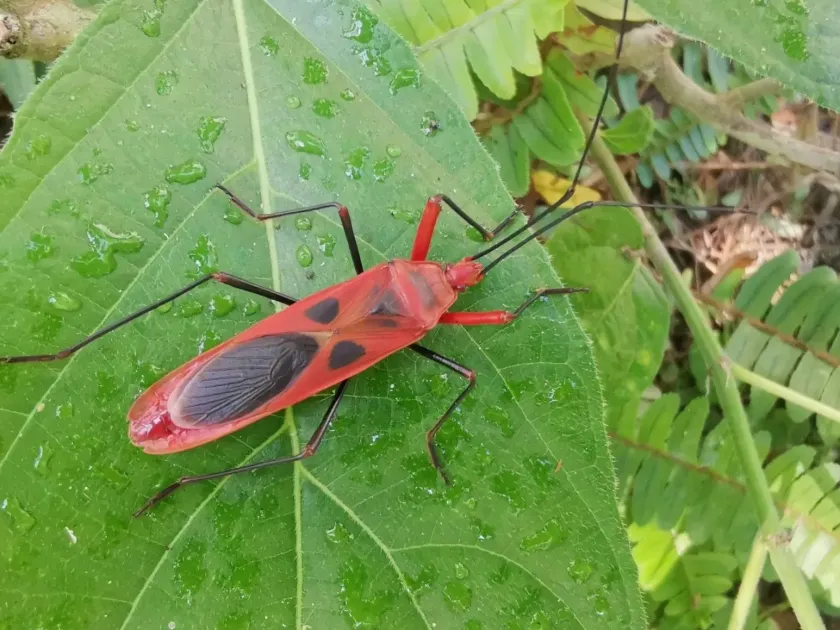
Macrocheraia grandis, often referred to as a species of red bug, is a large insect belonging to the family Largidae. These insects are easily recognizable by their vibrant warning coloration, typically shades of red and black.
Adults reach lengths of 20 to 25 mm, featuring a characteristic elongated body shape. They are equipped with long antennae and a piercing-sucking mouthpart designed specifically for extracting plant fluids.
The nymphs (immature stages) resemble adults but are smaller and lack fully developed wings. They tend to congregate in large numbers on host plants, which is a common behavioral trait for this species.
Taxonomically, they are part of the order Hemiptera. They share similar ecological niches with other seed-feeding bugs, often favoring warm, tropical, or subtropical environments.
Because they are social insects in their nymph stage, they often remain in clusters, moving collectively across the bark of host trees or stems of shrubs to feed.
What it damages
The primary damage caused by Macrocheraia grandis involves the extraction of sap from seeds, developing fruits, and succulent stems. This feeding pattern significantly reduces the vitality of the host plant.
Plants within the Malvaceae family are the most frequent targets. This includes economic crops like cotton as well as many ornamental garden plants such as hibiscus.
When these bugs feed on seeds, they disrupt development, leading to shriveled seeds that have poor germination rates. The physical puncture wounds also provide entry points for opportunistic pathogens.
Infestations can cause premature fruit drop and the wilting of terminal shoots. In young plants, severe feeding can stunt overall growth and lead to the loss of entire branches.
Beyond direct damage, the bug's presence often leads to the development of sooty mold, which grows on the sugary excretions left behind by the insects, further hindering plant photosynthesis.
When it appears
The insects become highly active during the warmer months of the year. Activity typically peaks in mid-summer when temperatures provide the ideal environment for rapid reproduction and growth.
The lifecycle is characterized by incomplete metamorphosis. After mating, females lay clusters of eggs in protected areas, usually on the bark of host plants or near the ground under debris.
As autumn temperatures begin to drop, adults look for suitable overwintering sites. They often seek refuge in cracks in tree bark, leaf litter, or debris around the base of host plants.
The number of generations per year is heavily influenced by the local climate, with longer, warmer growing seasons allowing for more frequent population explosions.
Monitoring should be most intense during the early stages of fruit development, as this is when the bugs are most likely to migrate to the most nutrient-rich parts of the plant.
Signs of infestation
The first sign of an infestation is the appearance of small, discolored spots on the fruit or seeds. These spots are the direct result of the bug's piercing mouthparts penetrating the tissue.
Visual identification is straightforward due to the bugs' habit of forming large, bright-colored clusters on stems or trunks, which are highly visible during the day.
One might notice a sticky, dark substance on the leaves and stems. This is honeydew excreted by the bugs, which quickly becomes colonized by black sooty mold fungus.
Stunted growth of new shoots or the premature yellowing of leaves can also indicate that a large population of bugs has been feeding on the plant for a significant period.
- Dark necrotic spots on fruits and seeds.
- Visible clusters of red-and-black bugs on stems.
- Sticky honeydew residue on foliage.
- Wilting of young shoots and buds.
Control measures
For small-scale gardening, mechanical removal is the most environmentally friendly method. Simply shaking the branches or hand-picking the clusters into a bucket of soapy water can drastically reduce populations.
Cultural control involves removing wild Malvaceae host plants from the vicinity of the garden or field to eliminate breeding grounds and alternative food sources.
If chemical control is necessary, apply insecticides targeting the nymphal stages, as they are often more susceptible to treatments than the hardened, larger adults.
Encouraging natural predators, such as spiders, birds, and predatory bugs, can help manage populations. Maintaining a healthy garden ecosystem is key to long-term prevention.
Proper sanitation is essential during the harvest season. Clearing all plant debris and fallen fruit prevents the bugs from finding adequate winter shelter, which helps lower the population the following year.
Taxonomy
- Latin name
- Macrocheraia grandis
- Order
- Hemiptera (bugs, aphids, leafhoppers)
- Family
- Largidae
- EPPO code
- MCRRGR
Discussion
No discussions yet — be the first.