
Chinese gypsy moth
Lymantria xylina
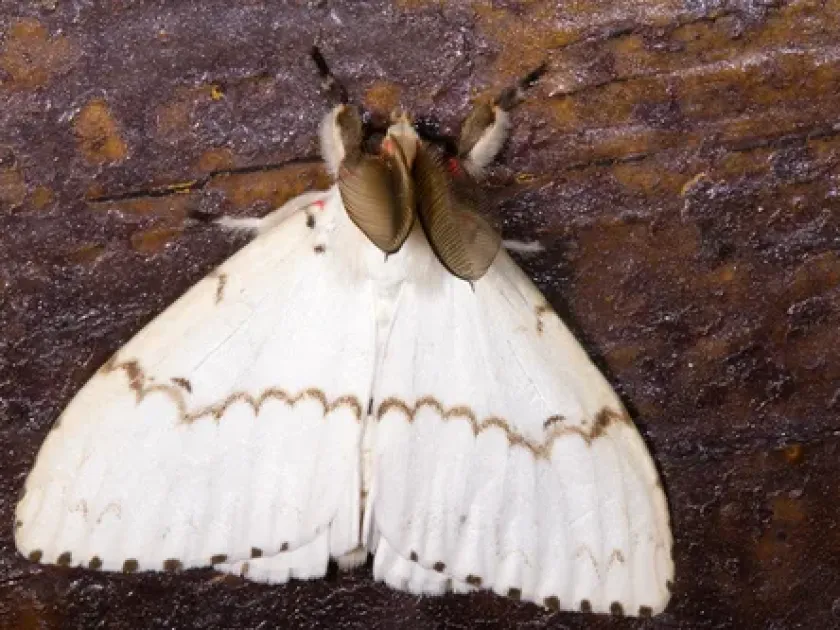
Description
How to identify
The Chinese gypsy moth (Lymantria xylina) is a serious defoliator belonging to the Erebidae family. It is a moth species known for its high reproductive potential and ability to cause extensive damage to forestry and orchard environments.
Adult moths exhibit sexual dimorphism. Males are smaller, dark brown with black wavy markings, and are strong fliers. Females are larger, with lighter-colored wings and a heavy body adapted for carrying a large number of eggs.
The larvae are covered in fine, irritating hairs and possess distinct rows of tubercles on their backs, often displaying bright red or blue colors. These caterpillars are highly mobile and can travel significant distances in search of suitable hosts.
Egg masses are deposited on tree trunks or branches, covered by a protective layer of tan or buff-colored scales from the female’s abdomen. This layer provides thermal insulation and moisture protection throughout the winter.
As a member of the Lymantriinae subfamily, this moth is closely related to other notorious defoliators. Its biological strategy relies on rapid larval development and synchronized emergence to overwhelm the host tree's defenses.
What it damages
This species is a generalist feeder (polyphagous) that attacks a wide array of deciduous trees. Major hosts include various oak species, as well as common fruit trees like apple, pear, and plum.
Damage is caused primarily by the late-instar larvae. They consume large volumes of leaf tissue, often stripping entire branches bare within a short period, leaving only the primary leaf veins intact.
Severe defoliation weakens the host plant, forcing it to expend stored energy reserves to produce new leaves. This leads to reduced growth rates, lack of fruit set, and increased susceptibility to other pathogens.
Repeated annual attacks can result in tree mortality. In orchards, this impact is translated into significant economic losses due to reduced fruit yield and poorer quality of the harvest.
The loss of canopy cover also alters the microclimate of the forest floor, potentially impacting local flora and fauna. The stress induced by constant foliage loss makes trees highly prone to secondary infestations by bark beetles.
When it appears
The life cycle begins with the hatching of larvae in the spring, which is timed to coincide with the bud break of host plants. This ensures an immediate food supply for the emerging caterpillars.
Larval feeding peaks during the early to mid-summer months. During this phase, caterpillars go through several developmental stages, molting as they grow significantly in size and appetite.
Pupation occurs in mid-summer. The larvae spin loose silken cocoons in hidden locations, such as under bark flaps, in tree crevices, or even among the leaves of the host tree.
Adult emergence and mating occur in late summer or early autumn. This is the period when the population is most visible, with males actively searching for females during the evening and night hours.
The winter is passed exclusively in the egg stage. The eggs remain dormant on the bark, capable of withstanding freezing temperatures, until the warming weather triggers the start of the next generation.
Signs of infestation
A common sign of infestation is the accumulation of larval frass (droppings) on the ground under the tree canopy. These pellets are often quite noticeable and indicate a high population density above.
Egg masses found on tree trunks are a key indicator during the dormant season. These patches appear as fuzzy or felt-like spots and are often located at the base or within deep fissures of the bark.
Visible defoliation is a major warning sign. The presence of skeletonized leaves or branches completely stripped of foliage signifies an active infestation that needs immediate attention.
Silken threads hanging from branches are another sign, as larvae use these to drop down to lower levels of the tree or move between branches during windy conditions.
General tree stress symptoms, such as premature leaf yellowing or sudden branch dieback in the middle of the growing season, should prompt an inspection for the presence of this pest.
Control measures
Mechanical removal of egg masses is a highly effective, low-impact strategy. Scraping them off the bark and burning them helps to prevent the emergence of a new generation of larvae.
Burlap or sticky band traps placed around tree trunks can intercept larvae as they move up and down the tree for shelter, allowing for easy manual removal and disposal.
Biological control using Bacillus thuringiensis (Bt) is recommended for larger areas. This bacterium is specific to lepidopteran larvae and does not harm beneficial pollinators or natural predators.
Chemical control should be used as a last resort during mass outbreaks. Systemic insecticides are preferred to minimize contact with non-target species, always adhering to local safety guidelines.
Promoting a healthy ecosystem by encouraging the presence of parasitic wasps, birds, and other insect predators helps keep the population of Chinese gypsy moths below the threshold of economic damage.
Taxonomy
- Latin name
- Lymantria xylina
- Order
- Lepidoptera (butterflies)
- Family
- Erebidae
- EPPO code
- LYMAXY
Discussion
No discussions yet — be the first.